Metal Casting Services
- From rapid prototypes to on-demand production
- Various metal casting techniques available
- 40+ surface finishing available

Metal Casting Capabilities


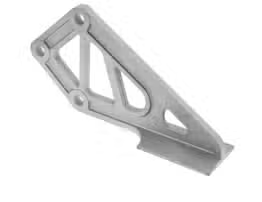
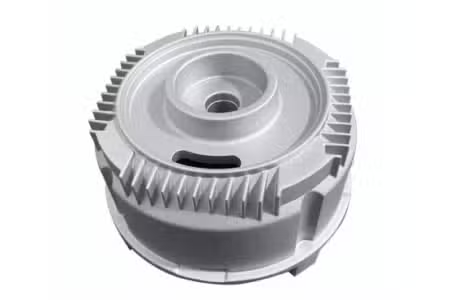
Metal Casting Materials

High machinability and ductility. Aluminum alloys have good strength-to-weight ratio, high thermal and electrical conductivity, low density and natural corrosion resistance.

Zinc is a slightly brittle metal at room temperature and has a shiny-greyish appearance when oxidation is removed.

Brass is mechanically stronger and lower-friction metal properties make CNC machining brass ideal for mechanical applications that also require corrosion resistance such as those encountered in the marine industry.
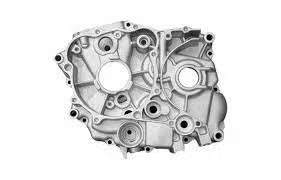
Due to the low mechanical strength of pure magnesium, magnesium alloys are mainly used. Magnesium alloy has low density but high strength and good rigidity. Good toughness and strong shock absorption. Low heat capacity, fast solidification speed, and good die-casting performance.
Metal Casting Finishing



Why Choose Us For Metal Casting Service

1-to-1 Quote Analysis
Just upload your 2D drawings or 3D models and you will get quote feedback in 24 hours. Our specialized engineers will analyze your design to avoid misunderstanding, communicate with you and offer an affordable price.

High Quality Production Parts
The responsible and rigorous attitude towards materials, casting technique, surface finishing and CMM testing guarantee the consistent quality from prototyping to production parts. We won’t bother to check the parts quality before delivery.

Fast Lead Time
The introduce of advanced metal casting equipment such as die cast machine, and professional quoters ensure the fast lead time. We set the priority for the arrangement of the order according to the requirements and order complexity.

Instant Communication
For the sake of your benefits, every customer will have technical support to get in touch with us from quotation to delivery. You will get instant feedback for any question until it’s confirmed that you receive the satisfied parts.
Metal Casting Technical Standards
Dimension
Standards
Metal Casting Guidelines
Standards
Description
Applications of Metal Casting Services



Metal Casting FAQs
Step 1: Clamping. Prior to this, the mold needs to be cleaned to remove any contaminants and lubricated for better injection and removal of cured product. After this, the mold is clamped and closed with high pressure.
Step 2: Injection. The metal to be injected is melted and poured into the firing chamber. The metal is then injected into the mold under high pressure generated by the hydraulic system.
Step 3: Cooling. The solidified material will have a shape similar to the mold design.
Step 4: Ejection. After loosening the mold, the ejector mechanism pushes the solid casting out of the mold. Proper solidification is ensured before ejecting the final product.
Step 5: Decorating. It involves removing excess metal from the finished gate and runners. Trimming can be done using a trimming die, saw, or other procedures.
to Die Casting

Precision Metal Casting Service

Prototyping
- Advanced Technology: metal casting, CMM inspection, elite engineers etc.
- Quick Response: full support to ensure problem solved.
- Customized service: customize precision metal casting solutions

Production
- Reasonable planning: precision resource allocation to ensure quick cycle time.
- Casting SOP : advanced technology and strict QC processes.
- Flexible Production: from rapid prototyping (1-20pcs) to low-volume production (20-1000pcs).