We have moved to a new Website Check Now

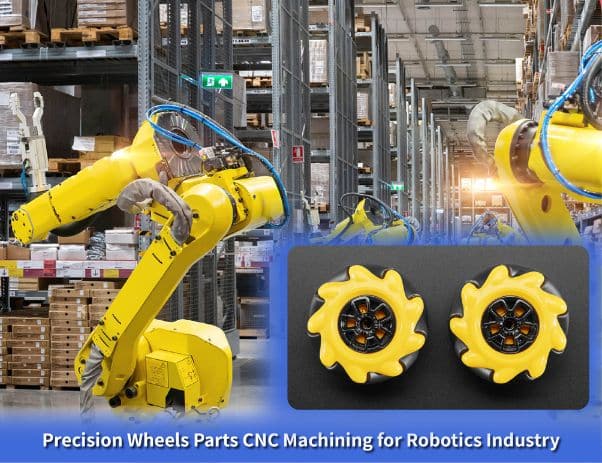
Precision Wheels Parts CNC Machining for Robotics Industry

In mobile robotic systems, precision wheels serve as vital drive components, facilitating controlled movement. We, at Zintilon, specialize in CNC machining of precision wheels. Our advanced turning and milling techniques redefine precision in achieving concentricity, surface finish, and dimensional accuracy, thereby ensuring dependable traction and accurate odometry for autonomous mobile robots and industrial materials handling.
  • Machining of intricate wheel geometries and hub interfaces
  • Tight tolerances of ±0.002 in
  • Turning, milling and balancing at precision levels
  • Rapid prototyping and mass production capabilities
  • ISO 9001-certified robotics industry


Trusted by 15,000+ businesses

Why Robotics Companies
Choose Zintilon

prductivity

Increased Productivity

Engineers get time back by not dealing with immature supply chains or lack of supply chain staffing in their company and get parts fast.

10x

10x Tighter Tolerances

Zintilon can machine parts with tolerances as tight as+/ - 0.0001 in -10x greater precision compared to other leading services.

world

World Class Quality

Zintilon provides medical parts for leading aerospace enterprises, verified to be compliant with ISO9001 quality standard by a certified registrar.

From Prototyping to Mass Production

Zintilon offers CNC machining of precision wheels and other driven components for mobile robotics, industrial automation, and autonomous vehicle systems.

Prototype Precision Wheels

Evaluate prototypes of precision wheels that reproduce your final design to CAD accuracy. This allows you to evaluate traction performance, validate encoders, check hub fit, and other aspects before committing to mass production.


Key Point

  • Rapid high precision prototyping

  • Stringent tolerances of ±0.002 in

  • Early evaluation of design, materials, and performance

3 Axis CNC Machined Stainless Steel Passivation

EVT – Engineering Validation Test

Assess wheel prototypes quickly to ascertain that all requirements for navigation and movement are fulfilled. Detect and solve potential problems before full-scale integration into robotics.


Key Point

  • Validate prototype functionality

  • Rapid design iterations

  • Ensure readiness for production


Anodized Aluminum 1024x536

DVT – Design Validation Test

Assess the dimension and rotational functionality of the design wheels that will be mass manufactured for the design alignment and optimal traction using the different materials and wheel tire compounds.


Key Point

  • Confirm design alignment and concentricity

  • Use different materials and configurations

  • Prepare for performance production

design aluminium

PVT – Production Validation Test

Assess the capacity for mass production of the manufactured wheels that offer precision and diagnose expected production problems to deliver effective solutions that offer consistency and efficiency.


Key Point

  • Planned mass production capability

  • Identifying and resolving problems within the production process

  • Uniformity of parts

finishes

Mass Production

Manufacture wheels of the best possible quality which are precision, to the required standards and within the expected timelines to offer the best possible service to robot manufacturers and automate integrated systems.


Key Point

  • Quality mass production

  • Quality industrial grade

  • Expected timelines with quality checks for the best possible service

production

Simplified Sourcing for
Robotics Industry

Our robotics industry parts manufacturing capabilities have been verified by many listed companies. We provide a variety of manufacturing processes and surface treatments for robotics parts including titanium alloys and aluminum alloys.

Explore Robotics Components

Discover our full range of precision CNC machined robotics components, designed for strength, stability, and seamless motion. Explore parts for robotic arms, joints, actuators, frames, and end effectors, all crafted to ensure high accuracy, repeatability, and performance in modern automation and robotics systems.

Robotics Precision Wheels Machining Capabilities

Using advanced CNC turning centers, clients are provided with Precision Wheels Parts CNC Machining for the Robotics Industry. Each part of the omni-directional wheel hubs, encoder wheel disks, and custom drive wheels with bearing seats is concentric and engineered for runout, and odometry feedback is reliable, and concentricity is optimal to achieve quality.

Our capabilities extend to precision CNC turning and milling, dynamic balancing, and surface finishing, supporting exacting rotational and traction surface requirements, runout assessment, and encoder pattern validation. Each precision wheel undergoes machining to meet industrial specifications from different grades of aluminum alloys, steel, stainless steel, engineered plastics, and other materials that provide strength, lightweight properties, and sustained operability and dimensional stability under industrial conditions.
milling

CNC Machining

sheet metal

Sheet Metal Fabrication

edm

Wire EDM

Aerospace
Materials & Finishes

Materials
We provide a wide range of materials, including metals, plastics, and composites.
Finishes
We offer superior surface finishes that enhance part durability and aesthetics for applications requiring smooth or textured surfaces.

Specialist Industries

you are welcome to emphasize it in the drawings or communicate with the sales.

Materials for Precision Wheels Components

For Precision Wheels Machining for Robotics Industry, our CNC machine shop Precision Wheels Machining for Robotics Industry provides the machining of Components CNC machine shop for Precision Wheels Machining for Robotics Industry, which consist of engineering thermoplastics, industrial-grade metals, and other materials required for precision machining. Bringing to the market over 35 industrial-grade metals and the plastics and other relevant engineered materials allows rapid prototyping and the consistent industrial-grade custom component manufacturing.
Aluminum Image

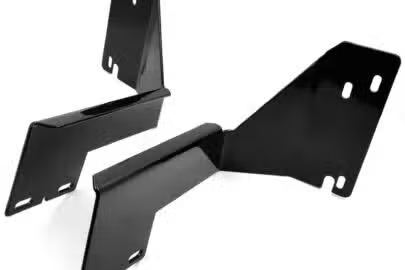
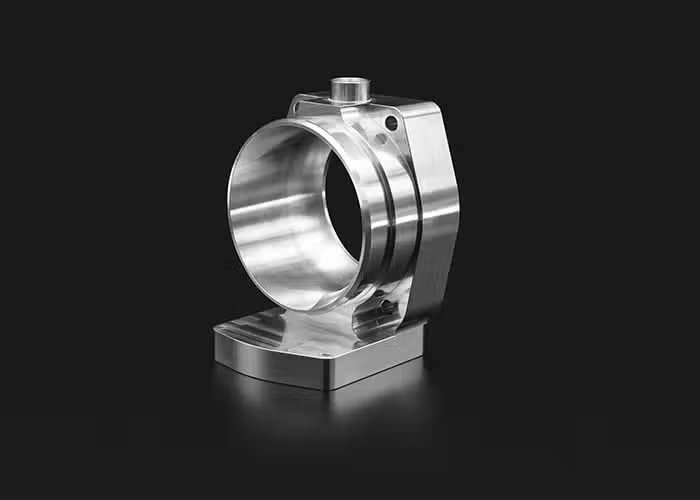
High machinability and ductility. Aluminum alloys have good strength-to-weight ratio, high thermal and electrical conductivity, low density and natural corrosion resistance.
Price
$ $ $
Lead Time
< 7 days
Tolerances
Down to ±0.003 mm
Max part size
3000*2200*1100 mm
Min part size
2*2*2 mm
Stainless steel Image

Stainless steel alloys have high strength, ductility, wear and corrosion resistance. They can be easily welded, machined and polished. The hardness and the cost of stainless steel is higher than that of aluminum alloy.

Price
$ $ $
Lead Time
< 7 days
Tolerances
Down to ±0.005 mm
Max part size
3000*2200*1100 mm
Min part size
2*2*2 mm
Titanium Image

Titanium is an advanced material with excellent corrosion resistance, biocompatibility, and strength-to-weight characteristics. This unique range of properties makes it an ideal choice for many of the engineering challenges faced by the medical, energy, chemical processing, and aerospace industries.

Price
$$$
Lead Time
< 10 days
Tolerances
Down to ±0.005 mm
Max part size
3000*2200*1100 mm
Min part size
2*2*2 mm
Steel Image

Steel is a strong, versatile, and durable alloy of iron and carbon. Steel is strong and durable. High tensile strength, corrosion resistance heat and fire resistance, easily molded and formed. Its applications range from construction materials and structural components to automotive and aerospace components.

Price
$ $ $ $ $
Lead Time
< 10 days
Tolerances
Down to ±0.001 mm (routing)
Max part size
3000*2200*1100 mm
Min part size
2*2*2 mm
Bronze Image

Highly resistant to seawater corrosion. The material’s mechanical properties are inferior to many other machinable metals, making it best for low-stress components produced by CNC machining.

Price
$ $ $ $ $
Lead Time
< 10 days
Tolerances
Down to ±0.005 mm
Max part size
3000*2200*1100 mm
Min part size
2*2*2 mm
Copper Image

Few metals have the electric conductivity that copper has when it comes to CNC milling materials. The material’s high corrosion resistance aids in preventing rust, and its thermal conductivity features facilitate CNC machining shaping.

Price
$$$
Lead Time
< 10 days
Tolerances
Down to ±0.005 mm
Max part size
3000*2200*1100 mm
Min part size
2*2*2 mm
Brass Image

Brass is mechanically stronger and lower-friction metal properties make CNC machining brass ideal for mechanical applications that also require corrosion resistance such as those encountered in the marine industry.

Price
$$$
Lead Time
< 10 days
Tolerances
Down to ±0.005mm
Max part size
3000*2200*1100 mm
Min part size
2*2*2 mm
Zinc Image

Zinc is a slightly brittle metal at room temperature and has a shiny-greyish appearance when oxidation is removed.

Price
$ $ $ $ $
Lead Time
< 10 days
Tolerances
Down to ±0.005 mm
Max part size
3000*2200*1100 mm
Min part size
2*2*2 mm
Iron Image

Iron is an indispensable metal in the industrial sector. Iron is alloyed with a small amount of carbon – steel, which is not easily demagnetized after magnetization and is an excellent hard magnetic material, as well as an important industrial material, and is also used as the main raw material for artificial magnetism.
Price
$ $ $ $ $
Lead Time
< 10 days
Tolerances
Down to ±0.005 mm
Max part size
3000*2200*1100 mm
Min part size
2*2*2 mm
Magnesium Image

Due to the low mechanical strength of pure magnesium, magnesium alloys are mainly used. Magnesium alloy has low density but high strength and good rigidity. Good toughness and strong shock absorption. Low heat capacity, fast solidification speed, and good die-casting performance.

Price
$ $ $ $
Lead Time
< 7 days
Tolerances
Down to ±0.005 mm
Max part size
3000*2200*1100 mm
Min part size
2*2*2 mm
Let’s Build Something Great, Together

FAQs: Precision Wheels for Robotics Applications

Precision robotic wheels are engineered machined components that provide drive and control to the movement of mobile robots, automation guided vehicles, and other autonomous systems. Different types are drive propulsion wheel hubs, omni-directional wheel assemblies which allow free movement in any direction, mecanum wheel rollers, encoder wheels for positional control, caster wheel mounts for steering, and other specialized wheels like polyurethane bonded cores for tires, magnetic guidance wheels, and cleanroom wheels that meet non-shedding requirements.

Aluminum is preferred for its lightweight construction which allows the overall robot mass and inertia to be minimized for improved acceleration, its excellent machinability for the complex geometries of the hubs, its strength for payloads up to 500 kilograms, and for its natural corrosion resistance. Steel provides the strength needed for heavy-duty AGVs which transport multi-ton payloads, for the enduring through wear the millions of rotations and for the wear resistant bearing surfaces. Stainless steel supplies the corrosion resistance for cleanrooms and food processing applications while retaining the needed strength. For specialty applications, Delrin and nylon which are engineering plastics supply lightweight, electrically insulating, and chemically resistant options.Aluminum is preferred for its lightweight construction which allows the overall robot mass and inertia to be minimized for improved acceleration, its excellent machinability for the complex geometries of the hubs, its strength for payloads up to 500 kilograms, and for its natural corrosion resistance. Steel provides the strength needed for heavy-duty AGVs which transport multi-ton payloads, for the enduring through wear the millions of rotations and for the wear resistant bearing surfaces. Stainless steel supplies the corrosion resistance for cleanrooms and food processing applications while retaining the needed strength. For specialty applications, Delrin and nylon which are engineering plastics supply lightweight, electrically insulating, and chemically resistant options.

CNC Turning is one of the techniques used to manufacture precision wheels. It allows to produced cylindrical wheel hubs and achieve concentricity of the outer diameters, bearing bores, and mounting features to within 0.002 inches. Face milling is used to produced flat mounting surfaces and precision boring machines bearing seats with tight tolerances within ±0.0005 inches for proper bearing fit. Coordinate drilling produces encoder slot patterns or mounting holes with position accuracy within ±0.003 inches. The dynamic balancing removes material and is used to achieve balance within 0.5 gram-millimeters to reduce vibration. Surface knurling is used to create tire bonding surfaces.

We achieve outer diameter tolerances within ±0.002 inches for consistent rolling circumference affecting odometry accuracy, bearing bore tolerances within ±0.0005 inches for proper shaft fit, concentricity within 0.002 inches minimizing vibration and encoder error, face runout within 0.003 inches ensuring proper motor coupling, dynamic balance within 0.5 gram-millimeters at operating speeds, and mounting hole positions within ±0.003 inches for secure motor attachment.

Yes, we provide rapid prototyping to verify fit and test assembly, with same-day CAD-to-part capability available for critical projects. For custom automation cells and research platforms, we perform low-volume production of 20 to 500 brackets. For standardized robot models, we perform high-volume production of thousands to tens of thousands of brackets annually, incorporating complete dimensional inspection, flatness verification, and material certifications.

Each component undergoes complete material traceability, dimensional verification against design specifications, runout and balance testing, and quality control under ISO 9001 certified manufacturing processes. All drive components in mobile robotics endure testing to ensure accurate odometry to within 1 percent error over 100 meters, traction, and durability for millions of rotations of wheels in warehousing and manufacturing settings, and balance.

We provide comprehensive finishing solutions tailored to aerospace requirements:
Anodizing (Type II and Type III)
Passivation for corrosion resistance
Precision polishing for aerodynamic surfaces
Custom protective coatings and thermal barriers
Standard drive wheel hubs require 7–12 business days including turning, balancing, and surface treatment, while complex omni-directional and mecanum wheel assemblies need 3–4 weeks. For rapid mobile robot testing and navigation validation, prototype runs can be completed in 5–8 days.

Yes. We craft high-traction wheels with built-in tire patterns for outdoor use, lightweight wheels for collaborative mobile robots, so as to not compromise payload, precision encoder wheels for sub-millimeter position feedback with 360 to 1000 slots per revolution, magnetic guiding wheels for tape-following AGVs, omnidirectional wheels with tailored roller systems, spherical wheels for inventive kinematics, and cleanroom wheels for the Class 5 ISO 14644 standard.

An accurately controlled outer diameter to ±0.002 inches guarantees a consistently rolling circumference which is crucial for odometry-based navigation-within a position error of 1 percent over 100 meters. Precision concentricity to within 0.002 inches wildly decreases encoder reading error, and the model of contractive concentricity and the vibration which ups sensor accuracy. Closely controlled tolerances of the bearing bore to ±0.0005 inches stops the shaft from play and misalignment, and also loss of power due to friction, thus losing to friction. Dynamic balancing stops loss of operation smoothness over 2 meters per second due to friction. Proper designed geometrically as a hub receiving axle enables positive control of the axle for slave rotation with pre-determined hub geometry with direct control to receive motor derive provides torque with non-slipping control. Proper pre-surface control allows proper shear control with tire, to make bonding permanent. Wear resistance of the tire will allow it to go through millions of odometry-precise rotations preserving dimensional accuracy.
Got any more questions?