We have moved to a new Website Check Now

Precision Housing Parts CNC Machining for Robotics Industry

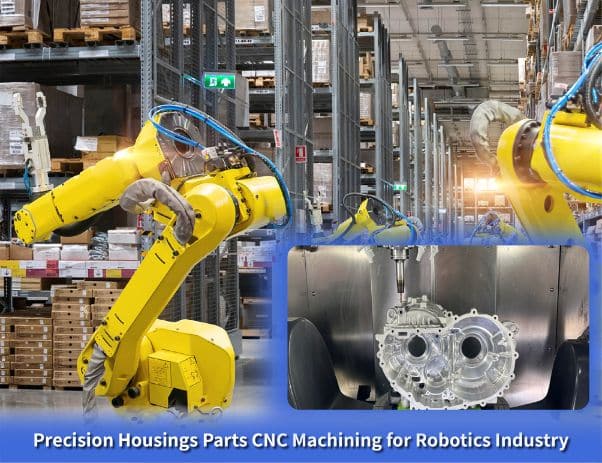
Application specific housing parts are protective enclosures that hold and position motors, sensors, electronics and mechanical assemblies within robotic systems and robotic automated equipment. We, at Zintilon, focus on CNC Machining precision housing components. Our advanced multi-axis machining ingenuity provides unequaled excellence and precision on components pertaining to bearing bore and sealing surface for guaranteed mechanical alignment, component protection and sealing on intense and heavy duty industrial robotics use and applications.
  • Machining for complex housing geometries and interface features
  • Tight tolerances up to ±0.002 in
  • Precision milling, boring & seal surface finishing
  • Support for rapid prototyping and full-scale production
  • ISO 9001-certified robotics manufacturing

Trusted by 15,000+ businesses

Why Robotics Companies
Choose Zintilon

prductivity

Increased Productivity

Engineers get time back by not dealing with immature supply chains or lack of supply chain staffing in their company and get parts fast.

10x

10x Tighter Tolerances

Zintilon can machine parts with tolerances as tight as+/ - 0.0001 in -10x greater precision compared to other leading services.

world

World Class Quality

Zintilon provides medical parts for leading aerospace enterprises, verified to be compliant with ISO9001 quality standard by a certified registrar.

From Prototyping to Mass Production

Zintilon specializes in CNC precision housing components and protective enclosures CNC machining for industrial robotic systems, collaborative robots and automated systems on a global scale.

Prototype Precision Housing Parts

Fully functional housing components with housing parts that can conform to your intended final design for precise prototyping are attainble. Fine components can be verified for fit, sealing, and alignment before proceeding to intended production scale.


Key Point

  • Rapid prototyping with high precision

  • Tight tolerances (±0.002 in)

  • Test design, fit, and environmental protection early

3 Axis CNC Machined Stainless Steel Passivation

EVT – Engineering Validation Test

Adjust housing prototypes rapidly and iteratively to make sure they are structurally sound and meet all sealing requirements. Point out possible problems early to ease the shift to full-scale robotics manufacturing.


Key Point

  • Validate prototype functionality

  • Rapid design iterations

  • Ensure readiness for production

Anodized Aluminum 1024x536

DVT – Design Validation Test

Check the design and construction of all precision housings, make sure they perform in the protective role using different construction materials, and control the design for protective performance to reduce the amount of material used before mass production.


Key Point

  • Confirm design integrity and bore accuracy

  • Test multiple materials and configurations

  • Ensure production-ready performance

design aluminium

PVT – Production Validation Test

Check the control of precision housing parts production for mass reproduction and find production problems before full production to maintain efficiency.


Key Point

  • Test large-scale production capability

  • Detect and fix process issues early

  • Ensure consistent part quality

finishes

Mass Production

Control precision reproducing and meet protective performance, then incorporate the parts for on-time delivery to robot builders and automation integrators.


Key Point

  • Consistent, high-volume production

  • Precision machining for industrial-grade quality

  • Fast turnaround with strict quality control

production

Simplified Sourcing for
Robotics Industry

Our robotics industry parts manufacturing capabilities have been verified by many listed companies. We provide a variety of manufacturing processes and surface treatments for robotics parts including titanium alloys and aluminum alloys.

Explore Robotics Components

Discover our full range of precision CNC machined robotics components, designed for strength, stability, and seamless motion. Explore parts for robotic arms, joints, actuators, frames, and end effectors, all crafted to ensure high accuracy, repeatability, and performance in modern automation and robotics systems.

Robotics Precision Housing Parts Machining Capabilities

For every piece of precision housing CNC machining for the robotics industry, our advanced CNC machining centers and precision boring tools paired with skilled CNC machinists create housing for motors, housing for robotic joints, housing for sensors, and sensor mount blocks with critical bearing seats. Every housing is mathematically analyzed and designed for component protection, hold the component at alignment and positional recess, and sealing performance.

For every set of precision CNC machine housing, we provide precision CNC milling, boring, seal groove machining and surface finishing for perfect component integration, environmental protection, and pressure testing with space geometric verification for dimensional. Every piece is machined, covered, grip sided, and sealed with friction between the housing and machines of diecast aluminum, steel (1018, 4140), magnesium alloys, aluminum alloys (6061-T6, 7075-T6), and casted aluminum for high industrial grade magnesium and aluminum alloys.
milling

CNC Machining

sheet metal

Sheet Metal Fabrication

edm

Wire EDM

Aerospace
Materials & Finishes

Materials
We provide a wide range of materials, including metals, plastics, and composites.
Finishes
We offer superior surface finishes that enhance part durability and aesthetics for applications requiring smooth or textured surfaces.

Specialist Industries

you are welcome to emphasize it in the drawings or communicate with the sales.

Materials for Precision Housing Parts

Our CNC machine shop has a range of raw stock materials for precision housing parts machining for robotics industry. With vertical milling and CNC layer milling and a 6061-T6 aluminum, we help produce industrial grade hoods and hoods for machines, along with pre production route CNC machine for box enclosures at a dimensional size of 0.5 cm for box enclosures and also industrial grade machining for consistent machining and precision at 5 industrial grade levels.
Aluminum Image

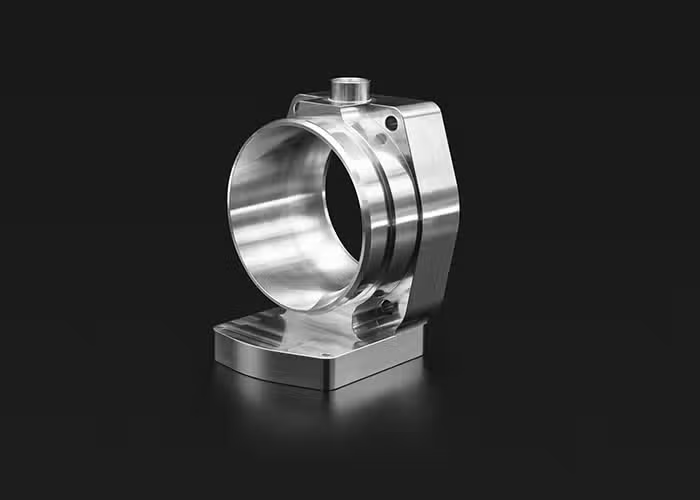
High machinability and ductility. Aluminum alloys have good strength-to-weight ratio, high thermal and electrical conductivity, low density and natural corrosion resistance.
Price
$ $ $
Lead Time
< 7 days
Tolerances
Down to ±0.003 mm
Max part size
3000*2200*1100 mm
Min part size
2*2*2 mm
Stainless steel Image

Stainless steel alloys have high strength, ductility, wear and corrosion resistance. They can be easily welded, machined and polished. The hardness and the cost of stainless steel is higher than that of aluminum alloy.

Price
$ $ $
Lead Time
< 7 days
Tolerances
Down to ±0.005 mm
Max part size
3000*2200*1100 mm
Min part size
2*2*2 mm
Titanium Image

Titanium is an advanced material with excellent corrosion resistance, biocompatibility, and strength-to-weight characteristics. This unique range of properties makes it an ideal choice for many of the engineering challenges faced by the medical, energy, chemical processing, and aerospace industries.

Price
$$$
Lead Time
< 10 days
Tolerances
Down to ±0.005 mm
Max part size
3000*2200*1100 mm
Min part size
2*2*2 mm
Steel Image

Steel is a strong, versatile, and durable alloy of iron and carbon. Steel is strong and durable. High tensile strength, corrosion resistance heat and fire resistance, easily molded and formed. Its applications range from construction materials and structural components to automotive and aerospace components.

Price
$ $ $ $ $
Lead Time
< 10 days
Tolerances
Down to ±0.001 mm (routing)
Max part size
3000*2200*1100 mm
Min part size
2*2*2 mm
Bronze Image

Highly resistant to seawater corrosion. The material’s mechanical properties are inferior to many other machinable metals, making it best for low-stress components produced by CNC machining.

Price
$ $ $ $ $
Lead Time
< 10 days
Tolerances
Down to ±0.005 mm
Max part size
3000*2200*1100 mm
Min part size
2*2*2 mm
Copper Image

Few metals have the electric conductivity that copper has when it comes to CNC milling materials. The material’s high corrosion resistance aids in preventing rust, and its thermal conductivity features facilitate CNC machining shaping.

Price
$$$
Lead Time
< 10 days
Tolerances
Down to ±0.005 mm
Max part size
3000*2200*1100 mm
Min part size
2*2*2 mm
Brass Image

Brass is mechanically stronger and lower-friction metal properties make CNC machining brass ideal for mechanical applications that also require corrosion resistance such as those encountered in the marine industry.

Price
$$$
Lead Time
< 10 days
Tolerances
Down to ±0.005mm
Max part size
3000*2200*1100 mm
Min part size
2*2*2 mm
Zinc Image

Zinc is a slightly brittle metal at room temperature and has a shiny-greyish appearance when oxidation is removed.

Price
$ $ $ $ $
Lead Time
< 10 days
Tolerances
Down to ±0.005 mm
Max part size
3000*2200*1100 mm
Min part size
2*2*2 mm
Iron Image

Iron is an indispensable metal in the industrial sector. Iron is alloyed with a small amount of carbon – steel, which is not easily demagnetized after magnetization and is an excellent hard magnetic material, as well as an important industrial material, and is also used as the main raw material for artificial magnetism.
Price
$ $ $ $ $
Lead Time
< 10 days
Tolerances
Down to ±0.005 mm
Max part size
3000*2200*1100 mm
Min part size
2*2*2 mm
Magnesium Image

Due to the low mechanical strength of pure magnesium, magnesium alloys are mainly used. Magnesium alloy has low density but high strength and good rigidity. Good toughness and strong shock absorption. Low heat capacity, fast solidification speed, and good die-casting performance.

Price
$ $ $ $
Lead Time
< 7 days
Tolerances
Down to ±0.005 mm
Max part size
3000*2200*1100 mm
Min part size
2*2*2 mm
Let’s Build Something Great, Together

FAQs: Precision Housing Parts for Robotics Applications

A precision housing part is a protective housing for the robotic joints, including motors, gearboxes, sensors, and control system electronics. Different types are: motor housings with precision bearing bores that support rotor, joint housings housing gear trains and encoders for articulated robot arms, sensor mounting blocks that house and position vision systems and proximity sensors with repeatable accuracy, linear and rotary actuator housing, electronics enclosure with EMI shielding and thermal management, gripper housing with pneumatic cylinders and sensors, gearbox cases that support multiple bearings and a gear mesh, and custom multi-component housings integrating mechanical, electrical, and fluid assemblies in compact form.

Aluminum 6061-T6 and 7075-T6 helps cut down the weight construction weight of the robot arm by almost 50 to 60%, allowing for a higher payload capacity. Along with the lightweight construction and ease of machining for incorporated features, it also has good thermal conductivity at 167 watts per meter-Kelvin and natural thermal corrosion resistance. With die-cast aluminum, it is also possible to produce high volumes of complex internal geometries for thin walls of 2 millimeters and integrated mounting features at a lower cost. Steel 1018 and 4140, on the other hand, provides maximum strength and rigidity for heavy-duty applications, wear resistance, structural weldability for assembled fabrication, and cost effectiveness. Finally, magnesium alloys will provide the best strength to weight ovation ratio at 35% less weight than aluminum. It is primarily used in the aerospace industry and in mobile robotics.

Multi-axis CNC milling helps make unique 3D shapes with attached mounting structures, channels for cables, and pockets for sensors. Precision boring machines make sure the bores are balanced and the diameters are aligned for the shaft within ±0.001 inches and concentricity (centered) to 0.002 inches. Face milling secures flat sealing surfaces which is crucial for keeping the environment out, with flatness within 0.005 inches. Seal groove machining IP54 to IP67 rated sealing enables, with O-ring depth and widths controlled. Coordinates drilling with countersinking allows bolts and mounting holes. Threads for closure and sealing are created by thread milling. Integrated fins for thermal management are machined with heat sinking.

We maintain and achieve concentricity, within 0.002 inches for shaft alignment, bores are within ±0.001 inches, and closure flatness up to 0.005 inches is made for mounting surfaces to allow fit sealing surfaces evenly. Seal groove dimensions are maintained up to ±0.003 for O-ring compression ensuring IP65 and or IP67 protection. Interfacing bolt hole positions for assembly are controlled for compatibility within ±0.005. Overall housing dimensions are provided for assembly clearances, and are controlled within ±0.010.

Yes, we provide rapid prototyping to verify fit and test assembly, with same-day CAD-to-part capability available for critical projects. For custom automation cells and research platforms, we perform low-volume production of 20 to 500 brackets. For standardized robot models, we perform high-volume production of thousands to tens of thousands of brackets annually, incorporating complete dimensional inspection, flatness verification, and material certifications.

All components are manufactured under ISO 9001 quality management systems with complete material traceability, and the defined specifications for each design are met. All measurements and reports bearing bore and concentricity are present along with declared IP ratings which are tested and documented pressure testing. Sealing provisions which prevent moisture and contaminants, and environmental sealing of the components encased and robotic housing.

We provide comprehensive finishing solutions tailored to aerospace requirements:
Anodizing (Type II and Type III)
Passivation for corrosion resistance
Precision polishing for aerodynamic surfaces
Custom protective coatings and thermal barriers
Standard motor and joint motor housings take 12-18 business days. This includes the processes of machining boring and finishing. Complex multi-cavity housings with integrated features required spans of 5-6 weeks to complete. For rapid robotic assembly, and testing validation prototype housings are done in 8-12 days

Absolutely! We create custom lightweight housings for collaborative robot arms where we reduce the moving mass and yet keep the arms rigid. We make sealed IP67 housings for wash down and outdoor robots. We create thermally optimized housings with cooling fins or liquid cooling passages for heat dissipation of over 150 watts. We create compact housings where the joints are space-constrained. We make modular housings which have a set of configuration options, split case designs for easy maintenance, motor-gearbox integrated housings for functional combinations, and special enclosures for harmonic drives, direct-drive motors, precision encoders, and bearing alignment within 10 microns.

Timely machining of bearing bore dimensions accuracy to within ±0.001 inches means a bearing will fit without excessive clearance which causes shaft runout and vibration or a tight fit that means excess heat and bearing failure. Co-axial alignment is critical to gear mesh quality and edge loading of the bearing which accelerates wear. The spacing of the bearing bores within 0.002 inches precision concentricity means the coaxial shafts remain aligned. The flatness of the bearing mounting surfaces to 0.005 inches means the structural loads of the housing torque will not distort it. Proper seal groove dimensions means the O-ring will achieve IP65 or IP67 to prevent moisture and particulates ingress. Up to a point ribs will maintain housing mass but will also provide structural rigidity to prevent housing deflection under load. Quality Dimensional stability due to thermal cycling and vibration is provided through the chosen construction materials. Proper construction provides functional component protection bearing life and sealed within environmental cleaning cycles to thorough enduring 10 years of service in industrial automation applications.
Got any more questions?