High-Accuracy Joints Parts CNC Machining for Robotics Industry
- Complex joint housing machining and shafts.
- Tight tolerances up to ±0.0002 in
- Precision boring, turning & gear interface machining.
- Favoritism of the rapid prototyping and full-scale production.
- Robotics production, which is certified by ISO 9001.

Why Joints Companies
Choose Zintilon

Increased Productivity
Engineers get time back by not dealing with immature supply chains or lack of supply chain staffing in their company and get parts fast.

10x Tighter Tolerances
Zintilon can machine parts with tolerances as tight as+/ - 0.0001 in -10x greater precision compared to other leading services.

World Class Quality
Zintilon provides medical parts for leading aerospace enterprises, verified to be compliant with ISO9001 quality standard by a certified registrar.
From Prototyping to Mass Production


Prototype Joint Components
Key Points:
- Smooth high-speed prototyping.
- Tight tolerances (±0.0002 in)
- Design, motion, and material of the test early.

EVT – Engineering Validation Test
Key Points:
- Test prototype functionality.
- Rapid design iterations
- Make sure you are prepared to make.

DVT – Design Validation Test
Key Points:
- Check design integrity and accuracy.
- Experiment with different materials, settings.
- Assure performance readiness to production.

PVT – Production Validation Test
Key Points:
- Test huge production capacity.
- Early identify and correct process failures.
- Maintain quality of parts.

Mass Production
Key Points:
- Repetitive and large scale manufacturing.
- Industrial grade quality machining.
- Quick turnover and quality control.

Simplified Sourcing for
the Joint Industry
Explore Robotics Components
Discover our full range of precision CNC machined robotics components, designed for strength, stability, and seamless motion. Explore parts for robotic arms, joints, actuators, frames, and end effectors, all crafted to ensure high accuracy, repeatability, and performance in modern automation and robotics systems.
- Base Plates
- Custom Arm
- Precision Gears
- Custom Gearbox
- Precision Bearings
- Custom Bearing Housings
- Precision Shafts
- Custom Spindles
- Precision Sensors
- Custom Sensor Housings
- Precision End Effectors
- Custom Grippers
- Precision Frames
- Custom Structural
- Precision Brackets
- Custom Mounts
- Precision Wheels
- Custom Tracks
- Precision Gear Racks
- Custom Linear
- Precision Actuators
- Custom Valve
- Precision Housings
- Custom Cover
Robotics Joints Machining Capabilities
Our services include accuracy in CNC boring, turning, gear cutting and bearing seat finishing to ensure accidental rotational accuracy and torque transfer, and runout checking and preload checking services. The individual components of the joints are made of aluminum alloys (7075-T6, 6061-T6), alloy steel (4140, 4340), stainless steel (17-4 PH), or titanium (Ti-6Al-4V) to provide superior rigidity and fatigue resistance at the joints of cyclic loads and even continuous operation.


Aerospace
Materials & Finishes

Specialist Industries



Materials for High-Accuracy Joints Components

High machinability and ductility. Aluminum alloys have good strength-to-weight ratio, high thermal and electrical conductivity, low density and natural corrosion resistance.
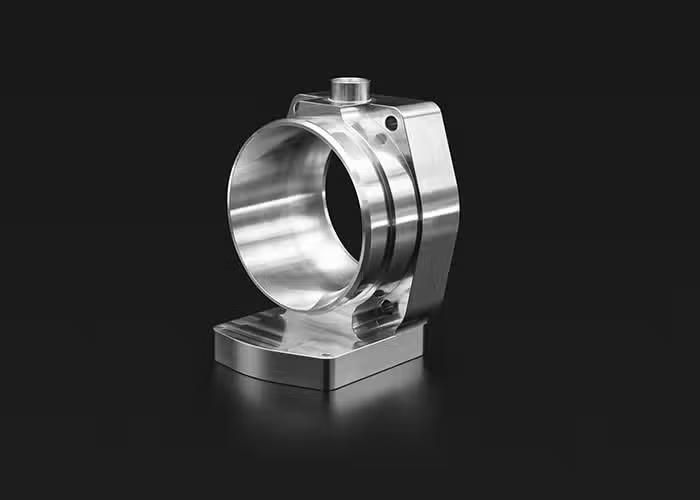
Stainless steel alloys have high strength, ductility, wear and corrosion resistance. They can be easily welded, machined and polished. The hardness and the cost of stainless steel is higher than that of aluminum alloy.

Titanium is an advanced material with excellent corrosion resistance, biocompatibility, and strength-to-weight characteristics. This unique range of properties makes it an ideal choice for many of the engineering challenges faced by the medical, energy, chemical processing, and aerospace industries.

Steel is a strong, versatile, and durable alloy of iron and carbon. Steel is strong and durable. High tensile strength, corrosion resistance heat and fire resistance, easily molded and formed. Its applications range from construction materials and structural components to automotive and aerospace components.

Highly resistant to seawater corrosion. The material’s mechanical properties are inferior to many other machinable metals, making it best for low-stress components produced by CNC machining.

Few metals have the electric conductivity that copper has when it comes to CNC milling materials. The material’s high corrosion resistance aids in preventing rust, and its thermal conductivity features facilitate CNC machining shaping.

Brass is mechanically stronger and lower-friction metal properties make CNC machining brass ideal for mechanical applications that also require corrosion resistance such as those encountered in the marine industry.

Zinc is a slightly brittle metal at room temperature and has a shiny-greyish appearance when oxidation is removed.

Iron is an indispensable metal in the industrial sector. Iron is alloyed with a small amount of carbon – steel, which is not easily demagnetized after magnetization and is an excellent hard magnetic material, as well as an important industrial material, and is also used as the main raw material for artificial magnetism.
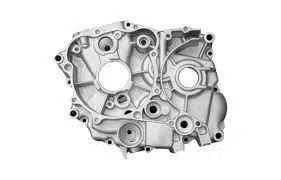
Due to the low mechanical strength of pure magnesium, magnesium alloys are mainly used. Magnesium alloy has low density but high strength and good rigidity. Good toughness and strong shock absorption. Low heat capacity, fast solidification speed, and good die-casting performance.
FAQs: High-Accuracy Joints for Robotics Applications
Anodizing (Type II and Type III)
Passivation for corrosion resistance
Precision polishing for aerodynamic surfaces
Custom protective coatings and thermal barriers