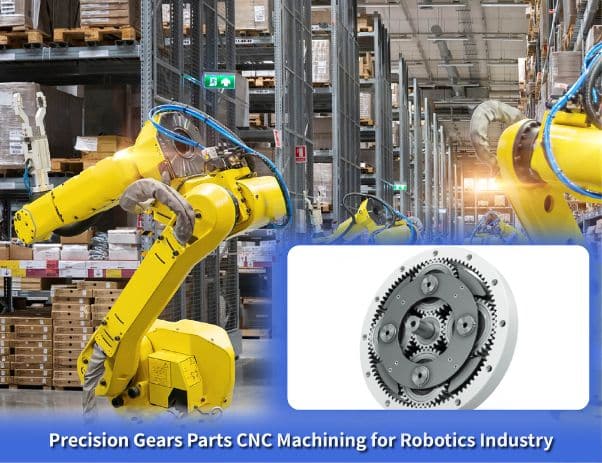
Precision Gears Parts CNC Machining for Robotics Industry
- Machining for complex gear geometries and tooth profiles
- Tight tolerances up to ±0.0001 in
- Precision gear cutting, hobbing & tooth grinding
- Support for rapid prototyping and full-scale production
- ISO 9001-certified robotics manufacturing
Why Robotics Companies
Choose Zintilon

Increased Productivity
Engineers get time back by not dealing with immature supply chains or lack of supply chain staffing in their company and get parts fast.

10x Tighter Tolerances
Zintilon can machine parts with tolerances as tight as+/ - 0.0001 in -10x greater precision compared to other leading services.

World Class Quality
Zintilon provides medical parts for leading aerospace enterprises, verified to be compliant with ISO9001 quality standard by a certified registrar.
From Prototyping to Mass Production


Prototype Precision Gears
Key Points:
- High precision rapid prototyping above all others in your class
- ±0.0001 in tight tolerances
- Evaluate early design, material choice, and mesh quality

EVT – Engineering Validation Test
Key Points:
- Prototypes and constructive functionality.
- Quick final design iterations.
- Prepare for design shift into execution.

DVT – Design Validation Test
Key Points:
- Validation of design and gear teeth profile.
- Multiple materials and treatments experiments.
- Performance ready for production.

PVT – Production Validation Test
Key Points:
- Establish production capability
- Proactively eliminate production roadblocks.
- Balance output consistency and quality.

Mass Production
Key Points:
- Ongoing, high-volume production
- Precision machined for Industrial-grade quality
- Fast turnaround with quality control

Simplified Sourcing for
the Gear Industry
Explore Robotics Components
Discover our full range of precision CNC machined robotics components, designed for strength, stability, and seamless motion. Explore parts for robotic arms, joints, actuators, frames, and end effectors, all crafted to ensure high accuracy, repeatability, and performance in modern automation and robotics systems.
- Base Plates
- Custom Arm
- High-Accuracy Joints
- Custom Gearbox
- Precision Bearings
- Custom Bearing Housings
- Precision Shafts
- Custom Spindles
- Precision Sensors
- Custom Sensor Housings
- Precision End Effectors
- Custom Grippers
- Precision Frames
- Custom Structural
- Precision Brackets
- Custom Mounts
- Precision Wheels
- Custom Tracks
- Precision Gear Racks
- Custom Linear
- Precision Actuators
- Custom Valve
- Precision Housings
- Custom Cover
Robotics Precision Gears Machining Capabilities
We provide precision gear hobbing, gear shaping, gear milling, and tooth grinding with involute profiles and surface finish, along with gear inspection using coordinate measuring machines. Each gear is machined from the alloy steels (4140, 4340, 8620), stainless steels (17-4 PH, 303), aluminum alloys (7075-T6) and brass, which ensures excellent tooth strength and wear resistance during cyclic loading and high-speed operation.


Aerospace
Materials & Finishes

Specialist Industries



Materials for Precision Gears Components

High machinability and ductility. Aluminum alloys have good strength-to-weight ratio, high thermal and electrical conductivity, low density and natural corrosion resistance.
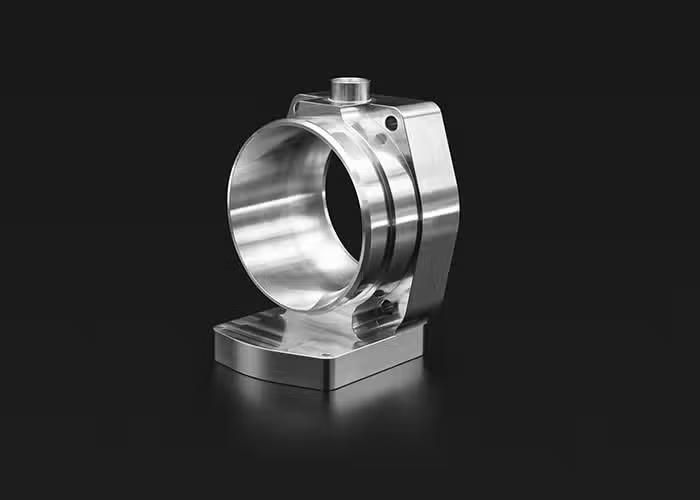
Stainless steel alloys have high strength, ductility, wear and corrosion resistance. They can be easily welded, machined and polished. The hardness and the cost of stainless steel is higher than that of aluminum alloy.

Titanium is an advanced material with excellent corrosion resistance, biocompatibility, and strength-to-weight characteristics. This unique range of properties makes it an ideal choice for many of the engineering challenges faced by the medical, energy, chemical processing, and aerospace industries.

Steel is a strong, versatile, and durable alloy of iron and carbon. Steel is strong and durable. High tensile strength, corrosion resistance heat and fire resistance, easily molded and formed. Its applications range from construction materials and structural components to automotive and aerospace components.

Highly resistant to seawater corrosion. The material’s mechanical properties are inferior to many other machinable metals, making it best for low-stress components produced by CNC machining.

Few metals have the electric conductivity that copper has when it comes to CNC milling materials. The material’s high corrosion resistance aids in preventing rust, and its thermal conductivity features facilitate CNC machining shaping.

Brass is mechanically stronger and lower-friction metal properties make CNC machining brass ideal for mechanical applications that also require corrosion resistance such as those encountered in the marine industry.

Zinc is a slightly brittle metal at room temperature and has a shiny-greyish appearance when oxidation is removed.

Iron is an indispensable metal in the industrial sector. Iron is alloyed with a small amount of carbon – steel, which is not easily demagnetized after magnetization and is an excellent hard magnetic material, as well as an important industrial material, and is also used as the main raw material for artificial magnetism.
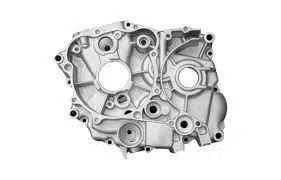
Due to the low mechanical strength of pure magnesium, magnesium alloys are mainly used. Magnesium alloy has low density but high strength and good rigidity. Good toughness and strong shock absorption. Low heat capacity, fast solidification speed, and good die-casting performance.
FAQs: Precision Gears for Robotics Applications
In order to ensure that these precision components function properly, they must produce accurate tooth profiles based on involute geometry to within 0.001 inches to ensure proper load distribution, maintain backlash typically below 3 arc-minutes for bidirectional positioning accuracy, ensure high transmission efficiency above 95 percent for spur and helical gears to lower energy loss, adequate tooth strength to withstand contact stresses greater than 150,000 PSI, operate quietly below 70 dB for collaborative robots working near humans, and endure for more than 10 million mesh cycles before exhibiting service wear or degradation such as pitting, mesh cycles to not limited service wear or pitting degradation.
Aluminum alloys such as 7075-T6 have lightweight construction which helps to minimize rotational inertia for high-speed applications, is strong enough for collaborative robots and low-load positioning systems which handle payloads below 20 kg, have a significant thermal conductivity for frictional heat dissipation, have exceptional machinability for advanced integrated features and complex geometric design, have natural corrosion resistance, and are economically priced for prototype and specialized applications where weight has a significant effect on dynamic performance for construction and cost reduction. Brass has superior machinability for complex tooth profiles and fine pitch, has natural lubricity which reduces friction and wear against steel gears in worm gear applications, has corrosion resistance, offers sufficient strength for transmission of low to medium torque, and its damping properties provide silencing for operation and is of old use for precision instruments and timing mechanisms which are made to a fine and quiet standard.
Rapid prototyping for design validation
Low-volume production for specialized applications
High-volume production with consistent quality control
Full structural and dimensional verification at every stage
Anodizing (Type II and Type III)
Passivation for corrosion resistance
Precision polishing for aerodynamic surfaces
Custom protective coatings and thermal barriers
Super-finished tooth surfaces enhance efficiency in helical gear sets from 94 to 98 percent by decreasing the friction coefficient by 30 percent. Effective tooth modifications, including tip relief, lessen the impact during engagement, leading to a noise reduction of 5 to 10 dB, which is critical for collaborative robots working in human environments. Accurate manufacturing allows matched gear sets, which offer consistent performance characteristics throughout production batches, to ensure predictable behavior in the robots, simplifying programming. Excellent materials along with heat treatment enable the design of smaller gears for specific torque due to reinforced tooth bending fatigue strength which surpasses 40,000 PSI.
Dimensional consistency prevents premature wear from misalignment, ensures proper assembly with designed shaft fits, and bearing arrangements, while precision machined gears provide the mechanical foundation for the robotic systems. These systems achieve position repeatability of ±0.02 millimeters due to accurate reduction ratios along with high, smooth motion profiles with no velocity ripple or cogging, allowing constant speed for applications such as welding and dispensing. They remain highly efficient to minimize heating caused by the motor and to save energy, operate quietly below 70 dB for a pleasant environment in the case of collaborative and service robots, long operating times between 10,000 hours of maintenance, and reliable predictable performance in productivity automation for many industries such as automotive assembly with cycle times below 60 seconds, with electronics for precise component placement, for food packaging over 200 units per minute, and warehouse logistics with high-speed sorting systems as well as medical robotics where motion smoothness and positioning accuracy directly affect patient safety in surgery.