We have moved to a new Website Check Now

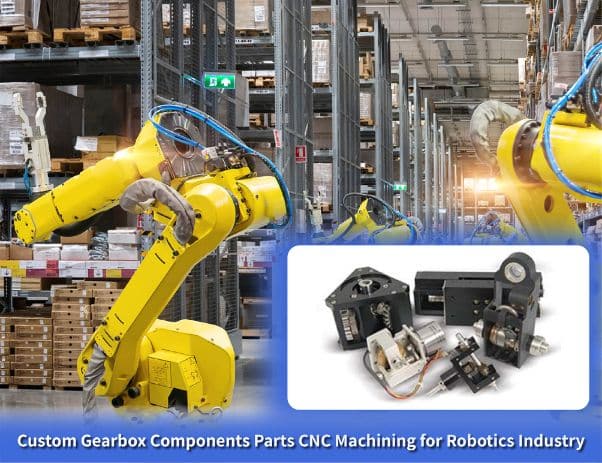
Custom Gearbox Components Parts CNC Machining for Robotics Industry

Robotic gearbox components are precision-engineered mechanical assemblies that house gears, bearings, and shafts to provide torque multiplication and speed reduction. At Zintilon, we specialize in CNC machining of custom gearbox components using advanced multi-axis machining to achieve exceptional housing accuracy, bearing seat precision, and optimal alignment for reliable power transmission and long-term durability.
  • Machining for complex gearbox housings and shafts
  • Tight tolerances up to ±0.001 in
  • Precision milling, boring & bearing seat machining
  • Support for rapid prototyping and full-scale production
  • ISO 9001-certified robotics manufacturing

Trusted by 15,000+ businesses

Why Robotics Companies
Choose Zintilon

prductivity

Increased Productivity

Engineers get time back by not dealing with immature supply chains or lack of supply chain staffing in their company and get parts fast.

10x

10x Tighter Tolerances

Zintilon can machine parts with tolerances as tight as+/ - 0.0001 in -10x greater precision compared to other leading services.

world

World Class Quality

Zintilon provides medical parts for leading aerospace enterprises, verified to be compliant with ISO9001 quality standard by a certified registrar.

From Prototyping to Mass Production

Zintilon provides CNC machining for custom gearbox components and related power transmission assemblies for industrial automation, collaborative robots, and research robotics projects.

Prototype Gearbox Components

Obtain high-precision prototypes of robotic gearbox components that accurately replicate your final design. Test bearing alignment, verify shaft concentricity, and ensure proper gear mesh before full-scale production.


Key Points:

  • Rapid prototyping with high precision

  • Tight tolerances (±0.001 in)

  • Test design, material, and assembly early

3 Axis CNC Machined Stainless Steel Passivation

EVT – Engineering Validation Test

Quickly iterate on gearbox component prototypes to ensure they meet all structural and thermal requirements. Identify potential issues early for a smoother transition to full-scale robotics manufacturing.


Key Points:

  • Validate prototype functionality.

  • Conduct fast design iterations.

  • Prepare for production.

Anodized Aluminum 1024x536

DVT – Design Validation Test

Evaluate the dimensional accuracy and structural integrity of the gearbox with different materials and manufacturing techniques to ensure design accuracy and performance before mass production.


Key Points:

  • Confirm design precision and integrity.

  • Test various materials and configurations.

  • Confirm production performance.

design aluminium

PVT – Production Validation Test

Evaluate the feasibility of large-scale production of gearbox components, and identify and resolve potential mass production challenges to ensure quality and efficient production.


Key Points:

  • Test the feasibility of large-scale production.

  • Identify and resolve process challenges early.

  • Maintain consistent quality of components.

finishes

Mass Production

Rapidly manufacture gearbox components with high precision and quality, ensuring timely delivery for automation integrators and robot manufacturers, and ensuring reliable power transmission.


Key Points:

  • Repeatedly full production output

  • Quality of industrial grade precision machining

  • Strict quality control with rapid turnarounds

production

Simplified Sourcing for
Robotics Industry

Our robotics industry parts manufacturing capabilities have been verified by many listed companies. We provide a variety of manufacturing processes and surface treatments for robotics parts including titanium alloys and aluminum alloys.

Explore Robotics Components

Discover our full range of precision CNC machined robotics components, designed for strength, stability, and seamless motion. Explore parts for robotic arms, joints, actuators, frames, and end effectors, all crafted to ensure high accuracy, repeatability, and performance in modern automation and robotics systems.

Robotics Gearbox Components Machining Capabilities

As mentioned in the previous edition, the combination of our expert precision machinists with advanced CNC machining centers and precision boring equipment, provides Custom Gearbox Components Parts CNC Machining for the Robotics Industry. Critical bearing bore multi-stage reducer assemblies, harmonic drive components, and planetary gearbox housings are the end products. Components are designed and engineered for maximum rigidity, efficient heat dissipation, precise alignment, and optimum robotic actuator performance.

We do precision CNC milling, boring, turning, line boring, and assembly testing, including oil seal and concentricity verification for perfect bearing and gear axis alignment. Gearbox components are made from aluminum alloys, alloy steels, cast irons, or ductile irons, providing excellent and structural rigidity and axial dimensional torque stability for the assembly over a wide range of operational temperatures.
milling

CNC Machining

sheet metal

Sheet Metal Fabrication

edm

Wire EDM

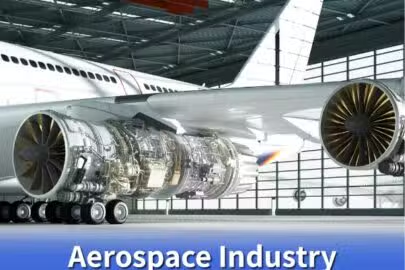
Aerospace
Materials & Finishes

Materials
We provide a wide range of materials, including metals, plastics, and composites.
Finishes
We offer superior surface finishes that enhance part durability and aesthetics for applications requiring smooth or textured surfaces.

Specialist Industries

you are welcome to emphasize it in the drawings or communicate with the sales.

Materials for Custom Gearbox Components Parts

We stock CNC machine components from numerous materials for Gearbox Components Parts Machining for Robotics Industry. We offer over 50 industrial grade metals, cast materials, and structural grade alloys for rapid prototyping and precision manufacturing for heavy-duty power transmission housings.
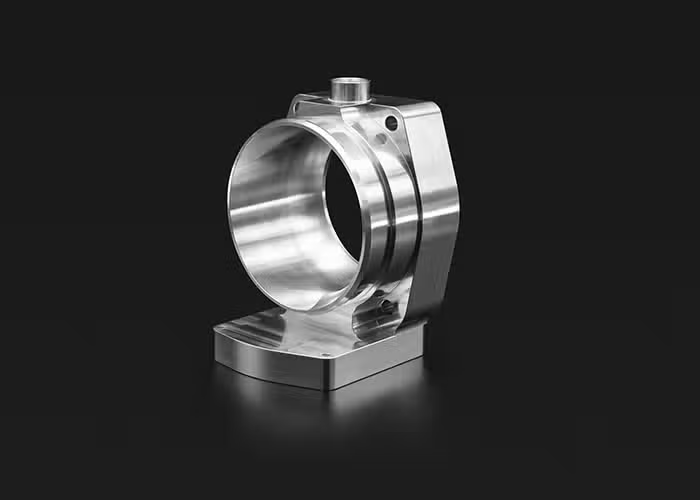
Aluminum Image

High machinability and ductility. Aluminum alloys have good strength-to-weight ratio, high thermal and electrical conductivity, low density and natural corrosion resistance.
Price
$ $ $
Lead Time
< 7 days
Tolerances
Down to ±0.003 mm
Max part size
3000*2200*1100 mm
Min part size
2*2*2 mm
Stainless steel Image

Stainless steel alloys have high strength, ductility, wear and corrosion resistance. They can be easily welded, machined and polished. The hardness and the cost of stainless steel is higher than that of aluminum alloy.

Price
$ $ $
Lead Time
< 7 days
Tolerances
Down to ±0.005 mm
Max part size
3000*2200*1100 mm
Min part size
2*2*2 mm
Titanium Image

Titanium is an advanced material with excellent corrosion resistance, biocompatibility, and strength-to-weight characteristics. This unique range of properties makes it an ideal choice for many of the engineering challenges faced by the medical, energy, chemical processing, and aerospace industries.

Price
$$$
Lead Time
< 10 days
Tolerances
Down to ±0.005 mm
Max part size
3000*2200*1100 mm
Min part size
2*2*2 mm
Steel Image

Steel is a strong, versatile, and durable alloy of iron and carbon. Steel is strong and durable. High tensile strength, corrosion resistance heat and fire resistance, easily molded and formed. Its applications range from construction materials and structural components to automotive and aerospace components.

Price
$ $ $ $ $
Lead Time
< 10 days
Tolerances
Down to ±0.001 mm (routing)
Max part size
3000*2200*1100 mm
Min part size
2*2*2 mm
Bronze Image

Highly resistant to seawater corrosion. The material’s mechanical properties are inferior to many other machinable metals, making it best for low-stress components produced by CNC machining.

Price
$ $ $ $ $
Lead Time
< 10 days
Tolerances
Down to ±0.005 mm
Max part size
3000*2200*1100 mm
Min part size
2*2*2 mm
Copper Image

Few metals have the electric conductivity that copper has when it comes to CNC milling materials. The material’s high corrosion resistance aids in preventing rust, and its thermal conductivity features facilitate CNC machining shaping.

Price
$$$
Lead Time
< 10 days
Tolerances
Down to ±0.005 mm
Max part size
3000*2200*1100 mm
Min part size
2*2*2 mm
Brass Image

Brass is mechanically stronger and lower-friction metal properties make CNC machining brass ideal for mechanical applications that also require corrosion resistance such as those encountered in the marine industry.

Price
$$$
Lead Time
< 10 days
Tolerances
Down to ±0.005mm
Max part size
3000*2200*1100 mm
Min part size
2*2*2 mm
Zinc Image

Zinc is a slightly brittle metal at room temperature and has a shiny-greyish appearance when oxidation is removed.

Price
$ $ $ $ $
Lead Time
< 10 days
Tolerances
Down to ±0.005 mm
Max part size
3000*2200*1100 mm
Min part size
2*2*2 mm
Iron Image

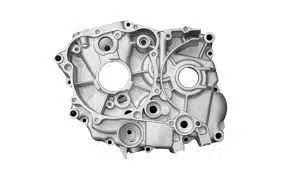
Iron is an indispensable metal in the industrial sector. Iron is alloyed with a small amount of carbon – steel, which is not easily demagnetized after magnetization and is an excellent hard magnetic material, as well as an important industrial material, and is also used as the main raw material for artificial magnetism.
Price
$ $ $ $ $
Lead Time
< 10 days
Tolerances
Down to ±0.005 mm
Max part size
3000*2200*1100 mm
Min part size
2*2*2 mm
Magnesium Image

Due to the low mechanical strength of pure magnesium, magnesium alloys are mainly used. Magnesium alloy has low density but high strength and good rigidity. Good toughness and strong shock absorption. Low heat capacity, fast solidification speed, and good die-casting performance.

Price
$ $ $ $
Lead Time
< 7 days
Tolerances
Down to ±0.005 mm
Max part size
3000*2200*1100 mm
Min part size
2*2*2 mm
Let’s Build Something Great, Together

FAQs: Custom Gearbox Components for Robotics Applications

Robotic gearbox components are parts of complete gear reduction assemblies designed to deliver high torque and low-speed output from high-speed motors. Gearbox components include housings which capture gear meshes and bearings, contain lubricants, and interface to be mounted on robot structures and motors, input shafts which connect to servo and stepper motors giving rotational power to gearboxes, output shafts or flanges which transfer low-speed and high-torque power to robot joints or end-effectors, bearing seats and retainers which align shafts and bear radial and axial loads, and gear support structures. Other components include planet carriers in planetary gearboxes, spider assemblies, housings and seal grooves which prevent lubricant leakage, mounting flanges for motor attachment and robot arms, oil fill and drain ports, breather assemblies for pressure relief, and inspection covers for maintenance access.
These precision components must provide rigid housing structures to prevent deflection that causes gear misalignment and potential premature wear, ensure precise bearing bore concentricity within 0.0005 inches throughout operating temperature ranges to maintain shaft alignment, have adequate wall thickness and ribbing for structural integrity while minimizing weight, ensure proper thermal management in dissipating heat generated by friction within the gears and losses in the bearings, provide environmental sealing to achieve IP54 or IP65 protection ratings for industrial environments, and provide the required dimensional accuracy to ensure proper gear mesh geometry where the designed center distances are maintained within ±0.001 inches.

Every material has its benefits for robotic gearboxes. Aluminum alloys, such as 6061-T6 for basic housings and 7075-T6 for more demanding applications, are lightweight, strong, and can reduce the mass for a cast iron actuator by 50-60% and 5 times more heat dissipative than cast iron. This allows more compact designs without requiring external cooling. They are easily machinable into complex shapes, integrated mounting features and fins for cooling, and natural corrosion resistance. This allows for lower service costs. With adequate stiffness, they are suitable for collaborative robots, light industrial applications, and for 200 Newton meters of output torque. These lightweight robotic systems are more cost effective and the reframed the reduced inertia for improved dynamic performance and energy efficiency. Alloy steels, such as 4140 and 4340, provide extreme strength and rigidity for 500 Newton meters output torque industrial robot gearboxes. They provide extreme wear resistance at the bearing and seal surfaces, fatigue strength for continuous cyclic loading, hardening level for shaft applications, and reliable performance for truck loading systems and welding robots. They are excellent under cyclic loading, provide even shaft-holding, and are dimensionally stable under temperature extremes. This performance and wear resistance are valuable in material handling systems and during welding.
Class 40 cast iron has remarkable vibration dampening qualities which reduce gear noise from 5 to 10 dB compared to welded steel housings. Moreover, it offers excellent dimensional stability with minimal thermal expansion, and gear-to-housing contact wear in planetary carrier applications, as well as traditional casting techniques that allow for complex patterns and internals with cored passageways. Additionally, the cost effective manufacture of large housings and the proven performance of cast iron in precision machine tools and industrial gearboxes have all contributed to the remarkable performance of cast iron. Ductile iron offers the added benefits of improved strength and impact resistance. In addition, it has better machinability for precision boring and has the needed ductility for protection from brittle fracture under shock loads, casting versatility, and cost efficiency suitable for the medium to high volume production of sturdy gearbox housings.

High-precision CNC technologies are employed for the production of gearbox components. These include multi-axis CNC milling for the housing of external profiles, flanges, and integrated features, which streamlines the process by eliminating setup errors and enhancing the precision of subsequent operations. Boring operations CNC-precision bore-bearing holes with ±0.0003-inch tolerances and 32 Ra microinch surface finishes. Bores distribute rage splitting housings concurrently coaxially in-line boring, aligning within 0.0002 concentricity across parting lines. CNC turning for input output shafts and precision turning for journal bearings, splined shafts, and threaded shafts in face milling. surfaces are flat within 0.001-inch tolerances across entire flanges, structural reinforcement and weight pocket milling are ribs designed for optimized in cross drilling tapped for oil passage, mount, hole and fastener seal grooves machined for control depths where surface finish calibrated for O-ring squeeze. Keyway broaching and spline broaching, precision grinding bearing seats, seal surface post heat-treating, and honing bore-opening for final dimension control. CMM inspection for critical dimension includes bore concentricity, distance center hole patterns, and others. Sand casting, investment casting, die casting for aluminum housings, and die or precision machining functional surfaces to designed tolerances completes the casting process.

For gearbox components, we consistently meet tolerances as close as ±0.001 inches on the overall dimensions of housings and on the dedicated mounting features, achieve bearing bore concentricity of 0.0005 inches for input and output shafts while preserving the gear mesh geometry, and maintain center distances between gear axes within ±0.0003 inches for proper tooth engagement and minimal backlash. The perpendicularity of mounting surfaces within 0.002 inches allows for accurate motor and robot assembly with no misalignment. Bearing seat diameter tolerances of H7 or tighter are appropriate for press fit, transition fit and bearing application. Seal grooves for O-ring compression are within ±0.002 inches. Mounting flange bolt circle diameters are ±0.005 inches for proper interchangeability. There is a tolerance of 0.001 inches between parallel faces on split housings, which aids in proper clamping and sealing. This is done so that the gearboxes maintain a rated efficiency of over 90% for planetary, 95% for parallel shafts, operate noiselessly under 70 dB at rated speed and load, and tether with a temperature-stable service life of over 20,000 continuous hours. The geared units will hold the lubricant viscosity within the optimal range and adjust dynamically according to the gear load.

Comprehensive finishing options for the components of a robotic gearbox include: boring and honing bearing seat finishes to 16 Ra microinches; anodizing and hard coating bronze and aluminum for added protective wear-resistance; powder coating for added environmental protection and brand identity; black oxide coating for steel components; copper and electroless nickel plating; seal surface and mating face grinding for 0.0005 leak-free interfaces; controlled roughness bead blasting; phosphate coating of steel housings; and 2.5 gallon thermal spray coatings on bearing surfaces of hybrid designs in lightweight aluminum housings with wear surfaces.

Yes, Zintilon has rapidly growing capabilities to support your needs including advanced prototyping for validation of gearboxes, and thermal testing quadrants of CNC machined solid billets as well as low volume production for tailored reduction ratios and specialized robotic applications with unconventional gearboxes, medium volume production for research platform and limited production industrial robots, high volume production for standardized robotic modules for actuators in robot assemblies requiring thousands of housings annually, full dimensional inspection, and CMM bearing bore concentricity and location control, closure seal pressure testing, trial assemblies to check gear mesh, load bearing preconditioning, material certifications, and design validation for all control packed robot applications to be conformed in documentation to meet the reliability and performance in control of critical functions in motion control robots, gearboxes, thermal quadrants of CNC machined solid billets.
Are your gearbox components certified to quality standards? Absolutely. All components are manufactured under ISO 9001 certified quality management systems. This includes compliance with all requirements for industrial robotics standards customer dimensional and material specifications hardness requirements for shafts heat treatment documentation AGMA documentation for gearbox design and manufacturing full traceability from raw material lot through to final assembly documentation for quality audits and continuous improvement on all power transmission components that are critical for downtime and loss in production or automation safety risk in robot industrial environments.

As with any complex order, leads vary. For machining, surface treatment, and inspection, 12 to 18 business days would likely do for basic gearbox housings with standard features. For complex gearbox assemblies with integrated cooling features and multiples bearing arrangements that are 4 to 6 weeks for final and all casting or forging preprocessing machining. For a prototype, Depending on the design to verify and test the assembly, a plan machined from Geoff billet can shorten this to 8' 12 days to. Higher order volumes allow for cycle time reductions. Optimized fixture designs and dedicated production cells on the order help. Time is detailed in the production schedule given on quote to buyers and includes time to procure materials, cycles in heat treatment, and final inspection.

As with any complex order, leads vary. For machining, surface treatment, and inspection, 12 to 18 business days would likely do for basic gearbox housings with standard features. For complex gearbox assemblies with integrated cooling features and multiples bearing arrangements that are 4 to 6 weeks for final and all casting or forging preprocessing machining. For a prototype, Depending on the design to verify and test the assembly, a plan machined from Geoff billet can shorten this to 8' 12 days to. Higher order volumes allow for cycle time reductions. Optimized fixture designs and dedicated production cells on the order help. Time is detailed in the production schedule given on quote to buyers and includes time to procure materials, cycles in heat treatment, and final inspection.

Our engineering team works alongside robotics designers to tailor custom gearboxes for particular performance and packaging requirements. We construct compact planetary gearbox housings for reduction ratios of 3:1 up to 100:1 within tight design envelopes, create right-angle gearboxes using bevel and worm gear arrangements for joints where motion axes intersect perpendicularly, and exploit maximum stiffness-to-weight ratio through FEA for optimal housing geometry. We also offer custom internal and external heat sink surface cooling for high duty cycle gearboxes, design hollow bore through shaft arrangements for cable passage through actuators, provide surface mount provisions for absolute encoders to enable feedback and sensorless external position encoders, and deliver geared motor sets where motors, encoders, and brakes are integrated into single stark assemblies. This makes it possible to design geared actuators for applications such as delta robots which are high speed and require low inertia and backlash, industrial robots for heavy payloads that require high torque within a tight space, collaborative robots for safely compliant torque limiting and quiet operation, and mobile robots with geared actuators that require IP65 and IP67 sealed gearboxes for outdoor driving.

The CNC machining of components enhances performance in a number of ways. Within 0.0005 inch tolerances, the concentricity of the input and output shafts and the bearings are maintained, and the mesh of the gears in the gearbox are maintained to design geometry throughout the operational range of -20 to +80 degrees Celsius. The design geometry of the gears controls the spacing between the gears and hence the backlash within the range of 0.003 to 0.008 inches. This provides for positional accuracy of 3 arc minutes and also provides for thermal expansion and lubrication. The axial and rigid control of the casing thickness, and ribs achieve casing and housing rigidity. This controls casing stiffness and deflection containment. The casing and housing rigidity control deflection within 0.0005 inches which is 0.003 inches in poorly designed cases. This axial and rigid control of the casing thickness, and ribs achieve casing and housing rigidity. Built cabinets control deflection within 0.0005 inches which is 0.003 inches in poorly designed cases. The control of the micro finish to below 16 Ra on the seat of the bearing controls the life of the bearing in correlated fashion to abrasion and fretting corrosion of the seats. The life of the bearing increases 10,000 to 50,000 hours. Control of the dimensions of the mounting flange achieve alignment of the motor which is 0.002 inch perpendicularity on the motor to gearbox of concentric and axial alignment. This reduces coupling wear and vibration.
Crafting appropriate grooves for seals allows for leak-proof sealing of lubrication and ingress of contaminants maintaining an IP54 or IP65 protection rating for an extended period of time. Considered selection of materials and the thoughtful design for heat dissipation allows lubrication for the system to exceed 80 degree Celsius providing enough viscosity and prolong the interval for lubrication to be replaced from 2000 to 10000 hours. Efficient manufacturing reduces the expected variability in the efficiency of the system. Planetary gearboxes are able to reach an efficiency of 90 to 94 percent and helical parallel shaft designs reach an impressive 96 to 98 percent efficiency. This leads to reduced heating and energy waste in the motor. Effective surface treatment extends the life of the system in harsh industrial environments to over 10 years despite humidity, ventilation, and cycling temperatures, and even exposure to chemicals.
Uniform dimensions across production facilitate interchangeable assemblies. This optimizes maintenance and diminishes spare parts storage. While precision machining of gearbox components form the mechanical basis for robotic actuators licensed for output torques ranging from 10 to 2000 Newton-meters depending on size and gear ratio. Achieves positioning repeatability of ±0.02 millimeters from accurate reduction ratios and minimal backlash. Reduced dead time smooth control of velocity at less than 2 percent for constant speed applications, including arc welding and adhesive dispensing. Operates at less than 70 dB which complies with collaborative robot safety standards to maintain silence. Performance under thermal stability across industrial temperature ranges. Reliability with predictable performance for productive automation and long-term use with maintenance exceeding 10,000 hours is definite. Precise spot welding torch positioning is for automotive assembly. Electronics manufacturing requires ±0.03 millimeters repeatable component placement for patterning. Food packaging automation for pick rates greater than 200 per minute. 24/7 operational reliable for logistics automation. Medical robotics for precision of motion and positioning requirements in surgery.
Got any more questions?