We have moved to a new Website Check Now

Custom Tracks Parts CNC Machining for Robotics Industry

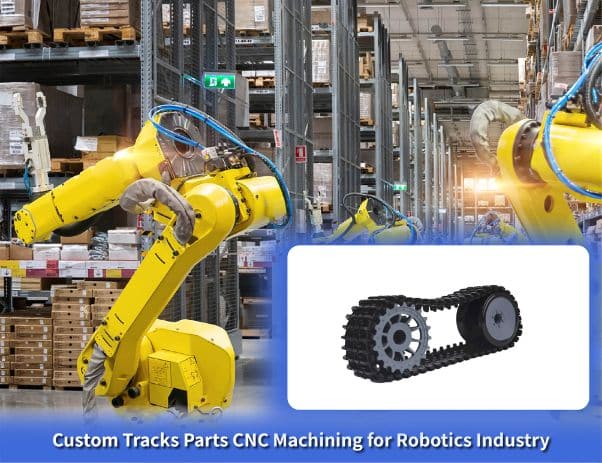
Custom tracks are application specific mobility components that offer traction and adaptability over various terrain for tracked mobile robots and unmanned ground vehicles. At Zintilon, we utilize CNC machining for custom track components before employing advanced multi-axis machining for various components along tracks to maximize precision, durability, and mechanical strength for dependable all-terrain navigation in industrial inspections and outdoor robotics.
  • Machining complex track geometries and drive interfaces
  • Interfacing precision to tolerances up ±0.005 in
  • Integrated precision milling, turning, & heat treatment
  • Comprehensive support for rapid prototyping and full-scale production
  • Total Quality Management (ISO 9001 standards) for all robotics manufacturing

Trusted by 15,000+ businesses

Why Robotics Companies
Choose Zintilon

prductivity

Increased Productivity

Engineers get time back by not dealing with immature supply chains or lack of supply chain staffing in their company and get parts fast.

10x

10x Tighter Tolerances

Zintilon can machine parts with tolerances as tight as+/ - 0.0001 in -10x greater precision compared to other leading services.

world

World Class Quality

Zintilon provides medical parts for leading aerospace enterprises, verified to be compliant with ISO9001 quality standard by a certified registrar.

From Prototyping to Mass Production

Zintilon offers CNC machining for custom track components, as well as custom machining for associated mobility systems for industrial automation, mobile robots, and unmanned vehicle platforms.

Prototype Custom Tracks

Get prototypes of track components for your final design that accurately and precisely replicate the terrain tested. Evaluate performance over various terrain, verify drive engagement and test for flexibility before scaling.


Key Point

  • Prototyping speed and precision

  • Tight tolerances (±0.005 in)

  • Early design, material, and terrain adaptability tests

3 Axis CNC Machined Stainless Steel Passivation

EVT – Engineering Validation Test

Prototyping for track components allows quick iterations to confirm all mobility and durability specifications. Anticipate potential complications that smoothen the transition to full-scale robotics manufacturing.


Key Point

  • Confirm working prototype functionalities

  • Develop and refine prototype design

  • Test prototypes for production readiness

Anodized Aluminum 1024x536

DVT – Design Validation Test

Before mass production begins, validate the design through dimension and mechanical performance tests of the track components using different materials and configurations to adapt optimally to the terrain navigation.


Key Point

  • Confirm design integrity

  • Test different materials and configurations

  • Test for production-ready performance

design aluminium

PVT – Production Validation Test

For custom track components, validate production feasibility and identify potential production problems that can be solved before full production begins to ensure consistency and efficiency.


Key Point

  • Validate large-scale production

  • Identify and resolve production problems

  • Ensure consistency of components

finishes

Mass Production

Produce application-specific track components in high quality and large volumes, ensuring precision, timely delivery, and performance reliability for the mobility of robots and unmanned vehicles, for manufacturers and integrators.


Key Point

  • Reliability of consistent and high-volume production

  • Accurate machining for industrial quality

  • Fast lead times with strong quality assurance

production

Simplified Sourcing for
Robotics Industry

Our robotics industry parts manufacturing capabilities have been verified by many listed companies. We provide a variety of manufacturing processes and surface treatments for robotics parts including titanium alloys and aluminum alloys.

Explore Robotics Components

Discover our full range of precision CNC machined robotics components, designed for strength, stability, and seamless motion. Explore parts for robotic arms, joints, actuators, frames, and end effectors, all crafted to ensure high accuracy, repeatability, and performance in modern automation and robotics systems.

Robotics Custom Tracks Machining Capabilities

We utilize advanced CNC machining and heat treatment facilities with skillful precision machinists to provide Custom Tracks Parts CNC Machining for the Robotics Industry. Every component from drive sprockets to track links and idler wheels with accurately profiled teeth is designed to optimally power a track system while conforming to the terrain and wearing longer in tough operating conditions.

We engage in complete precision CNC milling, turning, and gear cutting, alongside surface hardening for drive engagement and wear, which we test and verify dimensionally. Each component of custom tracks is designed in a non-ferrous alloy (6061-T6, 7075-T6), steel (4140, 8620), stainless steel (304, 316), and tool steel which is hardened, ensuring power the tracks can withstand the wear and resist abrasive outer elements in real-world operations of varying terrains during continuous use.
milling

CNC Machining

sheet metal

Sheet Metal Fabrication

edm

Wire EDM

Aerospace
Materials & Finishes

Materials
We provide a wide range of materials, including metals, plastics, and composites.
Finishes
We offer superior surface finishes that enhance part durability and aesthetics for applications requiring smooth or textured surfaces.

Specialist Industries

you are welcome to emphasize it in the drawings or communicate with the sales.

Materials for Custom Tracks Components

For Custom Tracks Machining for the Robotics Industry, our CNC machine shop has the most complete range of materials. Over 40 industrial-grade metals and specialty alloys provide the basis for precision and industrial quality standards for the rapid prototyping of application-specific mobility components and complete mobility component manufacturing.
Aluminum Image

High machinability and ductility. Aluminum alloys have good strength-to-weight ratio, high thermal and electrical conductivity, low density and natural corrosion resistance.
Price
$ $ $
Lead Time
< 7 days
Tolerances
Down to ±0.003 mm
Max part size
3000*2200*1100 mm
Min part size
2*2*2 mm
Stainless steel Image

Stainless steel alloys have high strength, ductility, wear and corrosion resistance. They can be easily welded, machined and polished. The hardness and the cost of stainless steel is higher than that of aluminum alloy.

Price
$ $ $
Lead Time
< 7 days
Tolerances
Down to ±0.005 mm
Max part size
3000*2200*1100 mm
Min part size
2*2*2 mm
Titanium Image

Titanium is an advanced material with excellent corrosion resistance, biocompatibility, and strength-to-weight characteristics. This unique range of properties makes it an ideal choice for many of the engineering challenges faced by the medical, energy, chemical processing, and aerospace industries.

Price
$$$
Lead Time
< 10 days
Tolerances
Down to ±0.005 mm
Max part size
3000*2200*1100 mm
Min part size
2*2*2 mm
Steel Image

Steel is a strong, versatile, and durable alloy of iron and carbon. Steel is strong and durable. High tensile strength, corrosion resistance heat and fire resistance, easily molded and formed. Its applications range from construction materials and structural components to automotive and aerospace components.

Price
$ $ $ $ $
Lead Time
< 10 days
Tolerances
Down to ±0.001 mm (routing)
Max part size
3000*2200*1100 mm
Min part size
2*2*2 mm
Bronze Image

Highly resistant to seawater corrosion. The material’s mechanical properties are inferior to many other machinable metals, making it best for low-stress components produced by CNC machining.

Price
$ $ $ $ $
Lead Time
< 10 days
Tolerances
Down to ±0.005 mm
Max part size
3000*2200*1100 mm
Min part size
2*2*2 mm
Copper Image

Few metals have the electric conductivity that copper has when it comes to CNC milling materials. The material’s high corrosion resistance aids in preventing rust, and its thermal conductivity features facilitate CNC machining shaping.

Price
$$$
Lead Time
< 10 days
Tolerances
Down to ±0.005 mm
Max part size
3000*2200*1100 mm
Min part size
2*2*2 mm
Brass Image

Brass is mechanically stronger and lower-friction metal properties make CNC machining brass ideal for mechanical applications that also require corrosion resistance such as those encountered in the marine industry.

Price
$$$
Lead Time
< 10 days
Tolerances
Down to ±0.005mm
Max part size
3000*2200*1100 mm
Min part size
2*2*2 mm
Zinc Image

Zinc is a slightly brittle metal at room temperature and has a shiny-greyish appearance when oxidation is removed.

Price
$ $ $ $ $
Lead Time
< 10 days
Tolerances
Down to ±0.005 mm
Max part size
3000*2200*1100 mm
Min part size
2*2*2 mm
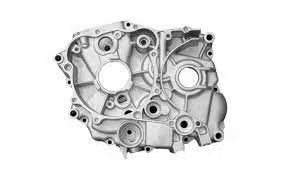
Iron Image

Iron is an indispensable metal in the industrial sector. Iron is alloyed with a small amount of carbon – steel, which is not easily demagnetized after magnetization and is an excellent hard magnetic material, as well as an important industrial material, and is also used as the main raw material for artificial magnetism.
Price
$ $ $ $ $
Lead Time
< 10 days
Tolerances
Down to ±0.005 mm
Max part size
3000*2200*1100 mm
Min part size
2*2*2 mm
Magnesium Image

Due to the low mechanical strength of pure magnesium, magnesium alloys are mainly used. Magnesium alloy has low density but high strength and good rigidity. Good toughness and strong shock absorption. Low heat capacity, fast solidification speed, and good die-casting performance.

Price
$ $ $ $
Lead Time
< 7 days
Tolerances
Down to ±0.005 mm
Max part size
3000*2200*1100 mm
Min part size
2*2*2 mm
Let’s Build Something Great, Together

FAQs: Custom Tracks for Robotics Applications

Custom track components are engineered for enabling tracked mobility for robots which must operate over rough, stair, and difficult surfaces. These include drive sprockets which transmit motor torque to track belts, track links which provide flexible yet durable track surface, idler wheels which preserve track tension, guide wheels which prevent track derailment, tensioner assemblies which adapt track tension to terrain, support rollers which distribute track load, and custom track pads for specific surfaces like concrete, gravel, mud, and stairs.

Lightweight construction is crucial for reducing overall vehicle mass, payload capacity, battery life, and overall cost, which is important for robots weighing up to 100 kg. Aluminum is easily machinable to provide over 100 various geometries for complex sprocket designs. Steel 4140 and 8620 are preferred for providing high strength, toughness and impact resistance for heavy duty tracked vehicles which support payloads over 500 kg. Tool steel provides maximum wear resistance for sprocket teeth and guide surfaces. Lastly, stainless steel provides corrosion resistance for marine and wet environment applications, while still possessing decent strength.

Complex sprocket geometries along with precise tooth profiles are crafted using multi-axis CNC milling. CNC turning generates spindle-turned cylindrical components such as idler wheels, support rollers, and shafts with specified diameters. Gear hobbing and wire EDM are used to cut sprocket teeth along specified pitches and profiles to ensure disengagement is smooth. Carburizing followed by quenching to create a surface hardness greater than 58 HRC and additional wear resistant is a track component's heat treatment. Post heat treatment surface grinding is done to restore the surface to specified dimensions and counter excessive heat treatment distortion. Coordinate drilling for creation of mounting holes and lubrication passages is used machining method.

For sprocket engagement, we achieve tooth pitch accuracy of ±0.005 inches, bore dimensions of ±0.002 inches for fitting a bearing, tooth profile precision of ±0.003 inches for power transmission, concentricity of 0.005 inches, and balance to within ±0.010 inches. Overall dimensions and surface hardness uniformity of 2 HRC ensure consistent wear across the teeth.

Yes, we provide rapid prototyping to verify fit and test assembly, with same-day CAD-to-part capability available for critical projects. For custom automation cells and research platforms, we perform low-volume production of 20 to 500 brackets. For standardized robot models, we perform high-volume production of thousands to tens of thousands of brackets annually, incorporating complete dimensional inspection, flatness verification, and material certifications.

Yes, all components incorporate comprehensive documentation maintained within a quality management system certified to ISO 9001 standard which includes certifying material traceability for elements within the components, certifying the heat treatment of components, measuring and certifying the dimensional compliance of elements within components in alignment with specified designs, certifying hardness of elements within the components in critical wear surfaces, and certifying components in tracked robots for reliable rugged terrain navigation across hundreds of operating hours, and certifying the coated elements for mobility which must sustain and bear payloads ranging from 10 to 1000 kilograms.

We provide comprehensive finishing solutions tailored to aerospace requirements:
Anodizing (Type II and Type III)
Passivation for corrosion resistance
Precision polishing for aerodynamic surfaces
Custom protective coatings and thermal barriers
10–15 business days is the lead time for standard sprockets and idler wheels; this includes the time for machining and heat treatment. For full custom track systems, it integrates features and takes about 4–6 weeks. For rapid tracked vehicle testing and terrain validation, prototype sets of components can be done within 7–10 days

Of course. For inspection robots, we design lightweight track systems that minimize ground pressure for use on delicate terrain. Other designs include aggressive sprocket profiles for maximum traction on loose terrains like sand and gravel, stair-climbing track geometries with optimized pitch and pad designs, and amphibious track components made of corrosion-resistant materials for operation in water. We also build high-speed track systems for patrol robots that reach speeds of more than 5 meters per second, and custom track pads with application-specific tread patterns for use on concrete, asphalt, or off-road conditions.

Having accurate sprocket teeth pitches to within ±0.005 inches allows for guaranteed positive engagement of track links, and no slippage that results in losing control and traction. Smooth power transmission is achieved as a result of precise tooth profile construction and reduces noise, vibration, and wear. Proper sprocket construction and treatment results in surface hardness of over 58 HRC and sprocket life of over 500 hours of operation. Controlled bore dimensions result in bearing fit that prevents wobble and misalignment. Optimal geometry for strategic weight reduction offers maximum payload capacity. Construction with quality materials yields the required impact resistance for negotiating obstacles. Mechanical life is prolonged with balanced components that reduce vibration and sensor accuracy is improved. Durable construction allows for reliable operation over different terrains characterized by slopes, stairs, debris, and rugged surfaces.
Got any more questions?