We have moved to a new Website Check Now

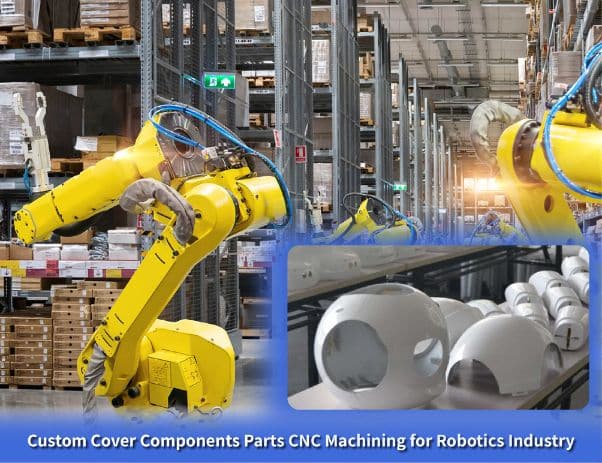
Custom Cover Components Parts CNC Machining for Robotics Industry

Custom cover components are CNC machined robotic arm, actuator covers, and automated equipment protective panels. Custom cover components are CNC machined protective panels designed to provide safety barriers, environmental cover, and aesthetic appeal for robotic arms, fixed automated equipment actuators and actuator automation. Every custom cover component aimed to provide protection, uphold reliability secure brand fastening and seamlessly installed for CNC machined precision covers identity to industrial robotics applications.
  • Machining for complex cover geometries and ventilation patterns
  • Tight tolerances up to ±0.010 in
  • Precision milling, laser cutting & surface finishing
  • Support for rapid prototyping and full-scale production
  • ISO 9001-certified robotics manufacturing

Trusted by 15,000+ businesses

Why Robotics Companies
Choose Zintilon

prductivity

Increased Productivity

Engineers get time back by not dealing with immature supply chains or lack of supply chain staffing in their company and get parts fast.

10x

10x Tighter Tolerances

Zintilon can machine parts with tolerances as tight as+/ - 0.0001 in -10x greater precision compared to other leading services.

world

World Class Quality

Zintilon provides medical parts for leading aerospace enterprises, verified to be compliant with ISO9001 quality standard by a certified registrar.

From Prototyping to Mass Production

Zintilon provides CNC machining for custom cover components and protective panels designed for industrial robots, collaborative robotics equipment and automated systems worldwide.

Prototype Custom Cover Components

Obtain high-precision prototypes of cover components that accurately replicate your final design. Test fit and alignment, verify access points, and ensure proper aesthetic appearance before full-scale production.


Key Point

  • Rapid prototyping with high precision

  • Tight tolerances (±0.010 in)

  • Test design, aesthetics, and functionality early

3 Axis CNC Machined Stainless Steel Passivation

EVT – Engineering Validation Test

Prototyping covers should iterate quickly and pass testing to validate all safety and access requirements. Smoothen transitions to full-scale robotics manufacturing by IDing potential issues early.


Key Point

  • Validate prototype functionality

  • Rapid design iterations

  • Ensure readiness for production

Anodized Aluminum 1024x536

DVT – Design Validation Test

For custom covers, assess various materials, finishes and design options to ascertain fitting and design aesthetics prior to mass production to protect optimum performance.


Key Point

  • Confirm design integrity and fit

  • Test multiple materials and surface treatments

  • Ensure production-ready performance

design aluminium

PVT – Production Validation Test

For custom cover components, validate large-scale production and full production set up to identify risks and potential level of production consistency before marking the batch.


Key Point

  • Test large-scale production capability

  • Detect and fix process issues early

  • Ensure consistent part quality

finishes

Mass Production

Capture high-quality, precision-grade cover components at large production scales to offer timely delivery and protective precision for robot manufacturers and automation integrators.


Key Point

  • Consistent, high-volume production

  • Precision machining for industrial-grade quality

  • Fast turnaround with strict quality control

production

Simplified Sourcing for
Robotics Industry

Our robotics industry parts manufacturing capabilities have been verified by many listed companies. We provide a variety of manufacturing processes and surface treatments for robotics parts including titanium alloys and aluminum alloys.

Explore Robotics Components

Discover our full range of precision CNC machined robotics components, designed for strength, stability, and seamless motion. Explore parts for robotic arms, joints, actuators, frames, and end effectors, all crafted to ensure high accuracy, repeatability, and performance in modern automation and robotics systems.


Robotics Custom Cover Components Machining Capabilities

Using CNC machines, laser cutting tools, and other tools, CNC Custom Cover Robotics can assemble parts for arms and safety panels to cover the vents. These covers are designed to enhance safety, aesthetic appeal, and easy maintenance.

For Custom Cover Components, we ensure safety and assemble the parts for a professional appearance. We meet the compliance standards and finish the parts CNC to grade standard or industrial quality. Parts are assembled from: 6061-T6, 5052 aluminum alloys, ABS, polycarbonate, PET engineering plastics, 304 stainless steel, or composite materials which can contain stainless steel. These materials are designed to withstand harsh working conditions.
milling

CNC Machining

sheet metal

Sheet Metal Fabrication

edm

Wire EDM

Aerospace
Materials & Finishes

Materials
We provide a wide range of materials, including metals, plastics, and composites.
Finishes
We offer superior surface finishes that enhance part durability and aesthetics for applications requiring smooth or textured surfaces.

Specialist Industries

you are welcome to emphasize it in the drawings or communicate with the sales.

Materials for Custom Cover Components

Our CNC machine shop offers a wide range of materials for Custom Cover Components Machining for Robotics Industry. With 25+ industrial-grade metals, plastics, and specialty materials, we support rapid prototyping and custom protective panel manufacturing with consistent precision and industrial-quality standards.
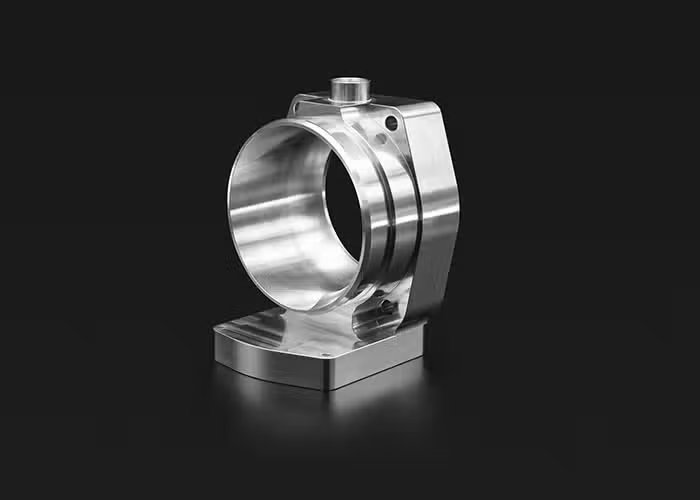
Aluminum Image

High machinability and ductility. Aluminum alloys have good strength-to-weight ratio, high thermal and electrical conductivity, low density and natural corrosion resistance.
Price
$ $ $
Lead Time
< 7 days
Tolerances
Down to ±0.003 mm
Max part size
3000*2200*1100 mm
Min part size
2*2*2 mm
Stainless steel Image

Stainless steel alloys have high strength, ductility, wear and corrosion resistance. They can be easily welded, machined and polished. The hardness and the cost of stainless steel is higher than that of aluminum alloy.

Price
$ $ $
Lead Time
< 7 days
Tolerances
Down to ±0.005 mm
Max part size
3000*2200*1100 mm
Min part size
2*2*2 mm
Titanium Image

Titanium is an advanced material with excellent corrosion resistance, biocompatibility, and strength-to-weight characteristics. This unique range of properties makes it an ideal choice for many of the engineering challenges faced by the medical, energy, chemical processing, and aerospace industries.

Price
$$$
Lead Time
< 10 days
Tolerances
Down to ±0.005 mm
Max part size
3000*2200*1100 mm
Min part size
2*2*2 mm
Steel Image

Steel is a strong, versatile, and durable alloy of iron and carbon. Steel is strong and durable. High tensile strength, corrosion resistance heat and fire resistance, easily molded and formed. Its applications range from construction materials and structural components to automotive and aerospace components.

Price
$ $ $ $ $
Lead Time
< 10 days
Tolerances
Down to ±0.001 mm (routing)
Max part size
3000*2200*1100 mm
Min part size
2*2*2 mm
Bronze Image

Highly resistant to seawater corrosion. The material’s mechanical properties are inferior to many other machinable metals, making it best for low-stress components produced by CNC machining.

Price
$ $ $ $ $
Lead Time
< 10 days
Tolerances
Down to ±0.005 mm
Max part size
3000*2200*1100 mm
Min part size
2*2*2 mm
Copper Image

Few metals have the electric conductivity that copper has when it comes to CNC milling materials. The material’s high corrosion resistance aids in preventing rust, and its thermal conductivity features facilitate CNC machining shaping.

Price
$$$
Lead Time
< 10 days
Tolerances
Down to ±0.005 mm
Max part size
3000*2200*1100 mm
Min part size
2*2*2 mm
Brass Image

Brass is mechanically stronger and lower-friction metal properties make CNC machining brass ideal for mechanical applications that also require corrosion resistance such as those encountered in the marine industry.

Price
$$$
Lead Time
< 10 days
Tolerances
Down to ±0.005mm
Max part size
3000*2200*1100 mm
Min part size
2*2*2 mm
Zinc Image

Zinc is a slightly brittle metal at room temperature and has a shiny-greyish appearance when oxidation is removed.

Price
$ $ $ $ $
Lead Time
< 10 days
Tolerances
Down to ±0.005 mm
Max part size
3000*2200*1100 mm
Min part size
2*2*2 mm
Iron Image

Iron is an indispensable metal in the industrial sector. Iron is alloyed with a small amount of carbon – steel, which is not easily demagnetized after magnetization and is an excellent hard magnetic material, as well as an important industrial material, and is also used as the main raw material for artificial magnetism.
Price
$ $ $ $ $
Lead Time
< 10 days
Tolerances
Down to ±0.005 mm
Max part size
3000*2200*1100 mm
Min part size
2*2*2 mm
Magnesium Image

Due to the low mechanical strength of pure magnesium, magnesium alloys are mainly used. Magnesium alloy has low density but high strength and good rigidity. Good toughness and strong shock absorption. Low heat capacity, fast solidification speed, and good die-casting performance.

Price
$ $ $ $
Lead Time
< 7 days
Tolerances
Down to ±0.005 mm
Max part size
3000*2200*1100 mm
Min part size
2*2*2 mm
Let’s Build Something Great, Together

FAQs: Custom Cover Components for Robotics Applications

Custom cover components are protective panels designed to ensure safety barriers for robotic systems to guard against environmental risks and portray brand appearance. These include robotic arm shrouds that cover articulated joints and prevent pinch points, maintenance access panels replacing components, safety covers that meet ISO 10218 requirements for collaborative robots, vents that allow heat dissipation while preventing debris entry, and joint bellows that protect against contamination. Other components include power signal and wiring cable cover routed systems, transparent sensor covers for protective windows over cameras and lasers, and custom panels shaped to fit complex robot geometries with mounting features, labled areas, access to emergency stop buttons, and other attributes.

Aluminum 6061-T6 and 5052 are ideal because they are very light, very easy to machine for any ventilation patterns or cutouts, strong enough to withstand impacts, naturally corrosion resistant, and they look very professional with anodized finishes. Engineering plastics such as ABS, polycarbonate, and PET are also very light, easily insulate electrically, and are very cost effective for high volume production which makes them ideal for complex covers. They also provide impact resistance which is great for collaborative robot safety, and transparency for sensor windows. Stainless steel 304 is very corrosion resistant and very washable for stainless steel covers so it is ideal for harsh environment applications. Lastly, composites are great for ultimate weight reduction while still maintaining adequate strength and chemical resistance which is great for specialized applications.

CNC milling makes cover components by creating panel shapes, mount holes, and ventilation patterns with close position accuracy of ±0.010 inches. Laser cutting takes care of complex outline shapes, display windows, and grilles with edges that require little secondary finishing. For complex shapes, Waterjet cutting works well on thicker materials. Edge routing and deburring avoid edge injuries to operators with smooth and safe edges. For three-dimensional covers, bending and sheet forming works on flat sheets. Tapping prepares the covers for mounting by making threaded holes. Engraving or laser marking tips these covers for safety or to identify the part and includes branding. Finally, the cover is powder coated or painted for protection and to add some color.

We achieve the overall panel dimensions for proper fitting with the robot structures to ±0.010 inches, mounting hole positions to ±0.005 inches for attachment, edge straightness of 0.020 inches for appearance, cutout dimensions to ±0.008 inches for sensor and cable access, bend angles to formed covers of ±2 degrees, and ±0.030 inches for contoured surface accuracy to match the robot geometry.

Yes, we provide rapid prototyping to verify fit and test assembly, with same-day CAD-to-part capability available for critical projects. For custom automation cells and research platforms, we perform low-volume production of 20 to 500 brackets. For standardized robot models, we perform high-volume production of thousands to tens of thousands of brackets annually, incorporating complete dimensional inspection, flatness verification, and material certifications.

Yes, all components are produced within ISO 9001 quality management systems, which include complete material traceability, verification of dimensions against design specifications, collaborative robot covers safety compliance testing aligned with ISO 10218 and ISO/TS 15066, protective panels documentation for industrial robotics, and ensuring operator safety, environmental protection, and aesthetic durability during and after cleaning cycles.

We provide comprehensive finishing solutions tailored to aerospace requirements:
Anodizing (Type II and Type III)
Passivation for corrosion resistance
Precision polishing for aerodynamic surfaces
Custom protective coatings and thermal barriers
Standard access panels and robot covers take 8-14 working days for cutting, forming, and finishing. For more advanced combat edges with multi-assembly and designed integrated features, we take 4-5 weeks. For fast approval and robot design prototyping, covers for design evaluation take 5-8 and we are able to design with fast cycles.

Sure. We design safety covers for the collaborative robots that are made of translucent covers. These fit the ISO/TS 15066 standard for forseeable and impact protection. We also design and ventilated covers that optimize airflow and protection against 6 mm sphere ingress for IP4X ratings. We create quick-release covers that allow maintenance and cut downtime by 50%. We have modular cover sets for different robot configurations. We design lightweight covers for high speed robots to reduce the mass that needs to be moved. We create chemical resistant covers for robots in the pharma and food processing industries. We also design cleanroom covers that meet ISO Class 5. Integrated designs that combine all the protective functions with cable management and sensor mounting are also available. These designs also include indicator lights and brand graphics.

Attaining the right dimensions of the cover components to within ±0.010 inches allows for the custom covers to properly fit with the robotic structures. This prevents the formation of gaps that may compromise safety or appearance while also ensuring designed clearances are kept for the moving parts. Locating the mounting holes with an accuracy of ±0.005 inches secures the covers so they don’t move or become dislodged while the robot is in operation. Deburring edges and maintaining smooth contours reduces potential for injuries during installation, operation, and maintenance. Defining and maintaining the pattern of ventilation openings ensures an adequate balance is achieved to cool motors below 80 degrees C and minimize the risk of 6 mm sphere ingress per IP4X standards. Precision bending to form covers to fit complex robot geometries enables high coverage ratios while optimizing material and weight. Refinishing surfaces increases brand visibility while maintaining cover appearance, chemical resistance, and UV resistance from isopropanol and detergent cleaners and prolonged exposure. Quality covers provide reliable protection to the robot, upholding the safety of the operators, IP rated environmental protection, and a professional appearance. The covers are designed to last 5 to 15 years of industrial service.
Got any more questions?