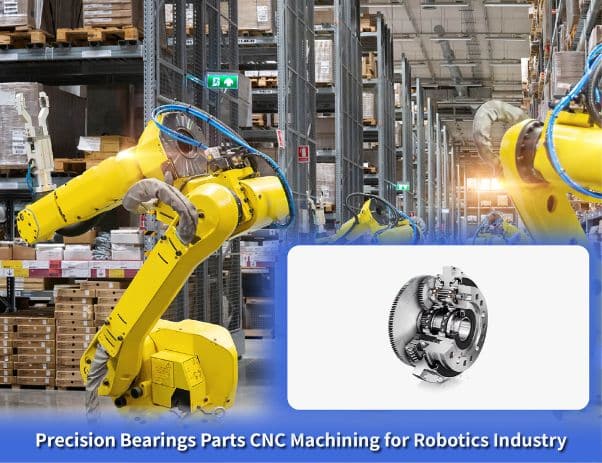
Precision Bearings Parts CNC Machining for Robotics Industry
- Machining for complex bearing races and housings
- Tight tolerances up to ±0.0001 in
- Precision turning, grinding & raceway finishing
- Support for rapid prototyping and full-scale production
- ISO 9001-certified robotics manufacturing
Why Robotics Companies
Choose Zintilon

Increased Productivity
Engineers get time back by not dealing with immature supply chains or lack of supply chain staffing in their company and get parts fast.

10x Tighter Tolerances
Zintilon can machine parts with tolerances as tight as+/ - 0.0001 in -10x greater precision compared to other leading services.

World Class Quality
Zintilon provides medical parts for leading aerospace enterprises, verified to be compliant with ISO9001 quality standard by a certified registrar.
From Prototyping to Mass Production


Prototype Bearing Components
Key Points:
- Rapid prototyping with high precision
- Tight tolerances (±0.0001 in)
- Test design, material, and performance early

EVT – Engineering Validation Test
Key Points:
- Validate prototype functionality
- Rapid design iterations
- Ensure readiness for production

DVT – Design Validation Test
Key Points:
- Confirm design integrity and raceway quality
- Test multiple materials and treatments
- Ensure production-ready performance

PVT – Production Validation Test
Key Points:
- Test large-scale production capability
- Detect and fix process issues early
- Ensure consistent part quality

Mass Production
Key Points:
- Consistent, high-volume production
- Precision machining for industrial-grade quality
- Fast turnaround with strict quality control

Simplified Sourcing for
the Joint Industry
Explore Robotics Components
Discover our full range of precision CNC machined robotics components, designed for strength, stability, and seamless motion. Explore parts for robotic arms, joints, actuators, frames, and end effectors, all crafted to ensure high accuracy, repeatability, and performance in modern automation and robotics systems.
- Base Plates
- Custom Arm
- High-Accuracy Joints
- Precision Gears
- Custom Gearbox
- Custom Bearing Housings
- Precision Shafts
- Custom Spindles
- Precision Sensors
- Custom Sensor Housings
- Precision End Effectors
- Custom Grippers
- Precision Frames
- Custom Structural
- Precision Brackets
- Custom Mounts
- Precision Wheels
- Custom Tracks
- Precision Gear Racks
- Custom Linear
- Precision Actuators
- Custom Valve
- Precision Housings
- Custom Cover
Robotics Precision Bearings Machining Capabilities
We offer precision CNC turning, cylindrical grinding, and surface grinding, as well as raceway finishing where the perfect ball or roller contact surfaces are constructed, and the specialized bearing metrology performs the final dimensional confirmation. Machining every bearing component of the assembly, whether it is bearing steel (52100, 440C stainless), tool steel (M2, D2), aluminum alloys (7075-T6), or hardened alloy steel (4340), is necessary to provide the expected wear resistance and dimensional stability.


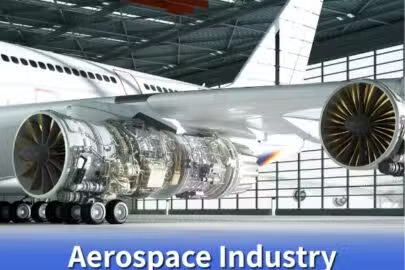
Aerospace
Materials & Finishes

Specialist Industries


Materials for Precision Bearings Components

High machinability and ductility. Aluminum alloys have good strength-to-weight ratio, high thermal and electrical conductivity, low density and natural corrosion resistance.
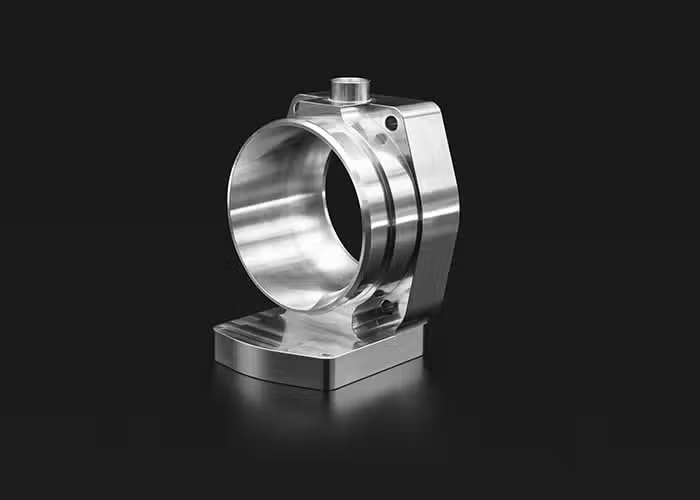
Stainless steel alloys have high strength, ductility, wear and corrosion resistance. They can be easily welded, machined and polished. The hardness and the cost of stainless steel is higher than that of aluminum alloy.

Titanium is an advanced material with excellent corrosion resistance, biocompatibility, and strength-to-weight characteristics. This unique range of properties makes it an ideal choice for many of the engineering challenges faced by the medical, energy, chemical processing, and aerospace industries.

Steel is a strong, versatile, and durable alloy of iron and carbon. Steel is strong and durable. High tensile strength, corrosion resistance heat and fire resistance, easily molded and formed. Its applications range from construction materials and structural components to automotive and aerospace components.

Highly resistant to seawater corrosion. The material’s mechanical properties are inferior to many other machinable metals, making it best for low-stress components produced by CNC machining.

Few metals have the electric conductivity that copper has when it comes to CNC milling materials. The material’s high corrosion resistance aids in preventing rust, and its thermal conductivity features facilitate CNC machining shaping.

Brass is mechanically stronger and lower-friction metal properties make CNC machining brass ideal for mechanical applications that also require corrosion resistance such as those encountered in the marine industry.

Zinc is a slightly brittle metal at room temperature and has a shiny-greyish appearance when oxidation is removed.

Iron is an indispensable metal in the industrial sector. Iron is alloyed with a small amount of carbon – steel, which is not easily demagnetized after magnetization and is an excellent hard magnetic material, as well as an important industrial material, and is also used as the main raw material for artificial magnetism.
Due to the low mechanical strength of pure magnesium, magnesium alloys are mainly used. Magnesium alloy has low density but high strength and good rigidity. Good toughness and strong shock absorption. Low heat capacity, fast solidification speed, and good die-casting performance.
FAQs: Precision Bearings for Robotics Applications
These precision components need to maintain raceway roundness to within 0.0001 inches so that loads can be uniformly distributed to all rolling elements. This will help prevent premature fatigue. Furthermore, raceway surface finish must be lower than 8 Ra microinches to minimize friction, thus extending bearings lifetime. Bores and outer diameters must be of ABEC 7 precision or better (outer diameters) to achieve proper shaft and housing fits. Controlled raceway geometry provides designed contact angles and optimal load capacity. Materials exceeding 58 HRC raceway hardness are required for wear resistance under Hertzian contact stress exceeding 200,000 PSI. Sufficient dimensional stability will maintain the required tolerances through minus 20 to plus 100 degrees Celsius temperature ranges in robotic operating environments, making it possible to sustain the dynamic stability of the component.
M2 high-speed steel and D2 air-hardening steel are custom bearing tool steels due to their extreme temperature stability, wear resistance in high abrasive environments, and complex geometry heat treatment stability. They are also available in smaller quantities for prototypes. Lightweight bearing housings and retainers made from aluminum alloy 7075-T6 decrease rotational inertia in high-speed applications. It also has excellent thermal conductivity for heat dissipation, superior machinability for complex integrated features, and adequate strength for non-raceway bearing components. It is also economically produced for collaborative robots and positioning systems, where improved dynamic performance is realized through weight reduction.
Having through-hardened raceways that achieve 60 to 62 HRC hardness provides wear resistance for predicted L10 bearing lives exceeding 20,000 hours under rated loads, as compared to 2,000 hours for inadequately hardened races. This is because the dimension consistency enables predictable bearing performance. A friction torque variation of under 20 percent between friction torque units allows the accurate control of robot motion without the need for individual calibration. A minimum radial runout of under 0.0001 inches provides a mechanical means of preventing the transmission of vibrations to delicate sensors and end-effectors, thus, maintaining positional accuracy. Technological advancements in heat treatment and stress relief minimize ongoing modifications to the mean dimensions of a workpiece, thus, maintaining tolerances through temperature cycling and extended service. Quality surface treatments protect against corrosion during storage and operation.
Contamination that causes 80 percent of premature bearing failures is prevented with clean manufacturing. Maintaining the bearing components that are machined with precision creates the rotational foundation for robotic systems that achieve angular positioning accuracy with minimal friction and backlash of ±0.005 degrees. They enable smooth motion profiles with no stick-slip or cogging and constant velocity for applications such as welding and dispensing that require highly variable total velocity of 1 percent or less. They also support high rotational speeds of over 10,000 RPM for spindle applications where the DN value is over 1 million, support moment loads for cantilevered robot wrist and elbow loads, and support thermal stability with performance from -20 to 100 degrees Celsius. They provide a long service life of over 20,000 hours with maintenance intervals of 5,000 to 10,000 hours and predictable reliability that facilitates the productive automation of several industries for automotive spot welding, electronics assembly, semiconductor wafer handling, medical robotics, and high-speed packaging.