We have moved to a new Website Check Now

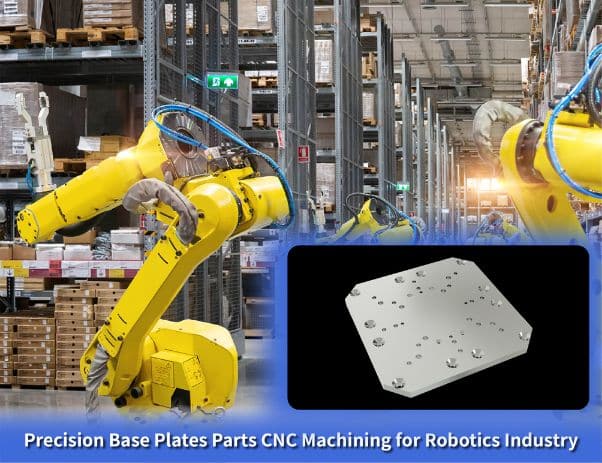
Precision Base Plates Parts CNC Machining for Robotics Industry

Robotics base plates are foundational mounting platforms that provide rigid support and precise positioning for robotic arms, actuators, and control systems. At Zintilon, we specialize in CNC machining of robotics base plates using advanced 3-axis and 5-axis machining to achieve exceptional flatness, mounting hole accuracy, and structural stability.
  • Complex base plates machining.
  • Tight tolerances up to ±0.001 in
  • Precision milling, drilling and flatness grinding.
  • Full-scale production and rapid prototyping.
  • Manufacturing of robotics with ISO 9001.

Trusted by 15,000+ businesses

Why Robotics Companies
Choose Zintilon

prductivity

Increased Productivity

Engineers get time back by not dealing with immature supply chains or lack of supply chain staffing in their company and get parts fast.

10x

10x Tighter Tolerances

Zintilon can machine parts with tolerances as tight as+/ - 0.0001 in -10x greater precision compared to other leading services.

world

World Class Quality

Zintilon provides medical parts for leading aerospace enterprises, verified to be compliant with ISO9001 quality standard by a certified registrar.

From Prototyping to Mass Production

Zintilon offers CNC machining services on robotics base plates and associated mounting components on industrial automation, collaborative robots, research robotics projects.

Prototype Base Plates

Get accurate prototypes of robotics base plates that will be a close replica of your final design. Test mounting schemes, check the flatness requirements and proper load distribution prior to full scale production.


Key Points:

  • High precision rapid prototyping..

  • Tight tolerances (±0.001 in)

  • Early design, material and stability of tests.

3 Axis CNC Machined Stainless Steel Passivation

EVT – Engineering Validation Test

The base plate prototypes must be repeated and checked within a few moments to make sure that they are satisfying the requirements of the structure and positioning. Detecting possible problems in time to make full-scale robotics manufacturing easier.


Key Points:

  • Check prototype functionality.

  • Rapid design iterations

  • Make sure that it is ready to be produced.

Anodized Aluminum 1024x536

DVT – Design Validation Test

The structural integrity and functionality of base plates can be verified with different materials and surface treatments to verify that the design is correct and the vibration dampening is highest possible before mass production.


Key Points:

  • Establish design integrity, design flatness.

  • Test a variety of materials and finish.

  • Enhance performance readiness.

design aluminium

PVT – Production Validation Test

Confirm large scale production of base plates and determine possible difficulties of production to prevent inconsistency and waste even at the start of the complete production.


Key Points:

  • Test high scale production capacity.

  • Identify and resolve process problems at an early stage.

  • Maintain uniform quality of parts.

finishes

Mass Production

Manufacture high-end, full-scale base plates with high quality and speed with consistent robotic placement and on-time delivery to automation integrators and robotics companies.


Key Points:

  • Continuous production with large volumes.

  • Industrial grade precision machining.

  • Quick response and quality control.

production

Simplified Sourcing for
the Base Industry

Our robotics industry parts manufacturing capabilities have been verified by many listed companies. We provide a variety of manufacturing processes and surface treatments for robotics parts including titanium alloys and aluminum alloys.

Explore Robotics Components

Discover our full range of precision CNC machined robotics components, designed for strength, stability, and seamless motion. Explore parts for robotic arms, joints, actuators, frames, and end effectors, all crafted to ensure high accuracy, repeatability, and performance in modern automation and robotics systems.

Robotics Base Plates Machining Capabilities

Precision Base Plates Parts CNC Machining of Robotics Industry is provided using our best 3-axis and 5-axis CNC machining centers and highly skilled precision machinists. Starting with small jointing bases and large mounting platforms of industrial robots with built-in cable management, all parts are designed with maximum rigidity, accurate datum surfaces, and repeatability with respect to position.

We offer accuracy CNC milling, surface grinding, coordinate hole drilling, and T-slot machining of ideal component mounting and flexibility, flatness measurement and stress relief services. The base plates are machined using aluminum tooling plate (ATP-5, MIC -6), cast iron (Class 40), steel plate (A36, 1018) or granite composite materials, which provide the highest level of dimensional stability and vibration damping when subjected to dynamic robotic loads and constant use.
milling

CNC Machining

sheet metal

Sheet Metal Fabrication

edm

Wire EDM

Aerospace
Materials & Finishes

Materials
We provide a wide range of materials, including metals, plastics, and composites.
Finishes
We offer superior surface finishes that enhance part durability and aesthetics for applications requiring smooth or textured surfaces.

Specialist Industries

you are welcome to emphasize it in the drawings or communicate with the sales.

Materials for Precision Base Plates Components

Bases Plates Parts Machining, CNC machine shop has a wide selection of materials. Our materials with 50+ industrial grade metals and composite materials can support quick prototyping and mounting platform with heavy-weight demands with a consistent and industrial-level precision and quality standards.
Aluminum Image

High machinability and ductility. Aluminum alloys have good strength-to-weight ratio, high thermal and electrical conductivity, low density and natural corrosion resistance.
Price
$ $ $
Lead Time
< 7 days
Tolerances
Down to ±0.003 mm
Max part size
3000*2200*1100 mm
Min part size
2*2*2 mm
Stainless steel Image

Stainless steel alloys have high strength, ductility, wear and corrosion resistance. They can be easily welded, machined and polished. The hardness and the cost of stainless steel is higher than that of aluminum alloy.

Price
$ $ $
Lead Time
< 7 days
Tolerances
Down to ±0.005 mm
Max part size
3000*2200*1100 mm
Min part size
2*2*2 mm
Titanium Image

Titanium is an advanced material with excellent corrosion resistance, biocompatibility, and strength-to-weight characteristics. This unique range of properties makes it an ideal choice for many of the engineering challenges faced by the medical, energy, chemical processing, and aerospace industries.

Price
$$$
Lead Time
< 10 days
Tolerances
Down to ±0.005 mm
Max part size
3000*2200*1100 mm
Min part size
2*2*2 mm
Steel Image

Steel is a strong, versatile, and durable alloy of iron and carbon. Steel is strong and durable. High tensile strength, corrosion resistance heat and fire resistance, easily molded and formed. Its applications range from construction materials and structural components to automotive and aerospace components.

Price
$ $ $ $ $
Lead Time
< 10 days
Tolerances
Down to ±0.001 mm (routing)
Max part size
3000*2200*1100 mm
Min part size
2*2*2 mm
Bronze Image

Highly resistant to seawater corrosion. The material’s mechanical properties are inferior to many other machinable metals, making it best for low-stress components produced by CNC machining.

Price
$ $ $ $ $
Lead Time
< 10 days
Tolerances
Down to ±0.005 mm
Max part size
3000*2200*1100 mm
Min part size
2*2*2 mm
Copper Image

Few metals have the electric conductivity that copper has when it comes to CNC milling materials. The material’s high corrosion resistance aids in preventing rust, and its thermal conductivity features facilitate CNC machining shaping.

Price
$$$
Lead Time
< 10 days
Tolerances
Down to ±0.005 mm
Max part size
3000*2200*1100 mm
Min part size
2*2*2 mm
Brass Image

Brass is mechanically stronger and lower-friction metal properties make CNC machining brass ideal for mechanical applications that also require corrosion resistance such as those encountered in the marine industry.

Price
$$$
Lead Time
< 10 days
Tolerances
Down to ±0.005mm
Max part size
3000*2200*1100 mm
Min part size
2*2*2 mm
Zinc Image

Zinc is a slightly brittle metal at room temperature and has a shiny-greyish appearance when oxidation is removed.

Price
$ $ $ $ $
Lead Time
< 10 days
Tolerances
Down to ±0.005 mm
Max part size
3000*2200*1100 mm
Min part size
2*2*2 mm
Iron Image

Iron is an indispensable metal in the industrial sector. Iron is alloyed with a small amount of carbon – steel, which is not easily demagnetized after magnetization and is an excellent hard magnetic material, as well as an important industrial material, and is also used as the main raw material for artificial magnetism.
Price
$ $ $ $ $
Lead Time
< 10 days
Tolerances
Down to ±0.005 mm
Max part size
3000*2200*1100 mm
Min part size
2*2*2 mm
Magnesium Image

Due to the low mechanical strength of pure magnesium, magnesium alloys are mainly used. Magnesium alloy has low density but high strength and good rigidity. Good toughness and strong shock absorption. Low heat capacity, fast solidification speed, and good die-casting performance.

Price
$ $ $ $
Lead Time
< 7 days
Tolerances
Down to ±0.005 mm
Max part size
3000*2200*1100 mm
Min part size
2*2*2 mm
Let’s Build Something Great, Together

FAQs: High-Accuracy Joints for Robotics Applications

Base plates are precision-machined mounting platforms that serve as the foundation for robotic systems. Think of them as the "anchor point" that keeps your robot stable and accurately positioned. These components include robot mounting bases, tool changer plates, rotary table bases, gantry system bases, workstation bases, mobile robot chassis plates, and modular base plates with standardized hole patterns for flexible reconfiguration.
Quality base plates require flatness typically from 0.001" to 0.005" across the entire surface, precision hole placement for repeatable positioning, sufficient rigidity to prevent deflection under loads, vibration dampening for high-speed consistency, and thermal stability to prevent dimensional changes with temperature fluctuations.

Each material offers unique advantages for different applications. Aluminum tooling plates like ATP-5 and MIC-6 are best for collaborative robots and light-duty applications up to 100 kg payload. They provide pre-stressed dimensional stability, excellent machinability, lightweight construction, superior thermal conductivity, natural corrosion resistance, and cost-effective performance.
Cast iron Class 40 is ideal for heavy industrial robots over 500 kg payload, offering superior vibration dampening, excellent dimensional stability with low thermal expansion, good wear resistance, high compressive strength, and proven reliability in high-precision applications.
Steel plates including A36 structural and 1018 mild steel provide maximum rigidity for extreme loads, excellent weldability for custom fabrication, economical pricing for large bases, and perform best when stress-relieved and precision machined.
Granite composite materials excel in metrology and harsh environments with ultimate thermal stability, better vibration damping than cast iron, decades of flatness retention, non-magnetic properties, and corrosion resistance in cleanrooms and chemical processing areas.
Our precision machining uses advanced CNC techniques including face milling and fly cutting to create flat mounting surfaces within 0.001" flatness. Precision surface grinding achieves reference surfaces flat to within 0.0005" for critical applications. Coordinate drilling and boring produce mounting hole patterns with positional accuracy within 0.0005". T-slot milling creates modular mounting systems for flexible fixturing. Additional operations include pocket milling for weight reduction, counterboring for flush mounting, and thread tapping with helicoil installation for durable connections.

We deliver industry-leading precision with standard tolerances of ±0.001" on overall dimensions and mounting hole locations. For critical robot tool center point (TCP) accuracy, we achieve ±0.0005" tolerance. Surface flatness ranges from 0.001" to 0.005" depending on size and application. Perpendicularity of mounting surfaces is held within 0.002" per foot, and parallelism between opposing surfaces within 0.001". All tolerances are verified through comprehensive CMM inspection and laser scanning with full documentation.

Yes, our flexible manufacturing accommodates any project scale. We provide rapid prototyping with quick turnaround for robot cell designs and proof-of-concept verification. Low volume production serves custom automation systems, research laboratories, and specialized applications. High volume production supports robot manufacturers and system integrators with standardized work cells. Every project receives full dimensional inspection with CMM verification, laser scanning for flatness validation, and complete material certification documentation.

Absolutely. Our manufacturing operates under ISO 9001 certified quality management systems with full compliance to industrial robotics requirements and complete traceability documentation. We serve automotive manufacturing, electronics assembly, aerospace fabrication, and medical device production where robot positioning accuracy directly impacts product quality. Our rigorous quality standards cover every stage from material selection through final inspection and packaging.

We offer comprehensive finishing solutions including precision surface grinding for flatness better than 0.0005", hard anodizing for aluminum to increase surface hardness and wear resistance, black oxide coating for steel to provide corrosion resistance and minimize glare in vision systems, powder coating in safety yellow or custom colors for visual identification and additional protection, precision lapping for ultra-flat mounting surfaces, and threaded inserts including tapped holes and helicoil inserts for reliable thread engagement through multiple reconfigurations.

Yes. Our large-capacity CNC machining centers can accommodate and machine substantial single-piece base plates up to 2 meters in length and width for heavy-duty industrial robots and gantry systems. This eliminates joints that could compromise flatness and rigidity while simplifying installation. For extremely large robot cells or modular systems, we can also produce precision multi-piece bases with dowel pin alignment systems and precision-machined mating surfaces that maintain overall flatness and position accuracy when assembled on-site.

Precision CNC manufacturing delivers measurable performance advantages across multiple areas. Accurate mounting hole locations ensure robots are positioned exactly where programmed, maintaining tool center point (TCP) accuracy within ±0.05 millimeters for precision assembly and welding operations. Flat mounting surfaces provide uniform contact and load distribution, preventing base deflection that would cause positional drift and reduce repeatability during high-speed pick-and-place cycles. Precise perpendicularity between mounting surfaces ensures robots are installed level and square, eliminating kinematic errors that compound through the robot's kinematic chain affecting end-effector positioning. Proper T-slot dimensions and spacing enable flexible work cell reconfiguration with modular fixturing, allowing quick changeover for different production runs without sacrificing positioning accuracy. Strategic weight reduction through pocket milling reduces overall system mass for mobile robots and ceiling-mounted applications while maintaining required stiffness to prevent vibration amplification. Stress-relieved materials prevent long-term warping and dimensional drift that would require periodic recalibration and teaching of robot positions. Precision-machined datum surfaces and reference holes provide known coordinates for measurement and alignment procedures, simplifying robot installation and calibration. Adequate rigidity and vibration dampening maintain positioning accuracy during rapid accelerations and decelerations, enabling faster cycle times without sacrificing precision. Proper surface treatment protects against corrosion and wear at mounting points, maintaining dimensional integrity through years of operation including hundreds of thousands of robot cycles, while consistent manufacturing quality ensures multiple robots in a production line operate with identical kinematic reference frames, simplifying programming and enabling program portability across work cells, ultimately delivering the foundation for precision automation that meets quality standards in industries demanding position repeatability better than ±0.02 millimeters including electronics assembly, automotive body welding, aerospace drilling and riveting, and medical device manufacturing.
Got any more questions?