We have moved to a new Website Check Now

Wind Turbine Hubs CNC Machining for Wind Energy

Wind turbine hubs are precisely machined structural components connecting rotor blades to the main shaft. They transfers aerodynamic loads and controls pitch of the blades of horizontal-axis wind turbines. At Zintilon we CNC machine wind turbine hubs and advanced finishing capabilities paired with intensive machining of cast components and welding optimizes fatigue strength, dimensional precision, and corrosion resilience for 20 dependable years in onshore and offshore wind installations.
  • Machining for complex hub geometries and blade mounting interfaces
  • Tight tolerances up to ±0.020 in
  • Precision boring, milling & fatigue-resistant finishing
  • Support for rapid prototyping and full-scale production
  • ISO 9001-certified wind energy manufacturing


Trusted by 15,000+ businesses

Why New Energy Companies
Choose Zintilon

prductivity

Increased Productivity

Engineers get time back by not dealing with immature supply chains or lack of supply chain staffing in their company and get parts fast.

10x

10x Tighter Tolerances

Zintilon can machine parts with tolerances as tight as+/ - 0.0001 in -10x greater precision compared to other leading services.

world

World Class Quality

Zintilon provides aerospace parts for leading aerospace enterprises, verified to be compliant with ISO9001 quality standard by a certified registrar. Also, our network includes AS9100 certified manufacturing partners, as needed.

From Prototyping to Mass Production

Zintilon supplies CNC machining for wind turbine hubs along with integrated drivetrain components to turbine manufacturers, blade suppliers, and renewable energy developers globally.

Prototype

Get accurate, high-precision prototypes of turbine hubs to run tests based on your finished design. Examine load distribution, check blade interface alignment, and verify structural integrity before you invest in full-scale production
Key Points:
Rapid prototyping with high precision
Tight tolerances (±0.020 in)
Test design, fatigue resistance, and load capacity early
3 Axis CNC Machined Stainless Steel Passivation

EVT

Turbine hub prototype iterations must meet structural and fatigue requirements. Identify potential problems early to allow a smooth transition to full-scale manufacturing of wind energy.
Key Points:
Validate prototype functionality
Rapid design iterations
Ensure readiness for production
Anodized Aluminum 1024x536

DVT

Test turbine hubs with different materials for structural performance to validate design accuracy and load transfer for mass production.
Key Points:
Confirm design integrity and fatigue life
Test multiple materials and configurations
Ensure production-ready performance
design aluminium

PVT

Test the feasibility of large-scale production of wind turbine hubs and find potential manufacturing problems to fix before starting full production. This improves the consistency and efficiency of production streams.
Key Points:
Test large-scale production capability
Detect and fix process issues early
Ensure consistent part quality
Anodized Titanium Fastener

Mass Production

Produce high-quality, fatigue-tested wind turbine hubs at scale with precision and speed, ensuring reliable power generation and on-time delivery for wind turbine manufacturers and wind farm developers.
Key Points:
Consistent, high-volume production
Precision machining for structural integrity
Fast turnaround with strict quality control
production

Simplified Sourcing for
the New Energy Industry

Our aviation industry parts manufacturing capabilities have been verified by many listed companies. We provide a variety of manufacturing processes and surface treatments for aerospace parts including titanium alloys and aluminum alloys.

Explore Other New Energy Components

Browse our complete selection of CNC machined components for new energy applications, crafted for precision and long-term reliability. From turbine housings and mounting brackets to battery enclosures and thermal management components, we deliver solutions tailored to the evolving needs of renewable energy and clean technology industries.

Wind Energy Turbine Hubs Machining Capabilities

Our advanced large-format CNC machining centers, non-destructive testing facilities, and experienced wind energy machinists provide first-rate Wind Turbine Hubs CNC Machining for Wind Energy. Fixed-pitch hubs, variable-pitch hydraulic hubs, and direct-drive designs with critical bearing and blade mounting surfaces are all engineered for optimal load distribution, fatigue resistance, and ease of maintenance. In addition to marked blade alignment and corrosion shutoff, we perform ultrasonic testing and dimensional verification. Every wind turbine hub ductile iron (65-45-12, 80-55-06), cast steel (GS-52), forged steel (42CrMo4), and welded steel fabrications were machined. This provides outstanding wind installation strength and resistance to fatigue failure across many load cycles.
milling

CNC Machining

sheet metal

Sheet Metal Fabrication

edm

Wire EDM

Aerospace
Materials & Finishes

Materials
We provide a wide range of materials, including metals, plastics, and composites.
Finishes
We offer superior surface finishes that enhance part durability and aesthetics for applications requiring smooth or textured surfaces.

Specialist Industries

you are welcome to emphasize it in the drawings or communicate with the sales.
Let’s Build Something Great, Together

FAQs: Wind Turbine Hubs for Wind Energy Applications

Yes, all components are built and handled under the ISO 9001 quality management system and each part of the wind turbine has complete material traceability along with the dimensions that are verified against the design and are non-destructively tested. Standards within the wind energy sector are met such as IEC 61400-1 turbine design requirements, DNV-GL certified wind turbine components, ISO 12944 and EN 1563 on the corrosion protection systems and ductile iron castings and structural integrity under blade load and fatigue life of above 20 years and 10^8 load cycles and environmental endurance of -30 to +40°C within and outside the turbine.

Yes. We offer flexible manufacturing capabilities including:
Rapid prototyping for design validation
Low-volume production for specialized applications
High-volume production with consistent quality control
Full structural and dimensional verification at every stage
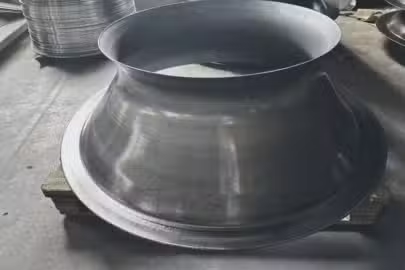
As for the hubs, we obtain the main shaft bore within ±0.020 inches because it’s critical for bearing clearance. The blade mounting surface flatness allowance is 0.030 inches across the 1 to 3 meter bolt circles for even load distribution. The bolt hole positions are within ±0.015 inches for alignment of the blade root flanges. The pitch bearing seat diameter is ±0.025 inches for bearing fit. We achieved shaft bore and blade mounting faces to ±0.040 inches perpendicularity. And the overall hubs, being large castings of over 2 meters, we attained ±0.050 inches tolerances.

CNC machining hubs are large-format centers with a horizontal spindle up to 5 meters in diameter which machine the bodies. Precision boring achieves the main shaft bore with a diameter of 300 to 800 mm which fits bearings with a tolerance of ± 0.020 inches. Face milling creates flat surfaces that are flat to within 0.030 inches across the 1 to 3 meter diameter bolt circle. The coordinates are drilled to produce the blade bolt patterns with a positional accuracy of ± 0.015 inches for holes M30 to M64. The threads are milled to pitch for bearing mounting. The fabricated hub sections are welded together, the welds being full penetration and the seams inspected by ultrasonic testing. The seams are shot-peened for the fatigue resistance of the hub and protective coating pharmaceuticals are applied for an overall dry film 500 microns thick.

Ductile iron grades 65-45-12 and 80-55-06 have excellent fatigue strength and yield strengths 310 to 380 MPa, allowing them to support bending moments on blade root for mid-size turbines 1.5 to 3 megawatts, have superior castability for complex geometry, including internal pitch bearing cavities, good machining, dampening vibration and reducing drivetrain loads, and are inexpensive. For ductile cast GS-52 steel, it has 350 MPa tensile strength cast steel which correlates to more compact designs, great weldability for integrated parts, and reliability of the structures. The 42CrMo4 forged steel has maximal strength through grain refinement, the fatigue life exceeds 10^8 load cycles and is used for offshore turbines that are 8 megawatts or more. For prototype and small-series fabrications, welded steel has the advantages of flexibility of the design, lower lead time, and lower costs.

Wind turbine hubs are structural components that connect 2 or 3 rotor blades to the main shaft which transmits aerodynamic torque that can range between 100 kilonewton-meters for small turbines to 10,000 kilonewton-meters for 10+ megawatt offshore turbines. Different types include fixed-pitch hubs which are stall-regulated turbines that have blades with permanent angles, variable-pitch hubs with hydraulic or electric motors that allow blades to be adjusted between minus 5 to plus 90 degrees for power adjustment and emergency braking, teetering hubs that allow to oscillate the rotor and lessen fatigue loads on two-blade turbines, and direct-drive hubs which specialize in gearless designs that house the generator to the rotor, modular hubs that allow blade replacement without nacelle access and offshore hubs which have improved corrosion resistance for marine environments.
Got any more questions?