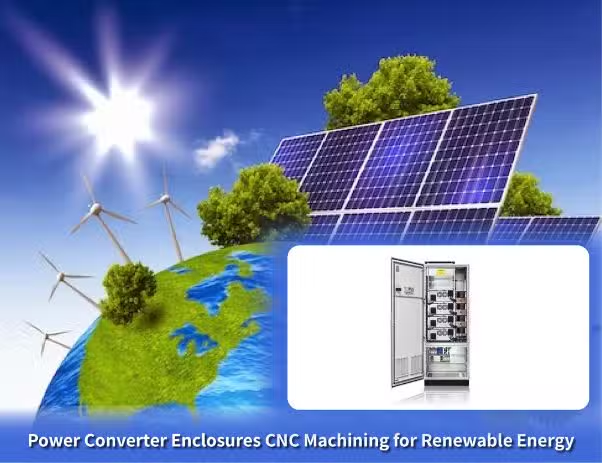
Power Converter Enclosures CNC Machining for Renewable Energy
- Machining for complex enclosure geometries and ventilation systems
- Tight tolerances up to ±0.010 in
- Precision bending, welding & weather-resistant finishing
- Support for rapid prototyping and full-scale production
- ISO 9001-certified renewable energy equipment manufacturing
Why New Energy Companies
Choose Zintilon

Fast Delivery
A professional engineering team that can respond quickly to customer needs and provide one-stop services from design to production in a short period of time to ensure fast delivery.

High Precision
We are equipped with automated equipment and sophisticated measuring tools to achieve high accuracy and consistency, ensuring that every part meets the most stringent quality standards.

ISO13485 Certified
As a ISO13485 certified precision manufacturer, our products and services have met the most stringent quality standards in the automotive industry.
From Prototyping to Mass Production


Prototype Power Converter Enclosures
Key Points:
- Rapid prototyping with high precision
- Tight tolerances (±0.010 in)
- Test design, IP rating, and thermal management early

EVT – Engineering Validation Test
Key Points:
- Validate prototype functionality
- Rapid design iterations
- Ensure readiness for production

DVT – Design Validation Test
Key Points:
- Confirm design integrity and IP rating
- Test multiple materials and configurations
- Ensure production-ready performance

PVT – Production Validation Test
Key Points:
- Test large-scale production capability
- Detect and fix process issues early
- Ensure consistent part quality

Mass Production
Key Points:
- Consistent, high-volume production
- Precision machining for outdoor durability
- Fast turnaround with strict quality control

Simplified Sourcing for
the New Energy Industry
Explore Other New Energy Components
Browse our complete selection of CNC machined components for new energy applications, crafted for precision and long-term reliability. From turbine housings and mounting brackets to battery enclosures and thermal management components, we deliver solutions tailored to the evolving needs of renewable energy and clean technology industries.
Renewable Energy Power Converter Enclosures Machining Capabilities
To achieve permanent weather tightness and durability, we execute precision laser cutting, CNC bending, MIG and TIG welding along with powder coating, and we also perform IP rating testing and thermal rating of the system. All power converter enclosures are composed of weather-resistant aluminum sheet (5052, 6061), stainless steel (304, 316), galvanized steel, and powder-coated carbon steel to withstand corrosion and to maintain integrity in structure for decades while exposed to harsh outdoor renewable energy environments.


Aerospace
Materials & Finishes


Specialist Industries



Materials for Power Converter Enclosures

High machinability and ductility. Aluminum alloys have good strength-to-weight ratio, high thermal and electrical conductivity, low density and natural corrosion resistance.
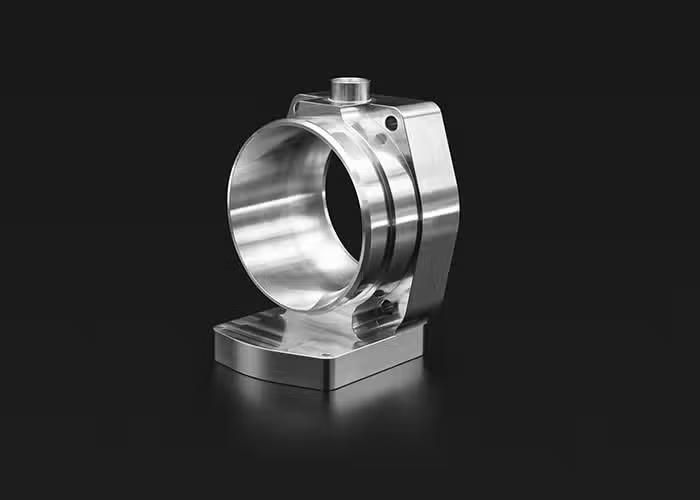
Stainless steel alloys have high strength, ductility, wear and corrosion resistance. They can be easily welded, machined and polished. The hardness and the cost of stainless steel is higher than that of aluminum alloy.

Steel is a strong, versatile, and durable alloy of iron and carbon. Steel is strong and durable. High tensile strength, corrosion resistance heat and fire resistance, easily molded and formed. Its applications range from construction materials and structural components to automotive and aerospace components.

Titanium is an advanced material with excellent corrosion resistance, biocompatibility, and strength-to-weight characteristics. This unique range of properties makes it an ideal choice for many of the engineering challenges faced by the medical, energy, chemical processing, and aerospace industries.

Highly resistant to seawater corrosion. The material’s mechanical properties are inferior to many other machinable metals, making it best for low-stress components produced by CNC machining.

Brass is mechanically stronger and lower-friction metal properties make CNC machining brass ideal for mechanical applications that also require corrosion resistance such as those encountered in the marine industry.

Few metals have the electric conductivity that copper has when it comes to CNC milling materials. The material’s high corrosion resistance aids in preventing rust, and its thermal conductivity features facilitate CNC machining shaping.

Zinc is a slightly brittle metal at room temperature and has a shiny-greyish appearance when oxidation is removed.

Iron is an indispensable metal in the industrial sector. Iron is alloyed with a small amount of carbon – steel, which is not easily demagnetized after magnetization and is an excellent hard magnetic material, as well as an important industrial material, and is also used as the main raw material for artificial magnetism.
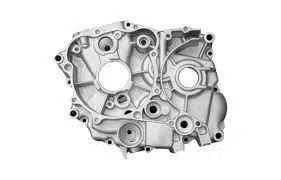
Due to the low mechanical strength of pure magnesium, magnesium alloys are mainly used. Magnesium alloy has low density but high strength and good rigidity. Good toughness and strong shock absorption. Low heat capacity, fast solidification speed, and good die-casting performance.
FAQs: Power Converter Enclosures for Renewable Energy Applications
Anodizing (Type II and Type III)
Passivation for corrosion resistance
Precision polishing for aerodynamic surfaces
Custom protective coatings and thermal barriers
Quality manufacturing ensures dependable safeguarding of equipment used in renewable energy installations with environmental protection in IP54 through IP66 ratings, with thermal management maintaining electronics below 50°C operating temperature, with electromagnetic shielding preventing interference with conflicting communication systems, and with a service life exceeding 25 years in residential solar, commercial solar, utility-scale solar farms, onshore and offshore wind turbines, and battery energy storage systems.