We have moved to a new Website Check Now

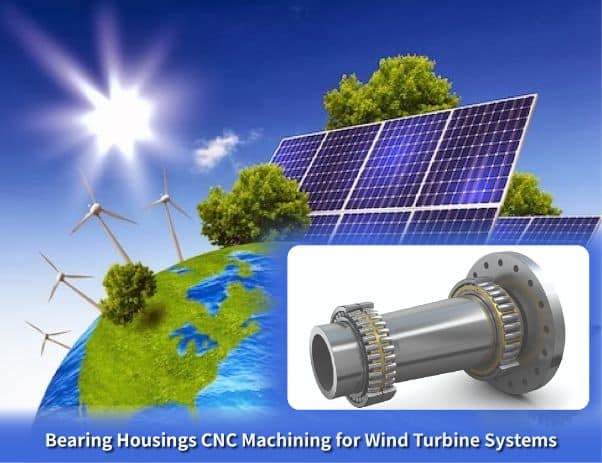
Bearing Housings CNC Machining for Wind Turbine Systems

Bearing housings for wind turbines are shield-structured and precisely machined and they provide support for and position the main shaft bearings, generator bearings, and gearbox bearings while transferring loads to the nacelle bedplate of horizontal-axis wind turbines. Zintilon specializes CNC machining on bearing housings. By utilizing advanced stress relief, casting finishing techniques, and machining for exceptional integrity and reliability of sealing, we provide the bearing housings with the promised 20 years of on and offshore wind installation fatigue resistance and sealing integrity.
  • Machining for complex housing geometries and bearing seat interfaces
  • Tight tolerances up to ±0.015 in
  • Precision boring, face milling & protective coating
  • Support for rapid prototyping and full-scale production
  • ISO 9001-certified wind turbine manufacturing

Trusted by 15,000+ businesses

Why New Energy Companies
Choose Zintilon

prductivity

Increased Productivity

Engineers get time back by not dealing with immature supply chains or lack of supply chain staffing in their company and get parts fast.

10x

10x Tighter Tolerances

Zintilon can machine parts with tolerances as tight as+/ - 0.0001 in -10x greater precision compared to other leading services.

world

World Class Quality

Zintilon provides aerospace parts for leading aerospace enterprises, verified to be compliant with ISO9001 quality standard by a certified registrar. Also, our network includes AS9100 certified manufacturing partners, as needed.

From Prototyping to Mass Production

Zintilon is a world-wide CNC Machining Supplier in Wind Turbine Based Bearing Housings. He works with turbine manufacturers, gearbox suppliers, and wind energy developers.

Prototype

Get prototypes of bearing housings made to high precision that match your design exactly. You can test bearing fit, ensure load paths, and check dimensional stability prior to full-scale production.
Key Points:
Rapid prototyping with high precision
Tight tolerances (±0.015 in)
Test design, bearing alignment, and structural integrity early
3 Axis CNC Machined Stainless Steel Passivation

EVT

Bear in mind structural and alignment requirements as you iterate prototypes of bearing housings for the wind turbine. You can identify issues that hinder scalability early in the design phase.
Key Points:
Validate prototype functionality
Rapid design iterations
Ensure readiness for production
Anodized Aluminum 1024x536

DVT

Validate performance and bearing fit of bearing housings to refine your design for optimal load bearing prior to mass production.
Key Points:
Confirm design integrity and bearing fit
Test multiple materials and configurations
Ensure production-ready performance
design aluminium

PVT

Assess the production readiness of bearing housings to find design and production control issues and production regulatory issues to ensure consistency prior to full production.
Key Points:
Test large-scale production capability
Detect and fix process issues early
Ensure consistent part quality
Anodized Titanium Fastener

Mass Production

Wind delivers bearing housings that are dimensionally stable, high quality, and produced on large-scale production lines with great precision and velocity for timely and reliable operation of the drivetrain, meeting the delivery windows of wind turbine manufacturers and component suppliers.
Key Points:
Consistent, high-volume production
Precision machining for drivetrain reliability
Fast turnaround with strict quality control
production

Simplified Sourcing for
the New Energy Industry

Our aviation industry parts manufacturing capabilities have been verified by many listed companies. We provide a variety of manufacturing processes and surface treatments for aerospace parts including titanium alloys and aluminum alloys.

Explore Other New Energy Components

Browse our complete selection of CNC machined components for new energy applications, crafted for precision and long-term reliability. From turbine housings and mounting brackets to battery enclosures and thermal management components, we deliver solutions tailored to the evolving needs of renewable energy and clean technology industries.

Wind Turbine Bearing Housings Machining Capabilities

Bearing Housings CNC Machining for Wind Turbine Systems is done by our large format CNC machining hubs coupled with wind energy machinists and allocentric coordination controlling devices. Each component, from the main bearing housings to generator support structures and bolts, incorporating gearbox mounting frames with critical bearing seat surfaces, is designed for optimal load transfer, bearing alignment, vibration reduction, and bearing seats. Wind turbine bearing housings are machined to accommodate and protect the bearing with a corrosion-resistant coating that preserves the environment, and with dimensional verification, stress-relief heat treatment, and large-bore machining, face milling, and seal groove machining are all completed. Each wind turbine bearing housing with the wrought spheroidal graphite iron (SG iron), ductile iron (65-45-12, 80-55-06), cast steel (GS-52), welded steel fabrications, or spheroidal graphite iron (SG iron), cast steel (GS-52), or spheroidal graphite, and is machined to ensure high rigidity and great fatigue strength for the operation in wind installations.
milling

CNC Machining

sheet metal

Sheet Metal Fabrication

edm

Wire EDM

Aerospace
Materials & Finishes

Materials
We provide a wide range of materials, including metals, plastics, and composites.
Finishes
We offer superior surface finishes that enhance part durability and aesthetics for applications requiring smooth or textured surfaces.

Specialist Industries

you are welcome to emphasize it in the drawings or communicate with the sales.
Let’s Build Something Great, Together

FAQs: Bearing Housings for Wind Turbine Applications

Lead time is dependent on the degree of complexity and volume of the order. Including machining, surface treatment, and inspection, the typical lead time for standard bearing block housings of lower complexity is 8–14 business days. For complete manufacturing, including applicable casting lead time, the lead time for more complex split housings containing multiple finger bores and engineered integrated split housings is 3–5 weeks. For design verification and bearing fit testing, prototype housings machined from billet aluminum or steel can be done in 5 to 8 days. Volume orders are processed in machining cells with fixture design that reduce cycle time. Reduction in cycle time is attained by the detailed production schedule provided as part of the quotation, which Includes procurement of materials, machining operations, surface treatment, and quality verification.

Options include anodizing on aluminum for the protection against corrosion, powder coating for environmental protection in custom colors where corrosion resistance exceeds 1000 hours in salt spray tests, zinc plating on steel for rust resistance, black oxide coating on steel for non-reflective surfaces in vision applications, bead blasting for uniform matte texture, and chromate conversion coating for electrical conductivity, while for precision grinding ultra-flat mounting surfaces are made with flatness made 0.003 inches.

Yes, all parts are produced under ISO 9001 certified quality management systems. We adhere to standards pertaining to industrial robotics as well as customized dimensional and material stipulations including surface finish, and structural integrity, covering tolerances, and surface finish of bearing housers, bearing manufacturer installation directives, and complete traceability and documentation for raw materials, quality audits, and continuous improvement for bearing support components, all of which prevent faulty housing designs and machining that can lead to premature failure of the bearing, malfunction of the robot, or downtime of the robot in industrial automation.

Yes, we provide rapid prototyping to verify fit and test assembly, with same-day CAD-to-part capability available for critical projects. For custom automation cells and research platforms, we perform low-volume production of 20 to 500 brackets. For standardized robot models, we perform high-volume production of thousands to tens of thousands of brackets annually, incorporating complete dimensional inspection, flatness verification, and material certifications.

We consistently achieve tolerances of ±0.0005 inches on critical dimensions of bearing housings. This involves ensuring that the bearing bore diameters are controlled within H7 tolerances (±0.0005 to ±0.001 inches depending on bore size) to fit bearings to housings with appropriate clearance and interference adjustments. These involve accurate bore geolocations defined within ±0.001 inches to shaft alignment requirements for perpendicularity, controlling alignment of the shaft, and bore axis perpendicularity to the mounting surface within ±0.001 inches per inch of the bore length to avoid side loading on the bearings. The flatness of the mounting surface within ±0.001 inches of the full area also counters side loading for lateral load-bearings. The required shaft alignment is achieved with concentricity of ±0.0005 inches on multiple bores in single housings. We place our clamp patterns for mounting holes within ±0.003 inch for conformity to common robots and mechanized patterns for interchangeability. Sealing with controlled tolerances for constructed grooves within ±0.002 in, shoulders for axial bearing assemblies, and shoulder dimensions, ensures active removal with designed clearance or interference and axial location of bearings with shafts and ends. These features are designed to effective sealing of contamination to IP54 or IP65 standards, thermal stability to bear and maintain designed shaft clearance at bearing housing to±80 to -20, stabled ranges, then rigid to stiff housing to limit housing deflection to less than 0.001 to maintain alignment of bearing and limit misalignment from shifting/load.

For bearing bores with diameters ranging from 400 to 1200 milimeters and tolerances of ±0.015 in CNC horizontal boring mills are used. Precision face milling meets the requirements of the flatness 0.025 in the drawn areas of excess 1 m2. Through coordinate drilling the bolt patterns are created with an accuracy of ±0.010 in. Even the seal grooves are machined with a depth control of ±0.005. For the stress-relief annealing to be effective the temperature of 550 degrees celcius is used to reduce residual stresses to prevent the changes of the dimension when the bearing is put to use. The sections are welded to each other as requested with the full penetration and inspected by ultrasound as per ASTM A609.

Ductile iron 65-45-12 and 80-55-06 offers strong rigidity which prevents bearing bore distortion for distortion amounts below 0.05 millimeters while under load. Ductile iron also has superior vibration dampening, which reduces the drivetrain's resonance. Ductile iron's cost-effectiveness is a huge advantage, as its housings can weigh anywhere from 500 kilograms to 5000 kilograms. Cast steel GS-52 delivers higher strength 350 MPa and enables ductile iron to have thinner walls which reduces mass, and improves the good weldability so integrated mounting features can be added, and so large offshore turbines can be welded. Welded steel fabrications allow for design flexibility, which also allows for reduced lead time from 30 to 16 weeks. SG iron is utilized for cold-climate applications under -20 degrees as it has the greatest ductility and greater impact toughness.

Wind turbine bearing housings are structural enclosures which support the main shaft bearing housings of wind turbines which can have bore diameters from 400 to 1200mm. These wind turbine bearing housings are also at times referred to or described as nacelle bedplates that support the generator bearing and gearbox input/output shaft bearing housings while transferring the load. These systems can include main bearing housings which support the rotor load ranging from 500 to 5000 kilonewtons with integrated sealing systems, generator bearing pedestals which position the drive-end and non-drive-end bearings, and gearbox torque arms which transmit reaction torque to the bedplate while allowing thermal expansion.
Got any more questions?