We have moved to a new Website Check Now

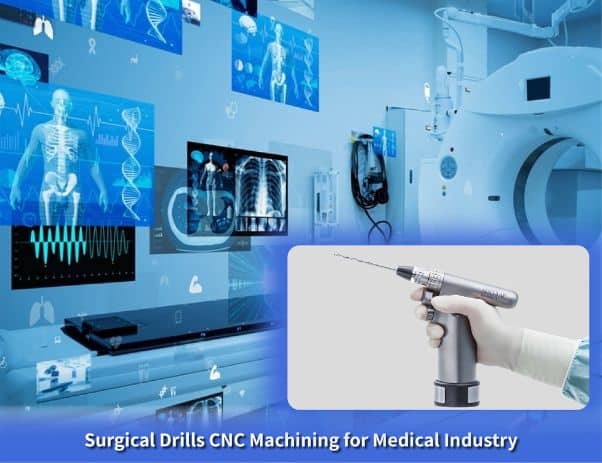
Surgical Drills CNC Machining for Medical Industry

Surgical drills are precision machined surgical instruments that create controlled perforations in bone for screw placement, wire insertion, and access for surgerys during orthopedic procedures. Zintilon CNC machining specializes in the surgical drill components, performing advanced grinding and fluting that refines the cutting edge geometry, concentricity, and biocompatible characteristics for efficient bone removal with minimal thermal necrosis during trauma and reconstructive surgery.
  • Machining for complex drill geometries and flute profiles
  • Allowed assigned tolerances of up to ±0.0003 in
  • Precision grinding, fluting & edge sharpening
  • Support for rapid prototyping and full-scale production
  • ISO 13485-certified medical device manuf

Trusted by 15,000+ businesses

Why Medical Companies
Choose Zintilon

prductivity

Fast Delivery

A professional engineering team that can respond quickly to customer needs and provide one-stop services from design to production in a short period of time to ensure fast delivery.

10x

High Precision

We are equipped with automated equipment and sophisticated measuring tools to achieve high accuracy and consistency, ensuring that every part meets the most stringent quality standards.

world

ISO13485 Certified

As a ISO13485 certified precision manufacturer, our products and services have met the most stringent quality standards in the automotive industry.

From Prototyping to Mass Production

Zintilon CNC machining for surgical drill components and other cutting instruments works with hospitals, surgical centers, and medical device manufacturers across the globe.

Prototype Surgical Drills

Receive high precision surgical drill prototypes that are exact replicas of your final surgical drill design. Evaluate cutting performance, test concentricity and chip removal for efficient clearance before proceeding to full scale medical production.

Key Points:

  • Rapid prototyping with high precision

  • Tight tolerances (±0.0003 in)

  • Test design, cutting efficiency, and thermal control early

3 Axis CNC Machined Stainless Steel Passivation

EVT – Engineering Validation Test

Drill prototypes can be quickly iterated to verify they comply with all cutting and durability conditions. Anticipate issues that will make the transition to full-scale production of the medical device smoother.

Key Points:

  • Validate prototype functionality

  • Rapid design iterations

  • Ensure readiness for production
Anodized Aluminum 1024x536

DVT – Design Validation Test

Ensure the design is correct and bone preparation is optimal by testing the dimensional accuracy and cutting efficiency of surgical drills with various materials and coatings before scaling up production.

Key Points:

  • Confirm design integrity and sharpness

  • Test multiple materials and edge geometries

  • Ensure production-ready performance
design aluminium

PVT – Production Validation Test

Examine the large-scale production of surgical drills to assess uniformity and the ease of production for full-scale operations to capture any inconsistencies early.

Key Points:

  • Test large-scale production capability

  • Detect and fix process issues early

  • Ensure consistent part quality
Anodized Titanium Fastener

Mass Production

Deliver consistent, high-quality, surgical grade drills for cutting, to be in sync with medical device distributors and health care institutions for prompt delivery.

Key Points:

  • Consistent, high-volume production

  • Precision machining for medical-grade quality

  • Fast turnaround with strict quality control
production

Simplified Sourcing for
the Medical Industry

Our precision manufacturing capabilities are widely used in the medical industry. CNC machining, sheet metal fabrication and other technologies ensure high precision and heat resistance in the application of medical grade materials such as titanium alloy and PEEK.

Explore Other Medical Components

Browse our extensive selection of CNC machined medical parts, engineered to meet the highest quality and hygiene standards. From implant-grade components and instrument handles to housings for imaging systems and lab automation equipment, we deliver precision solutions for the evolving needs of the medical industry.

Medical Surgical Drills Machining Capabilities

Utilizing spindle tools with advanced fluting and grinding technology and experienced medical-device machinists, we perform Surgical Drills CNC Machining for the Medical Industry. Each orthopedic drill bit and cannulated drill, as well as custom step drill configurations, are equipped with engineered cutting edges and optimized for cutting efficiency, reduced heat, and long edge retention.

Each surgical drill is machined from medical-grade stainless steel (440C, 420), cobalt-chromium, tungsten carbide, or tool steel with the appropriate hardness and wear during sterilization and surgical procedures, thus assuring an uninterrupted drill, for repeated concentricity and cutting torque, and coating consistency and durability with flute grinding, point grinding, cylindrical grinding, and the application of a coating system.
milling

CNC Machining

sheet metal

Sheet Metal Fabrication

edm

Wire EDM

Aerospace
Materials & Finishes

Materials
We provide a wide range of materials, including metals, plastics, and composites.
Finishes
We offer superior surface finishes that enhance part durability and aesthetics for applications requiring smooth or textured surfaces.

Specialist Industries

you are welcome to emphasize it in the drawings or communicate with the sales.

Materials for Surgical Drills Components

Materials for Surgical Drills Machining for Medical Industry are available at our CNC machine shop. In the form of 10 materials that are FDA-approved along with 10 medical-grade metals and 10 medical-grade cutting tool materials, we significantly expedite prototyping and complete the precision cutting instrument manufacturing with consistent quality which is ideal for setting materials.
Aluminum Image

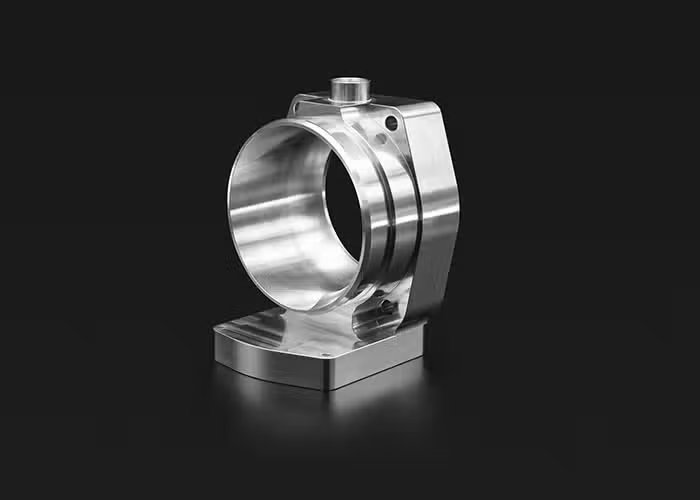
High machinability and ductility. Aluminum alloys have good strength-to-weight ratio, high thermal and electrical conductivity, low density and natural corrosion resistance.
Price
$ $ $
Lead Time
< 7 days
Tolerances
Down to ±0.003 mm
Max part size
3000*2200*1100 mm
Min part size
2*2*2 mm
Stainless steel Image

Stainless steel alloys have high strength, ductility, wear and corrosion resistance. They can be easily welded, machined and polished. The hardness and the cost of stainless steel is higher than that of aluminum alloy.

Price
$ $ $
Lead Time
< 7 days
Tolerances
Down to ±0.005 mm
Max part size
3000*2200*1100 mm
Min part size
2*2*2 mm
Steel Image

Steel is a strong, versatile, and durable alloy of iron and carbon. Steel is strong and durable. High tensile strength, corrosion resistance heat and fire resistance, easily molded and formed. Its applications range from construction materials and structural components to automotive and aerospace components.

Price
$ $ $ $ $
Lead Time
< 10 days
Tolerances
Down to ±0.001 mm (routing)
Max part size
3000*2200*1100 mm
Min part size
2*2*2 mm
Titanium Image

Titanium is an advanced material with excellent corrosion resistance, biocompatibility, and strength-to-weight characteristics. This unique range of properties makes it an ideal choice for many of the engineering challenges faced by the medical, energy, chemical processing, and aerospace industries.

Price
$$$
Lead Time
< 10 days
Tolerances
Down to ±0.005 mm
Max part size
3000*2200*1100 mm
Min part size
2*2*2 mm
Bronze Image

Highly resistant to seawater corrosion. The material’s mechanical properties are inferior to many other machinable metals, making it best for low-stress components produced by CNC machining.

Price
$ $ $ $ $
Lead Time
< 10 days
Tolerances
Down to ±0.005 mm
Max part size
3000*2200*1100 mm
Min part size
2*2*2 mm
Brass Image

Brass is mechanically stronger and lower-friction metal properties make CNC machining brass ideal for mechanical applications that also require corrosion resistance such as those encountered in the marine industry.

Price
$$$
Lead Time
< 10 days
Tolerances
Down to ±0.005mm
Max part size
3000*2200*1100 mm
Min part size
2*2*2 mm
Copper Image

Few metals have the electric conductivity that copper has when it comes to CNC milling materials. The material’s high corrosion resistance aids in preventing rust, and its thermal conductivity features facilitate CNC machining shaping.

Price
$$$
Lead Time
< 10 days
Tolerances
Down to ±0.005 mm
Max part size
3000*2200*1100 mm
Min part size
2*2*2 mm
Zinc Image

Zinc is a slightly brittle metal at room temperature and has a shiny-greyish appearance when oxidation is removed.

Price
$ $ $ $ $
Lead Time
< 10 days
Tolerances
Down to ±0.005 mm
Max part size
3000*2200*1100 mm
Min part size
2*2*2 mm
Iron Image

Iron is an indispensable metal in the industrial sector. Iron is alloyed with a small amount of carbon – steel, which is not easily demagnetized after magnetization and is an excellent hard magnetic material, as well as an important industrial material, and is also used as the main raw material for artificial magnetism.
Price
$ $ $ $ $
Lead Time
< 10 days
Tolerances
Down to ±0.005 mm
Max part size
3000*2200*1100 mm
Min part size
2*2*2 mm
Magnesium Image

Due to the low mechanical strength of pure magnesium, magnesium alloys are mainly used. Magnesium alloy has low density but high strength and good rigidity. Good toughness and strong shock absorption. Low heat capacity, fast solidification speed, and good die-casting performance.

Price
$ $ $ $
Lead Time
< 7 days
Tolerances
Down to ±0.005 mm
Max part size
3000*2200*1100 mm
Min part size
2*2*2 mm
Let’s Build Something Great, Together

FAQs: Surgical Drills for Medical Applications

Surgical drills are specialty instruments that allow the surgeon to create holes in the bones for the purpos­e of inserting screws, placing wires, and for surgical access during orthopedic surgeries. Drills are categorized as twist drills which are used for standard bone drilling of various diameters and range from 1.5 to 6.5 millimeters, cannulated drills which are used for wire-guided drilled, step drills which allow the operator to create holes of multiple diameters, core drills associated with bone biopsy, spade drills that allow rapid removal of bone, countersink drills that allow bone to be shaped to the screw, oscillating saw blades that are designed for cutting bone and various burrs that are used for shaping and smoothing the bone which can be designed as a sphere, cone, and barrel.

Medical-grade stainless steel, particularly types 420 and 440C, meets the necessary criteria because it reaches a hardness of greater than 54 HRC after heat treatment, which is required for cutting cortical bone, creating a strong cutting edge, and is biocompatible, corrosion resistant to sterilization and bodily fluids, and reasonably priced for disposable instruments. For cobalt-chromium, enhanced hardness and wear resistance, and marginal heat resistance, which protects bone from heat during cutting, and toughness to prevent chipping during bone cutting, and thus allows the instrument to retain a sharp cutting edge after making 50 to 100 perforations. Tungsten carbide offers the cutting life of over 200 perforations, extreme hardness of greater than 90 HRC, wear resistance for cutting dense cortical bone, and minimal deflection for maintaining the desired geometrical shape for scale and shape accuracy. Tool steel is of reasonable cost, provides a full-through hardness, excellent machinability for the demanding geometries and the ability to harden to 60-62 HRC for the reusable drill systems.

Precision cylindrical grinding ensures drill shanks obtain diameter tolerances of ±0.0003 inches while concentricity for balanced rotation is within 0.0005 inches. Flute grinding electrically driven spindle units equip dedicated spindle taper sleeves, which are indexed to receive fourteen 2.5 x 40 mm hex screws for helical channel grinding. Point grinding precisely forms the edge and the chisel of the 118-degree bone penetrating drill point. Edge sharpening takes rational knife handles. Coating application is for titanium nitride (TiN) and carbon graphite inlay. Heat treatment is for surface hardness 54 to 62 HRC. Laser marking is for surface identification.

Drills require diameter tolerances of ±0.0003 inches for precise hole sizing which is crucial for screws and implants fit. Concentricity is within 0.0005 to prevent wobbling and oversized holes. Cutting lip symmetry is within ±0.002 inches for balanced cutting forces while flute depth is uniform within ±0.001 inches for constant chip evacuation. Point angle is precise within ±2 degrees for optimal penetration. Total indicator runout (TIR) is below 0.001 inches for free operation at 1000 to 20,000 revolutions per minute (RPM).

Yes, we provide rapid prototyping to verify fit and test assembly, with same-day CAD-to-part capability available for critical projects. For custom automation cells and research platforms, we perform low-volume production of 20 to 500 brackets. For standardized robot models, we perform high-volume production of thousands to tens of thousands of brackets annually, incorporating complete dimensional inspection, flatness verification, and material certifications.

All components are manufactured under an ISO 13485 certified quality management systems for medical devices which includes full compliance with FDA regulations for Class I and Class II surgical instruments and European Medical Device Regulation (MDR) requirements. The drills fully comply with ASTM F899 for surgical stainless steel instruments and biocompatibility testing per ISO 10993 which ensures patient safety during bone preparation procedures. The drills also comply with complete traceability from raw material through final product and adherence to Good Manufacturing Practices.

We provide comprehensive finishing solutions tailored to aerospace requirements:
Anodizing (Type II and Type III)
Passivation for corrosion resistance
Precision polishing for aerodynamic surfaces
Custom protective coatings and thermal barriers
Standard orthopedic drill bits require 12–18 business days including grinding, heat treatment, coating, and quality verification, while custom step drills or cannulated designs need 4–5 weeks. Prototype drills for cutting performance evaluation can be completed in 8–12 days depending on material availability and coating requirements.

Absolutely. We construct extra-length drills exceeding 300 millimeters for spine and deep tissue access, sub-1.0 millimeter micro-drills for craniofacial and hand surgery, self-centering drills with pilot tips to prevent skiving on curved bone surfaces, irrigation drills with internal coolant channels to reduce thermal necrosis, quick-coupling drills for rapid drill bit exchange, cost-effectively single-use disposable drills, and custom geometries for dental implant osteotomies, arthroscopy, and minimally invasive percutaneous fixation drills.

Precision machining contributions begin with the control of diameters to within ±0.0003 inches. This machining capability ensures drills produce holes of the correct size necessary for threaded screws to remain engaged within designed limits to avoid stripping and loosening. We further enhance performance by ensuring concentricity tolerances of 0.0005 inches. This maachines ensures drills avoid wobbling and achieving straight trajectory holes that align with the implant. Uniform axial symmetry of the cutting lip geometry garners balanced cutting lip geometry to achieve cutting torque 20 to 40 percent and diminish drill deflection. Competently crafted cutting edges allow drills to efficiently penetrate bone to reduce insertion heat and bone necrosis that occurs above 47 degrees celsius. Flute design guilds drill to accommodate bone chip removal with clogging avoidance that encourages friction and temperature increases. Optimal point drills are designed to 118 degrees to enhance penetration and promote chip formation. Quality drill coatings achieve 100 to 200 holes as opposed to 30 to 50 for uncoated drills. Drill hardness of 54 to 62 HRC ensures the edges remain sharp to prepare bones before trauma fixation, arthroplasty, spine surgery, and reconstructive surgeries.
Got any more questions?