We have moved to a new Website Check Now

Medical Valves CNC Machining for Medical Industry

Medical valves are flow control devices that determine the direction and flow of fluids and gases in medical equipment and patient care devices and systems. At Zintilon, we work with advanced Swiss-type turning and lapping to scallop biocompatible diagnostic and therapeutic devices to safely perform valves and flow control devices CNC machining for sealing and flow control to specific medical diagnostic equipment.
  • Machining for complex valve geometries and sealing surfaces
  • Tight tolerances up to ±0.0005 in
  • Precision Swiss turning, lapping & electropolishing
  • Support for rapid prototyping and full-scale production
  • ISO 13485-certified medical device manufacturing


Trusted by 15,000+ businesses

Why Medical Companies
Choose Zintilon

prductivity

Fast Delivery

A professional engineering team that can respond quickly to customer needs and provide one-stop services from design to production in a short period of time to ensure fast delivery.

10x

High Precision

We are equipped with automated equipment and sophisticated measuring tools to achieve high accuracy and consistency, ensuring that every part meets the most stringent quality standards.

world

ISO13485 Certified

As a ISO13485 certified precision manufacturer, our products and services have met the most stringent quality standards in the automotive industry.

From Prototyping to Mass Production

Based on Zintilon CNC machining for medical valves and fluid control components for hospitals, surgical centers, and medical device manufacturers worldwide.

Prototype Medical Valves

Obtain medical valve prototypes which are a high precision reproduction of the final design to test distinguishing flow characteristics, sealing integrity, and biocompatibility to substantiate the final medical production in high scale.

Key Points:

  • Rapid prototyping with high precision

  • Tight tolerances (±0.0005 in)

  • Test design, sealing, and flow control early

3 Axis CNC Machined Stainless Steel Passivation

EVT – Engineering Validation Test

Conduct rapid iterations on prototypes of medical valves to verify compliance with all functional and safety standards. Identify critical design concerns early to ensure efficiency in transitioning to large-scale manufacturing of medical devices.

Key Points:

  • Validate prototype functionality

  • Rapid design iterations

  • Ensure readiness for production
Anodized Aluminum 1024x536

DVT – Design Validation Test

Assess the sealing and dimensional accuracy of valves in different materials to guarantee design precision and flow control pre mass production.

Key Points:

  • Confirm design integrity and sealing

  • Test multiple materials and configurations

  • Ensure production-ready performance
design aluminium

PVT – Production Validation Test

Evaluate medical valves' large-scale production to identify and address manufacturing challenges to guarantee optimal production control prior to mass production.

Key Points:

  • Test large-scale production capability

  • Detect and fix process issues early

  • Ensure consistent part quality
Anodized Titanium Fastener

Mass Production

Deliver on time to medical device distributors and healthcare facilities top quality medical-grade valves produced with precision and rapid flow control performance.

Key Points:

  • Consistent, high-volume production

  • Precision machining for medical-grade quality

  • Fast turnaround with strict quality control
production

Simplified Sourcing for
the Medical Industry

Our precision manufacturing capabilities are widely used in the medical industry. CNC machining, sheet metal fabrication and other technologies ensure high precision and heat resistance in the application of medical grade materials such as titanium alloy and PEEK.

Explore Other Medical Components

Browse our extensive selection of CNC machined medical parts, engineered to meet the highest quality and hygiene standards. From implant-grade components and instrument handles to housings for imaging systems and lab automation equipment, we deliver precision solutions for the evolving needs of the medical industry.

Medical Device Valves Machining Capabilities

Each medical device machinist works with advanced Swiss-type CNC machines and lapping equipment to complete Medical Valves CNC Machining for Medical Industry. Every component is engineered to prevent leaks, control flow, and endure long-term sterilization for check valves, proportional flow control valves, pressure relief valves with critical sealing surfaces, and advanced lapping equipment and experience.

Precision Swiss turning, lapping, honing, and electropolishing produces sealing surfaces and flow passages for unparalleled valves for medical devices. Medical-grade stainless steels, brass, titanium alloys, medical-grade plastics, and other materials with biocompatibility and corrosion resistance under repeated sterilization cycles and clinical use strengthen straps and stents.
milling

CNC Machining

sheet metal

Sheet Metal Fabrication

edm

Wire EDM

Aerospace
Materials & Finishes

Materials
We provide a wide range of materials, including metals, plastics, and composites.
Finishes
We offer superior surface finishes that enhance part durability and aesthetics for applications requiring smooth or textured surfaces.

Specialist Industries

you are welcome to emphasize it in the drawings or communicate with the sales.

Materials for Medical Valves Components

Our CNC machines shop provides Medical Valves Machining for Medical Industry using an expanded selection of materials. Medical-grade metals and plastics, biocompatible materials, and all rapid prototyping and precision flow control component construction well exceed FDA's most current guidelines is quality and consistency.
Aluminum Image

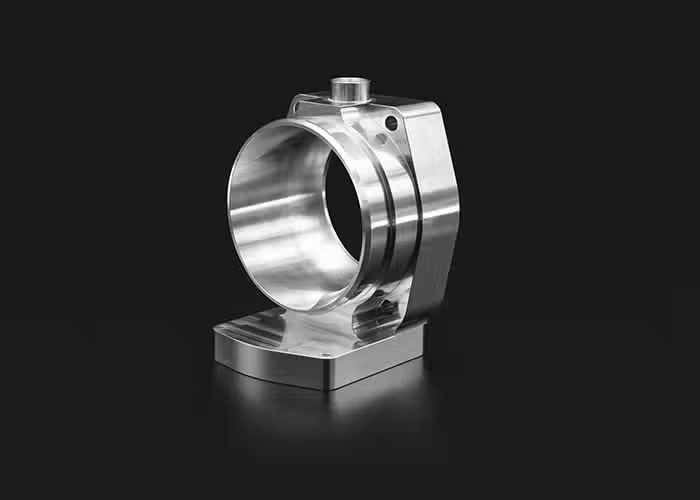
High machinability and ductility. Aluminum alloys have good strength-to-weight ratio, high thermal and electrical conductivity, low density and natural corrosion resistance.
Price
$ $ $
Lead Time
< 7 days
Tolerances
Down to ±0.003 mm
Max part size
3000*2200*1100 mm
Min part size
2*2*2 mm
Stainless steel Image

Stainless steel alloys have high strength, ductility, wear and corrosion resistance. They can be easily welded, machined and polished. The hardness and the cost of stainless steel is higher than that of aluminum alloy.

Price
$ $ $
Lead Time
< 7 days
Tolerances
Down to ±0.005 mm
Max part size
3000*2200*1100 mm
Min part size
2*2*2 mm
Steel Image

Steel is a strong, versatile, and durable alloy of iron and carbon. Steel is strong and durable. High tensile strength, corrosion resistance heat and fire resistance, easily molded and formed. Its applications range from construction materials and structural components to automotive and aerospace components.

Price
$ $ $ $ $
Lead Time
< 10 days
Tolerances
Down to ±0.001 mm (routing)
Max part size
3000*2200*1100 mm
Min part size
2*2*2 mm
Titanium Image

Titanium is an advanced material with excellent corrosion resistance, biocompatibility, and strength-to-weight characteristics. This unique range of properties makes it an ideal choice for many of the engineering challenges faced by the medical, energy, chemical processing, and aerospace industries.

Price
$$$
Lead Time
< 10 days
Tolerances
Down to ±0.005 mm
Max part size
3000*2200*1100 mm
Min part size
2*2*2 mm
Bronze Image

Highly resistant to seawater corrosion. The material’s mechanical properties are inferior to many other machinable metals, making it best for low-stress components produced by CNC machining.

Price
$ $ $ $ $
Lead Time
< 10 days
Tolerances
Down to ±0.005 mm
Max part size
3000*2200*1100 mm
Min part size
2*2*2 mm
Brass Image

Brass is mechanically stronger and lower-friction metal properties make CNC machining brass ideal for mechanical applications that also require corrosion resistance such as those encountered in the marine industry.

Price
$$$
Lead Time
< 10 days
Tolerances
Down to ±0.005mm
Max part size
3000*2200*1100 mm
Min part size
2*2*2 mm
Copper Image

Few metals have the electric conductivity that copper has when it comes to CNC milling materials. The material’s high corrosion resistance aids in preventing rust, and its thermal conductivity features facilitate CNC machining shaping.

Price
$$$
Lead Time
< 10 days
Tolerances
Down to ±0.005 mm
Max part size
3000*2200*1100 mm
Min part size
2*2*2 mm
Zinc Image

Zinc is a slightly brittle metal at room temperature and has a shiny-greyish appearance when oxidation is removed.

Price
$ $ $ $ $
Lead Time
< 10 days
Tolerances
Down to ±0.005 mm
Max part size
3000*2200*1100 mm
Min part size
2*2*2 mm
Iron Image

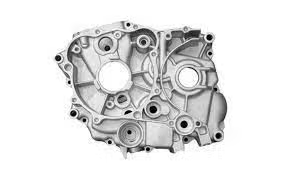
Iron is an indispensable metal in the industrial sector. Iron is alloyed with a small amount of carbon – steel, which is not easily demagnetized after magnetization and is an excellent hard magnetic material, as well as an important industrial material, and is also used as the main raw material for artificial magnetism.
Price
$ $ $ $ $
Lead Time
< 10 days
Tolerances
Down to ±0.005 mm
Max part size
3000*2200*1100 mm
Min part size
2*2*2 mm
Magnesium Image

Due to the low mechanical strength of pure magnesium, magnesium alloys are mainly used. Magnesium alloy has low density but high strength and good rigidity. Good toughness and strong shock absorption. Low heat capacity, fast solidification speed, and good die-casting performance.

Price
$ $ $ $
Lead Time
< 7 days
Tolerances
Down to ±0.005 mm
Max part size
3000*2200*1100 mm
Min part size
2*2*2 mm
Let’s Build Something Great, Together

FAQs: Medical Valves for Healthcare Applications

Medical valves are classified as flow control devices that regulate the medical fluid, gas, or medication flow within patient care equipment, diagnostics, and therapeutic devices. Some different types are: Check Valves – ensure backflow prevention for IV lines and catheters; Pressure Relief Valves – prevent over-pressure on patients in ventilators and anesthesia systems; Proportional Valves – precise flow control in infusion pumps and dialysis machines; Solenoid Valves – fluid automation in analyzers; Ball Valves – manual flow control in surgical equipment; Stopcock Valves – multi-port routing for fluids; and Specialty Valves – one-way respiratory valves and heart valve components.

Medical-grade stainless steel 316L and 17-4 PH are capable of withstanding varying degrees of corrosion posed by bodily fluids and sterilization chemicals, and are used in high-pressure applications up to 400 psi due to their strength, proven biocompatibility for patient contact applications, and ultra-smooth electropolished surfaces below 0.1 Ra microns. Brass’s sheer machinability for complex internal passages, cost-effectiveness for high-volume production and non-patient contact applications in gas systems and other equipment offers a significant value for corrosion resistance. Brass offers adequate performance and is cost-effectiveness for high-volume production. For implantable valve components, Titanium offers biocompatibility, MRI compatibility, corrosion resistance, and is lightweight. Medical plastics including PEEK and Polysulfone are cost-effective disposables that provide electrical insulation, chemical resistance, autoclave compatibility up to 134 degrees Celsius, and provide cost-effectiveness in disposability.

Sealing surface tolerances are controlled so that flatness of 0.0001 inches and leak-free performance is achieved for preventing backflow contamination. Valve bore tolerances are controlled within ±0.0005 inches which stems clearance and orifice diameters are ±0.0003 inches to provide control of flow of within 2 percent, the surface finish achieved is below 0.05 Ra microns, and concentricity of 0.0003 inches to promote proper alignment of the valves. Thread dimensions are ±0.0005 inches, which ensures that the connections which are rated for 300 psi are concentric.

Yes, we provide rapid prototyping to verify fit and test assembly, with same-day CAD-to-part capability available for critical projects. For custom automation cells and research platforms, we perform low-volume production of 20 to 500 brackets. For standardized robot models, we perform high-volume production of thousands to tens of thousands of brackets annually, incorporating complete dimensional inspection, flatness verification, and material certifications.

Yes, Zintilon can give you rapid prototyping for integrated medical devices, and flow testing and calibration. You can get low-volume customized production for medical equipment and clinical trial devices up to 5,000 valves and high-volume production for standard medical systems supplying hospitals with hundreds of thousands to millions of valves annually. We completely document and perform dimensional inspections, leak testing to >0.1cc/min, flow calibration, and biocompatibility testing to ISO 10993. We certify to standard medical equipment systems that you supply to hospitals globally..

We provide comprehensive finishing solutions tailored to aerospace requirements:
Anodizing (Type II and Type III)
Passivation for corrosion resistance
Precision polishing for aerodynamic surfaces
Custom protective coatings and thermal barriers
For standard check valves and ball valves which includes Swiss turning, lapping, electropolishing, and quality verification, lead time is 10-15 business days. More complex proportional valves with precision flow control take about 4-5 weeks. Prototype runs for flow testing and regulatory validation can be performed in 7-10 days, materials and compliance levels permitting..

Yes, we design miniature valves for minimally invasive devices. These valves have port sizes below 2 millimeters. We also design high-pressure valves for contrast injectors that operate at 1200 psi. We create sterile disconnect valves for aseptic pharmaceutical transfer, including contamination prevention. We provide proportional valves for precision infusion, where flow accuracy is within 1 percent. We design biocompatible long-term implantable devices. We make autoclave-compatible plastic valves for disposable medical circuits. We design integrated valve assemblies that combine multiple functions of check, relief, and flow control in compact manifolds.

Flat lapped sealing surfaces within 0.0001 of an inch result in leak-proof metal-to-metal sealing with leak rates remaining below detectable limits. This prevents backflow contamination critical for patient safety in IV therapy and respiratory support. Infusion pumps maintain proper medication dosing due to precise control within 2 percent enabled by valving orifices with dimensions controlled to within ±0.0003 of an inch. Smooth electropolished passages with Ra below 0.1 microns facilitate cleaning validation by preventing particle entrapment and avoiding bacterial colonization in reusable medical fluid systems. Accurate valve bore tolerances of ±0.0005 of an inch allow for optimization of stem clearance to achieve the balanced act of low friction for easy actuation with leakage control. Valves are made of quality materials to withstand over 500 sterilization cycles to retain sealing performance and dimensional accuracy. Biocompatible surface preparation in patient contact applications prevents reactions to tissue.
Got any more questions?