Knee Implants CNC Machining for Medical Industry
- Machining for complex femoral and tibial components
- Tight tolerances up to ±0.0002 in
- Precision milling, contouring & surface finishing
- Support for rapid prototyping and full-scale production
- ISO 13485-certified medical device manufacturing

Why Medical Companies
Choose Zintilon

Fast Delivery
A professional engineering team that can respond quickly to customer needs and provide one-stop services from design to production in a short period of time to ensure fast delivery.

High Precision
We are equipped with automated equipment and sophisticated measuring tools to achieve high accuracy and consistency, ensuring that every part meets the most stringent quality standards.

ISO13485 Certified
As a ISO13485 certified precision manufacturer, our products and services have met the most stringent quality standards in the automotive industry.
From Prototyping to Mass Production


Prototype Knee Implants
Key Points:
- Quick prototyping
- Rapid tolerances ±.0002
- Test design, material, and biomechanical function early

EVT – Engineering Validation Test
Key Points:
- Rapid design iterations
- Ensure production readiness
- Validate prototype functionality

DVT – Design Validation Test
Key Points:
- Confirm design integrity and kinematics
- Test multiple materials and articulations
- Ensure production-ready performance

PVT – Production Validation Test
Key Points:
- Test large-scale production capability
- Detect and fix process issues early
- Ensure consistent part quality

Mass Production
Key Points:
- Reliable, extensive production
- Accurate machining to medical-grade standard
- Quick relief with fast-paced quality assurance

Simplified Sourcing for
the Medical Industry
Explore Other Medical Components
Browse our extensive selection of CNC machined medical parts, engineered to meet the highest quality and hygiene standards. From implant-grade components and instrument handles to housings for imaging systems and lab automation equipment, we deliver precision solutions for the evolving needs of the medical industry.
- Orthopedic Implants
- Bone Screws
- Bone Plates
- Hip Implants
- Dental Implants
- Medical Housings
- Surgical Handles
- Medical Shafts
- Surgical Forceps
- Scalpel Components
- Medical Couplings
- Medical Fittings
- Endoscopic Components
- Medical Valves
- Catheter Components
- Medical Connectors
- Surgical Clamps
- Medical Hubs
- Surgical Pins
- Surgical Drills
- Prosthetic Components
- Medical Brackets
- Medical Casings
- Medical Tubing
- Medical Adapters
- Medical Covers
- Implantable Components
- Medical Device Enclosures
- Surgical Instruments
Medical Knee Implants Machining Capabilities
For precision CNC milling, contouring, coordinate drilling, and surface finishing, we ensure uninterrupted articulation and optimal bony interfaces, wear testing, and kinematic analysis. Each knee implant component is finished in cobalt-chromium-molybdenum alloys, titanium alloys (Ti-6Al-4V ELI), medical stainless steel (316LVM), oxidized zirconium, and their combinations to guarantee the construction durability and biocompatibility.


Aerospace
Materials & Finishes


Specialist Industries



Materials for Knee Implants Components

High machinability and ductility. Aluminum alloys have good strength-to-weight ratio, high thermal and electrical conductivity, low density and natural corrosion resistance.
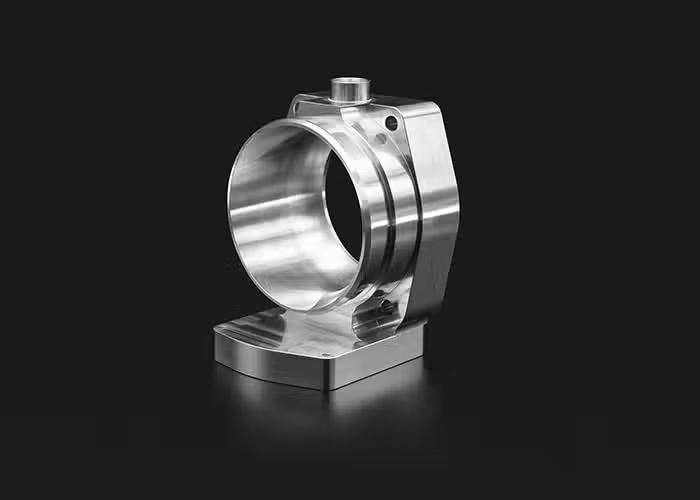
Stainless steel alloys have high strength, ductility, wear and corrosion resistance. They can be easily welded, machined and polished. The hardness and the cost of stainless steel is higher than that of aluminum alloy.

Steel is a strong, versatile, and durable alloy of iron and carbon. Steel is strong and durable. High tensile strength, corrosion resistance heat and fire resistance, easily molded and formed. Its applications range from construction materials and structural components to automotive and aerospace components.

Titanium is an advanced material with excellent corrosion resistance, biocompatibility, and strength-to-weight characteristics. This unique range of properties makes it an ideal choice for many of the engineering challenges faced by the medical, energy, chemical processing, and aerospace industries.

Highly resistant to seawater corrosion. The material’s mechanical properties are inferior to many other machinable metals, making it best for low-stress components produced by CNC machining.

Brass is mechanically stronger and lower-friction metal properties make CNC machining brass ideal for mechanical applications that also require corrosion resistance such as those encountered in the marine industry.

Few metals have the electric conductivity that copper has when it comes to CNC milling materials. The material’s high corrosion resistance aids in preventing rust, and its thermal conductivity features facilitate CNC machining shaping.

Zinc is a slightly brittle metal at room temperature and has a shiny-greyish appearance when oxidation is removed.

Iron is an indispensable metal in the industrial sector. Iron is alloyed with a small amount of carbon – steel, which is not easily demagnetized after magnetization and is an excellent hard magnetic material, as well as an important industrial material, and is also used as the main raw material for artificial magnetism.
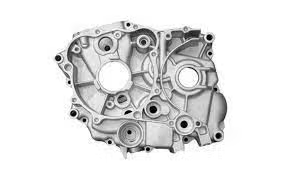
Due to the low mechanical strength of pure magnesium, magnesium alloys are mainly used. Magnesium alloy has low density but high strength and good rigidity. Good toughness and strong shock absorption. Low heat capacity, fast solidification speed, and good die-casting performance.
FAQs: Knee Implants for Medical Applications
Everyone getting knee or knee replacements requites femoral component which replace the distal femur with the medial and lateral condyle which attached surfaces; these are usually cobalt-chromium alloy which are polished to bearing surfaces. These also tibial base-plates which anchor to the proximal tibia. These provide platforms for polyethylene inserts with bearing and mobile bearing tibial base plates with various fixation cemented, cement- less, and also press-fit. These are super high molecular weight polyethylene (UHMWPE) which provide the bearing surface which articulated against the femoral condyle. These are standard and also highly cross linked with antioxidant and cross linked without. The upper patellar component replace the undersurface patella with polyethylene buttons or domed surfaces which wiil and did articulate with femoral patellar groove. These includes posterior stabilized design with tibial posts and femoral cam mechanism which substitutes posterior cruciate ligament. These includes cruciate retaining designs which retains the posterior cruciate ligament with less constrained articulation. These also hinge and rotating hinge which are for designs with severe deformity or ligament def.These devices are intended to achieve dimensional accuracy with condyle radii within ± 0.050 millimeters to facilitate the proper contact mechanics for load distribution across the polyethylene surfaces, ensure flatness of the tibial baseplate within 0.020 millimeters to achieve an uniform cement mantle or bone contact, incorporate alignment features, rotatinal markers, and anatomical references for the correct positioning of the components typically within 3 degrees of the mechanical axis, ensure mechanical tibial components are capable of withstanding 3000-4500 Newtons cyclic loading as per ISO 14243, provide smooth articulating surfaces with Ra below 0.05 microns to minimize polyethylene wear, and achieve biocompatibility that'll last for permanent implantation for a period of 15-25 years
Rapid prototyping for design validation
Low-volume production for specialized applications
High-volume production with consistent quality control
Full structural and dimensional verification at every stage
Anodizing (Type II and Type III)
Passivation for corrosion resistance
Precision polishing for aerodynamic surfaces
Custom protective coatings and thermal barriers
Achieving nearly perfect femoral and tibial rotations and avoiding patellofemoral complications associated with malrotation hinge on rotational alignment features and assistive technology in component positioning. Limiting variation with respect to component thickness consistently achieves the position of the designed joint line within 4mm of the anatomical location, protecting the function of the collateral ligaments and the patellofemoral joint. Optimized porous coating with 100 to 400 micron pores promotes bone ingrowth achieving biological fixation with interface strength exceeding 20 MPa enabling cementless fixation in younger patients. Tried and tested design, as well as the use of biocompatible materials, permit incorporation with no adverse tissue reactions, guaranteeing permanent implantation. Predictability with regard to the surgical technique in the assembly of limb segments is achievable with balanced flexion-extension gaps. This is the result of the quality of design and wavering standards of construction, as well as incorporation of features that remove fatigue from the assembly and use of materials.
When properly designed and manufactured, fatigue strength allows for more than 10 million cycles at ISO 14879 physiological stresses. This, together with precision machined knee implants, establishes the clinical groundwork for successful outcomes, including relief of pain, where the Knee Society Scores increase from 40 pre-operatively to more than 85 post-operatively, functional restoration where patients reclaimed their daily activities of walking, stair climbing, and some recreational activities, and restoration of function with implant survival rates over 95 percent at 10 years and 90 percent at 15 years for modern total knee prostheses with optimal alignment. Complication rates are low with infections below 1 percent, postoperative instability below 2 percent, and aseptic loosening below 0.5 percent per year. Cross-linked polyethylene showed minimal wear with a volumetric loss of less than 100 cubic millimeters over 10 years. Properly selected patients with good preoperative motion can achieve more than 120 degrees of flexion and range of motion. Patient satisfaction exceeds 80 percent alongside restoration of pain-free mobility and functional activities, work, and recreation for a 15 to 30 year post-operative lifetime to improve the quality of life for patients with severe knee arthritis or knee injuries.