Hip Implants CNC Machining for Medical Industry
- Machining for complex femoral stems and acetabular cups
- Tight tolerances up to ±0.0002 in
- Precision turning, milling & taper grinding
- Support for rapid prototyping and full-scale production
- ISO 13485-certified medical device manufacturing

Why Medical Companies
Choose Zintilon

Fast Delivery
A professional engineering team that can respond quickly to customer needs and provide one-stop services from design to production in a short period of time to ensure fast delivery.

High Precision
We are equipped with automated equipment and sophisticated measuring tools to achieve high accuracy and consistency, ensuring that every part meets the most stringent quality standards.

ISO13485 Certified
As a ISO13485 certified precision manufacturer, our products and services have met the most stringent quality standards in the automotive industry.
From Prototyping to Mass Production


Prototype Hip Implants
Key Points:
- Rapid prototyping with high precision
- Tight tolerances (±0.0002 in)
- Test design, material, and biomechanical fit early

EVT – Engineering Validation Test
Key Points:
- Confirm the functionality of the prototypes
- Implement rapid design iterations
- Assess the production readiness of the prototypes

DVT – Design Validation Test
Key Points:
- Confirm design integrity and biocompatibility
- Evaluate a range of materials and bearing surfaces
- Assess and evaluate performance for production readiness

PVT – Production Validation Test
Key Points:
- Evaluate large-scale production capabilities
- Identify and address production challenges early
- Monitor and evaluate part quality

Mass Production
Key Points:
- Production Consistency at Large Volumes
- Medically Relevant Quality Equipment Use
- Rapid Orientation with Reachable Quality Standards

Simplified Sourcing for
the Medical Industry
Explore Other Medical Components
Browse our extensive selection of CNC machined medical parts, engineered to meet the highest quality and hygiene standards. From implant-grade components and instrument handles to housings for imaging systems and lab automation equipment, we deliver precision solutions for the evolving needs of the medical industry.
- Orthopedic Implants
- Bone Screws
- Bone Plates
- Knee Implants
- Dental Implants
- Medical Housings
- Surgical Handles
- Medical Shafts
- Surgical Forceps
- Scalpel Components
- Medical Couplings
- Medical Fittings
- Endoscopic Components
- Medical Valves
- Catheter Components
- Medical Connectors
- Surgical Clamps
- Medical Hubs
- Surgical Pins
- Surgical Drills
- Prosthetic Components
- Medical Brackets
- Medical Casings
- Medical Tubing
- Medical Adapters
- Medical Covers
- Implantable Components
- Medical Device Enclosures
- Surgical Instruments
Medical Hip Implants Machining Capabilities


Aerospace
Materials & Finishes


Specialist Industries



Materials for Hip Implants Components

High machinability and ductility. Aluminum alloys have good strength-to-weight ratio, high thermal and electrical conductivity, low density and natural corrosion resistance.
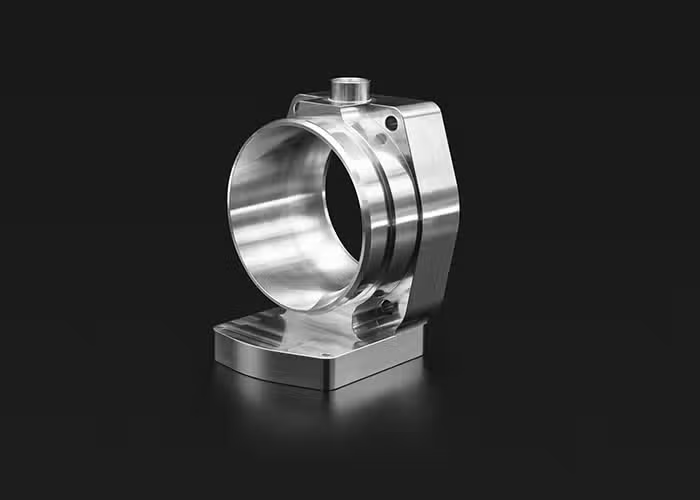
Stainless steel alloys have high strength, ductility, wear and corrosion resistance. They can be easily welded, machined and polished. The hardness and the cost of stainless steel is higher than that of aluminum alloy.

Steel is a strong, versatile, and durable alloy of iron and carbon. Steel is strong and durable. High tensile strength, corrosion resistance heat and fire resistance, easily molded and formed. Its applications range from construction materials and structural components to automotive and aerospace components.

Titanium is an advanced material with excellent corrosion resistance, biocompatibility, and strength-to-weight characteristics. This unique range of properties makes it an ideal choice for many of the engineering challenges faced by the medical, energy, chemical processing, and aerospace industries.

Highly resistant to seawater corrosion. The material’s mechanical properties are inferior to many other machinable metals, making it best for low-stress components produced by CNC machining.

Brass is mechanically stronger and lower-friction metal properties make CNC machining brass ideal for mechanical applications that also require corrosion resistance such as those encountered in the marine industry.

Few metals have the electric conductivity that copper has when it comes to CNC milling materials. The material’s high corrosion resistance aids in preventing rust, and its thermal conductivity features facilitate CNC machining shaping.

Zinc is a slightly brittle metal at room temperature and has a shiny-greyish appearance when oxidation is removed.

Iron is an indispensable metal in the industrial sector. Iron is alloyed with a small amount of carbon – steel, which is not easily demagnetized after magnetization and is an excellent hard magnetic material, as well as an important industrial material, and is also used as the main raw material for artificial magnetism.
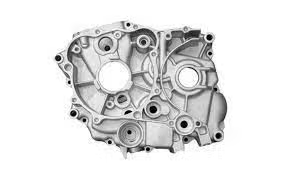
Due to the low mechanical strength of pure magnesium, magnesium alloys are mainly used. Magnesium alloy has low density but high strength and good rigidity. Good toughness and strong shock absorption. Low heat capacity, fast solidification speed, and good die-casting performance.
FAQs: Hip Implants for Medical Applications
Some of the most critical hip implant components are femoral stems that replace the femoral head and neck and fit into the medullary canal of the femur. These are available in both cemented and cementless designs with different fixation surfaces. There are modular femoral heads, ranging in size from 22 to 44 millimeters in diameter, that move against acetabular bearings made of metal, ceramic, or polyethylene. Other components are Morse taper connections, which are made to join femoral heads to stems and have standardized dimensions to enable secure attachment and load transfer, and acetabular cups or shells that replace the acetabulum and have outer hemispherical surfaces to allow bone fixation. There are also acetabular liners that provide the bearing surface for femoral head articulation in various configurations along with dual mobility systems that have mobile polyethylene liners. Other components are revision stems for failed primary implants, bipolar heads for hemiarthroplasty, and custom implants made from CT scans for complex anatomies.
Each of these elements must maintain precision within tight tolerances of ±0.010 millimeters at certain dimensions for proper fits within acetabular liners. The Morse tapers must also meet ISO 7206-4 guidelines for taper angles of 5 degrees 40 minutes ±6 minutes to ensure connection strengths exceed 4000 Newtons of pull-off force. Spherical surfaces of various femoral heads should maintain roundness tolerances of 0.005 millimeters to ensure minimal wear. Furthermore, the strength of the femoral stems must exceed the 5.3 kilonewtons cyclic loading pressure specified in ISO 7206-4 and 7206-6. Also, these devices should be permanently implanted for over 20 years while holding their biocompatibility, corrosion resistance, and mechanical strength must meet the specified standards with surface finish guidelines provided for either bone ingrowth or articulation on the bearing surfaces.
Cobalt-chromium-molybdenum alloys demonstrate maximum abrasion resistance for articulating surfaces in metal-on-metal bearings and metal-on-polyethylene couplings which show volumetric wear rates of less than 1 mm³/year, enabling the fabrication of thin-walled acetabular shells and large-diameter femoral heads, excellent fatigue resistance for revision stems and highly loaded components, clinically proven performance in bearing applications for over 50 years, and the capability of achieving mirror polished surfaces of Ra < 0.01 microns reducing wear of polyethylene in metal-on-polyethylene bearings. Clinical applications show alumina (Al2O3) and zirconia (ZrO2) ceramics with volumetric wear rates 100 times lower than those of polyethylene than metal-on-polyethylene bearings, bioinert properties eliminating metal sensitivity, extreme hardness (HV > 1800) for surface integrity after millions of gait cycles, hydrophilic surfaces with Ra < 0.005 microns, clinically proven performance in ceramic-on-ceramic and ceramic-on-polyethylene bearings with < 15% 15 year survival and > 95% implant survival, and ceramic bearings with free surfaces which demonstrate respectively. Medical-grade stainless steel 316LVM is clinically suitable for cemented femoral stems in older patients with limited life expectancy, provides sufficient cost-effective performance, has sufficient strength and fatigue resistance, proven biocompatibility for medium to long-term implantation, and has 60 years of clinical history in cemented hip arthroplasty.
Rapid prototyping for design validation
Low-volume production for specialized applications
High-volume production with consistent quality control
Full structural and dimensional verification at every stage
Anodizing (Type II and Type III)
Passivation for corrosion resistance
Precision polishing for aerodynamic surfaces
Custom protective coatings and thermal barriers
When the stem geometry conforms to specifications, including neck-shaft angle of ±1 degree and offsets of ±0.5mm, hip biomechanics and soft tissue tension allow for 5mm leg length equality. With bone ingrowth and biological fixation of 20 MPa shear strength accomplished within 6 months, customized bone coatings of 100 to 400 micron pore sizes with 30 to 50 percent porosity provide adequate fixation. The design and material properties provide adequate stem stiffness to prevent stress shielding and bone loss. The bone mineral density surrounding the implant is within 10 percent of contralateral hip. Biocompatible materials with appropriate surface finish prevent adverse tissue reactions allowing for permanent implantation. Dimensional consistency allows predictability in the surgical technique and in achieving reproducible component positioning. The defect-free quality of the manufacturing is what prevents catastrophic failure.
ISO 7206-4 specifies the testing standards for the assessment of fatigue strength for different models. With the properly constructed and manufactured testing models with fatigue strength exceeding 10 million loading cycles at 2300 Newtons, the hip implants precision machining results with clinical foundations for successful outcomes including pain relief after hip surgery, patients’ Harris Hip Scores moving from 40 preoperative to over 90 postoperative, functional restoration after the surgery including activities of daily living and recreational activities, with implant survival rate exceeding 95% at 10 years and 90% at 20 years for modern cementless implants, having advanced bearing couples, low complication rates with dislocation below 2%, infection below 1%, and aseptic loosening below 1% per year, minimal wear with linear wear rates below 0.05 at year for cross-linked polyethylene and ceramic bearings, and long-term patient satisfaction with pain free mobility, and improved quality of life for patients for the 20 to 40 years for the post operatively lifetime.