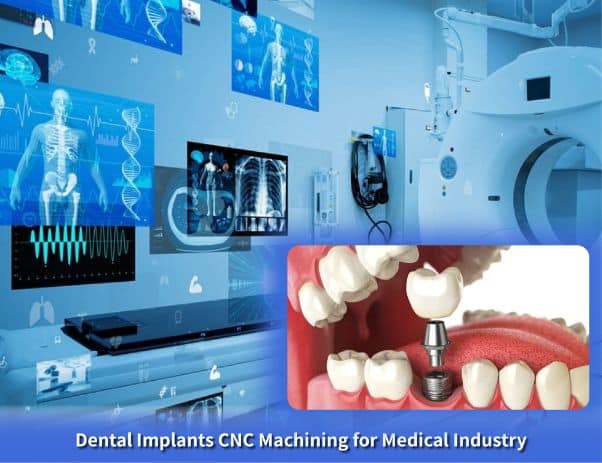
Dental Implants CNC Machining for Medical Industry
- Machining for complex implant bodies and abutments.
- Tight tolerances up to ±0.0003 in.
- Precision Swiss turning, thread milling & micro-drilling.
- Support for rapid prototyping and full-scale production.
- ISO 13485-certified medical device manufacturing.
Why Medical Companies
Choose Zintilon

Fast Delivery
A professional engineering team that can respond quickly to customer needs and provide one-stop services from design to production in a short period of time to ensure fast delivery.

High Precision
We are equipped with automated equipment and sophisticated measuring tools to achieve high accuracy and consistency, ensuring that every part meets the most stringent quality standards.

ISO13485 Certified
As a ISO13485 certified precision manufacturer, our products and services have met the most stringent quality standards in the automotive industry.
From Prototyping to Mass Production


Prototype Dental Implants
Key Points:
- Rapid prototyping with high precision.
- Tight tolerances (±0.0003 in).
- Test design, material, and osseointegration potential early

EVT – Engineering Validation Test
Key Points:
- Ensure the prototype works as intended.
- Make design changes in quick succession.
- Make sure it’s good to go for production.

DVT – Design Validation Test
Key Points:
- Confirm the design and thread quality
- Assess several surface treatments
- Confirm production performance is attainable

PVT – Production Validation Test
Key Points:
- Assess large-scale production capability
- Resolve production issues early
- Ensure process consistency for quality control

Mass Production
Key Points:
- High-volume production consistency
- Quality control for precision machining
- Fast turn around times.

Simplified Sourcing for
the Medical Industry
Explore Other Medical Components
Browse our extensive selection of CNC machined medical parts, engineered to meet the highest quality and hygiene standards. From implant-grade components and instrument handles to housings for imaging systems and lab automation equipment, we deliver precision solutions for the evolving needs of the medical industry.
- Orthopedic Implants
- Bone Screws
- Bone Plates
- Hip Implants
- Knee Implants
- Medical Housings
- Surgical Handles
- Medical Shafts
- Surgical Forceps
- Scalpel Components
- Medical Couplings
- Medical Fittings
- Endoscopic Components
- Medical Valves
- Catheter Components
- Medical Connectors
- Surgical Clamps
- Medical Hubs
- Surgical Pins
- Surgical Drills
- Prosthetic Components
- Medical Brackets
- Medical Casings
- Medical Tubing
- Medical Adapters
- Medical Covers
- Implantable Components
- Medical Device Enclosures
- Surgical Instruments
Medical Dental Implants Machining Capabilities
Along with torque testing and connection verification we perform surgical bone interface preparation. We perform precision Swiss turning, thread rolling, thread cutting, micro drilling, and surface finishing on connective prosthetics for bone interface perfection. Each dental implant titanium component is made from Grade 4 or Grade 5 titanium (Ti-6Al-4V), titanium-zirconium alloys, or zirconia ceramic; hence, they are mechanically robust and clinically functional for decades under masticatory stress. Each component is bone integrated with tested torque and clinically functional for decades.


Aerospace
Materials & Finishes


Specialist Industries



Materials for Dental Implants Components

High machinability and ductility. Aluminum alloys have good strength-to-weight ratio, high thermal and electrical conductivity, low density and natural corrosion resistance.
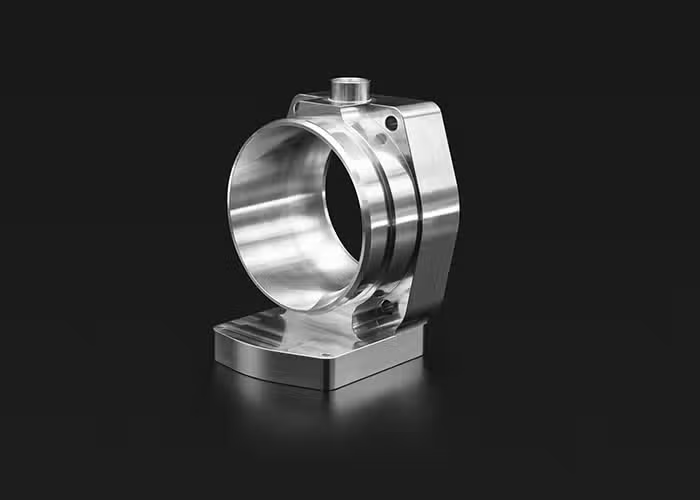
Stainless steel alloys have high strength, ductility, wear and corrosion resistance. They can be easily welded, machined and polished. The hardness and the cost of stainless steel is higher than that of aluminum alloy.

Steel is a strong, versatile, and durable alloy of iron and carbon. Steel is strong and durable. High tensile strength, corrosion resistance heat and fire resistance, easily molded and formed. Its applications range from construction materials and structural components to automotive and aerospace components.

Titanium is an advanced material with excellent corrosion resistance, biocompatibility, and strength-to-weight characteristics. This unique range of properties makes it an ideal choice for many of the engineering challenges faced by the medical, energy, chemical processing, and aerospace industries.

Highly resistant to seawater corrosion. The material’s mechanical properties are inferior to many other machinable metals, making it best for low-stress components produced by CNC machining.

Brass is mechanically stronger and lower-friction metal properties make CNC machining brass ideal for mechanical applications that also require corrosion resistance such as those encountered in the marine industry.

Few metals have the electric conductivity that copper has when it comes to CNC milling materials. The material’s high corrosion resistance aids in preventing rust, and its thermal conductivity features facilitate CNC machining shaping.

Zinc is a slightly brittle metal at room temperature and has a shiny-greyish appearance when oxidation is removed.

Iron is an indispensable metal in the industrial sector. Iron is alloyed with a small amount of carbon – steel, which is not easily demagnetized after magnetization and is an excellent hard magnetic material, as well as an important industrial material, and is also used as the main raw material for artificial magnetism.
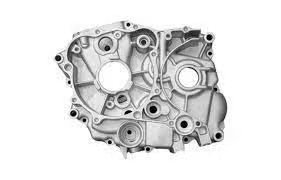
Due to the low mechanical strength of pure magnesium, magnesium alloys are mainly used. Magnesium alloy has low density but high strength and good rigidity. Good toughness and strong shock absorption. Low heat capacity, fast solidification speed, and good die-casting performance.
FAQs: Dental Implants for Medical Applications
Their specifications require them to provide threading with a pitch accuracy to within ±0.010 millimeters for the engagement of the bone and primary stability to be effective. The precision of the connection geometry must be to within ±0.005 millimeters to ensure the prosthetic will attach securely and the screws will not loosen or micro-move. The posterior implants must be designed to withstand and resist fractures on masticatory forces in excess of 500 Newtons. The roughness of the threaded surfaces must have proper surface roughness gains with Ra values of 1 to 2 microns while promoting osseointegration and maintaining the smooth machined collar sections below 0.8 Ra microns at the tissue level to prevent the colonization of bacteria with osseointegration and be biocompatible for lifetime implantation that can exceed 20 to 30 years.
Roxolid titanium-zirconium alloy’s 50 percent increase in strength in comparison to Grade 4 titanium, all while keeping the same osseointegration characteristics, allows for 3.3 millimeter diameter implants to be produced, even though the mechanical properties are equivalent to 4.0 millimeter Grade 4 implants. This decreases the volume of the implants which makes the surgeries less invasive. Multiple animal studies show comparable or superior bone-implant contact, and there is growing clinical evidence for use in difficult anatomical locations. As for zirconia ceramic (yttria-stabilized zirconium dioxide), the metal-free and aesthetically pleasing alternative works to eliminate the grayish discoloration that occurs with thin biotype tissues. The lower surface energy of zirconia allows for minimal plaque accumulation, and the biocompatibility with the human body is fantastic. There is more than adequate strength of over 900 MPa for one-piece implants. The success rate in clinical studies of well-selected cases is over 95 percent for 5 years, and patients who have health concerns or metal allergies are very pleased with metal-free restorations.
Rapid prototyping for design validation
Low-volume production for specialized applications
High-volume production with consistent quality control
Full structural and dimensional verification at every stage
Anodizing (Type II and Type III)
Passivation for corrosion resistance
Precision polishing for aerodynamic surfaces
Custom protective coatings and thermal barriers
This allows us to address complicated scenarios such as severe ridge resorption requiring accurate angulation of the implant for proper prosthetic support, immediate implant placement into extraction sockets with custom healing profiles, full-arch rehabilitations with tilted distal implants evading anatomical structures, anterior esthetic cases where tissues require refined architecture, soft tissue revisions on cases with failed implants where repositioning or angulation was steep, predictable placement, optimal esthetic emergence profiles with tissue support on prosthetics as a result of improved surgical position, contour chairtime with digital design, and increased patient satisfaction from streamlined esthetic outcomes and shortened overall integrated treatment duration.
A smooth machined collar which has an Ra of under 0.8 microns at the tissue level inhibits the accumulation of bacterial plaque. This reduces the incidence of peri-implantitis from 15 percent with rough surfaces to under 5 percent with smooth collars. The optimal surface roughness with Ra of 1 to 2 microns on the bone contact areas facilitates cellular attachment and bone formation at the areas of osseointegration which also exceeds 95 percent success rates even with compromised bone quality. Specific surface treatments that promote bioactivity result in SLA surfaces which show a 20 percent increase in bone contact and the presence of calcium phosphate coatings promote early bone formation, which allows for immediate loading in certain cases. The precise machining of critical cross-sections allows adequate mechanical strength and provides fracture resistance which exceeds 500 Newtons for standard diameter implants and a fatigue life of over 10 million cycles at ISO 14801 physiological loads. Biocompatible titanium materials prevent adverse tissue reactions which allows for permanent integration. This also allows for predictable surgical protocols, given the consistency of dimensions and the correct sizing with depth control. The quality of manufacturing removes surface defects which prevents stress concentration and the initiation of cracks.
The modernized workflows of restorative prosthetics have been simplified by precise manufacturing of modular systems, as well as interchangeable components to be prosthetized. Also, precision machining of dental implants has laid down the clinical groundwork for continued successful outcomes, which includes long-term osseointegration outcomes of more than 95% success rates with viable bone, preservation long-term survival rates beyond 90% for the 15-year mark with appropriate maintenance, minimal complication rates (implant fractures under 0.5% and screw loosening under 2% as long as properly torqued), marginal bone loss of less than 1.5 mm the first year, less than 0.2 mm loss every year thereafter as properly maintained with acceptable design and loading, functional restoration, and supporting mastication following normal chewing patterns, improved dietary intake, and healthy, restored esthetics. Over 85% of patients restored with prosthetics provided predictable tooth replacements report satisfactory outcomes as it was comfortable, functional, and esthetic for a prosthetic which improves the quality of life for millions with missing teeth.