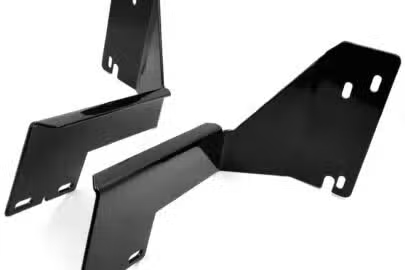
We have moved to a new Website Check Now

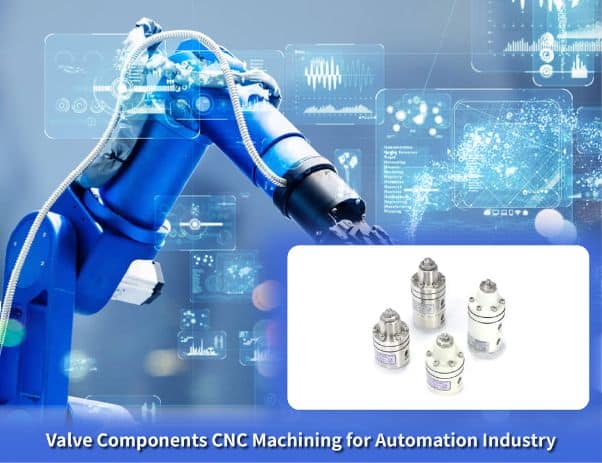
Valve Components CNC Machining for Automation Industry

Valve parts are precision parts which control the flow of fluids in hydraulic systems and automation equipment. They also control the pressure in pneumatic circuits. Here at Zintilon, we specialize in the CNC machining of valve components, using advanced Swiss-type turning and lapping for exceptional sealing surfaces and precise flow orifices, leak-free performance reliable for process control in industrial automation applications.
  • Machining for complex valve bodies and sealing surfaces
  • Tight tolerances up to ±0.0005 in
  • Precision Swiss turning, lapping & flow passage machining
  • Support for rapid prototyping and full-scale production
  • ISO 9001-certified automation manufacturing

Trusted by 15,000+ businesses

Automotive Body Panels Machining Capabilities

prductivity

Fast Delivery

A professional engineering team that can respond quickly to customer needs and provide one-stop services from design to production in a short period of time to ensure fast delivery.

10x

High Precision

We are equipped with automated equipment and sophisticated measuring tools to achieve high accuracy and consistency, ensuring that every part meets the most stringent quality standards.

world

ITAF16949 Certified

As a IATF16949 certified precision manufacturer, our products and services have met the most stringent quality standards in the automotive industry.

From Prototyping to Mass Production

Zintilon offers CNC machining for valve components and fluid control parts integrated with industrial automation, hydraulic systems, and process control equipment globally.

Prototype Valve Components

High precision prototypes of valve components are available and replicate your end design perfectly. They help in testing flow characteristics, sealing performance, and pressure regulation control which are essential for production scaling.
Key Points:
Rapid prototyping with high precision
Tight tolerances (±0.0005 in)
Test design, flow control, and sealing early
3 Axis CNC Machined Stainless Steel Passivation

EVT – Engineering Validation Test

Rapid iteration on valve component prototypes helps in ascertaining which prototypes meet the required pressure and flow for the corresponding valve. Prototypes help in early identification of issues before the transition to automated manufacturing at full scale.
Key Points:
Validate prototype functionality
Rapid design iterations
Ensure readiness for production
Anodized Aluminum 1024x536

DVT – Design Validation Test

Prototype valve components to various materials and test for flow control to ensure design accuracy and sealing integrity prior to mass production. Sealing integrity, crafted components, and controlled flow are design validations for stamp approval prior to production.
Key Points:
Confirm design integrity and sealing
Test multiple materials and configurations
Ensure production-ready performance
design aluminium

PVT – Production Validation Test

Validate the production provision for the control valve parts and dislocate the obstacles for consistent production. Obstacle dislocation provides rework for the production process, navigating integral guidances for part quality.
Key Points:
Test large-scale production capability
Detect and fix process issues early
Ensure consistent part quality
Anodized Titanium Fastener

Mass Production

Evaluate the production provision for the control valve parts and dislocate the obstacles for consistent production. Obstacle dislocation provides rework for the production process, navigating integral guidances for part quality.
Key Points:
Consistent, high-volume production
Precision machining for industrial-grade quality
Fast turnaround with strict quality control
production

Simplified Sourcing for
the Automotive Industry

Through excellent processing technologies such as CNC machining, sheet metal manufacturing, metal casting, etc., we can achieve a balance between quality and speed, whether it is special-shaped parts, lightweight or cost effect.

Explore Other Automation Components

Browse our complete selection of CNC machined automation components, engineered for accuracy and long-lasting operation. From precision shafts and brackets to robotic frames, housings, and end effectors, we deliver tailored solutions to support automation, robotics, and smart manufacturing technologies.

Automation Valve Components Machining Capabilities

Because of our advanced Swiss-type CNC machines and lapping equipment in combination with the experienced precision machinists, we provide Valve Components CNC Machining for Automation Industry. Each piece, from hydraulic valve spools to pressure relief bodies and directional control valve housings with critical sealing surfaces, is manufactured for smooth flow control, low leakage, and long cycle life. Every part is made from long lasting and corrosion resistant materials including brass (C36000, C46400), stainless steel (303, 316, 17-4 PH), alloy steel (4140), aluminum alloys (6061-T6), and other industrial grade alloys or warehouses metals.
milling

CNC Machining

sheet metal

Sheet Metal Fabrication

edm

Wire EDM

Aerospace
Materials & Finishes

Materials
We provide a wide range of materials, including metals, plastics, and composites.
Finishes
We offer superior surface finishes that enhance part durability and aesthetics for applications requiring smooth or textured surfaces.

Specialist Industries

you are welcome to emphasize it in the drawings or communicate with the sales.

Materials for Valve Components

More than 25 industrial grade metals and specialized alloys for Valve Components Machining for Automation Industry allows our production and machine CNC shop to provide Valve Components for CNC Automation with a wide choice of raw materials. This helps us provide custom fluid control manufacturing and rapid prototyping while ensuring consistent precision and industrial grade quality.
Aluminum Image

High machinability and ductility. Aluminum alloys have good strength-to-weight ratio, high thermal and electrical conductivity, low density and natural corrosion resistance.

Price
$ $ $
Lead Time
< 7 days
Tolerances
Down to ±0.003 mm
Max part size
3000*2200*1100 mm
Min part size
2*2*2 mm
Steel Image

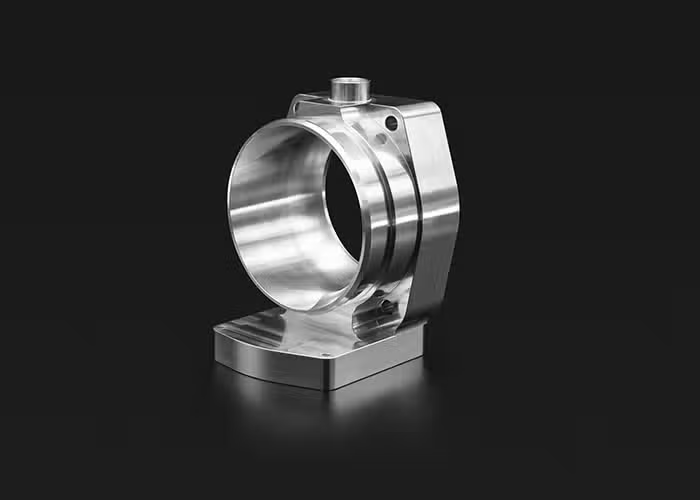
Steel is a strong, versatile, and durable alloy of iron and carbon. Steel is strong and durable. High tensile strength, corrosion resistance heat and fire resistance, easily molded and formed. Its applications range from construction materials and structural components to automotive and aerospace components.
Price
$ $ $ $ $
Lead Time
< 10 days
Tolerances
Down to ±0.001 mm (routing)
Max part size
3000*2200*1100 mm
Min part size
2*2*2 mm
Stainless steel Image

Stainless steel alloys have high strength, ductility, wear and corrosion resistance. They can be easily welded, machined and polished. The hardness and the cost of stainless steel is higher than that of aluminum alloy.

Price
$ $ $
Lead Time
< 7 days
Tolerances
Down to ±0.005 mm
Max part size
3000*2200*1100 mm
Min part size
2*2*2 mm
Titanium Image

Titanium is an advanced material with excellent corrosion resistance, biocompatibility, and strength-to-weight characteristics. This unique range of properties makes it an ideal choice for many of the engineering challenges faced by the medical, energy, chemical processing, and aerospace industries.

Price
$$$
Lead Time
< 10 days
Tolerances
Down to ±0.005 mm
Max part size
3000*2200*1100 mm
Min part size
2*2*2 mm
Bronze Image

Highly resistant to seawater corrosion. The material’s mechanical properties are inferior to many other machinable metals, making it best for low-stress components produced by CNC machining.

Price
$ $ $ $ $
Lead Time
< 10 days
Tolerances
Down to ±0.005 mm
Max part size
3000*2200*1100 mm
Min part size
2*2*2 mm
Brass Image

Brass is mechanically stronger and lower-friction metal properties make CNC machining brass ideal for mechanical applications that also require corrosion resistance such as those encountered in the marine industry.

Price
$$$
Lead Time
< 10 days
Tolerances
Down to ±0.005mm
Max part size
3000*2200*1100 mm
Min part size
2*2*2 mm
Copper Image

Few metals have the electric conductivity that copper has when it comes to CNC milling materials. The material’s high corrosion resistance aids in preventing rust, and its thermal conductivity features facilitate CNC machining shaping.

Price
$$$
Lead Time
< 10 days
Tolerances
Down to ±0.005 mm
Max part size
3000*2200*1100 mm
Min part size
2*2*2 mm
Zinc Image

Zinc is a slightly brittle metal at room temperature and has a shiny-greyish appearance when oxidation is removed.

Price
$ $ $ $ $
Lead Time
< 10 days
Tolerances
Down to ±0.005 mm
Max part size
3000*2200*1100 mm
Min part size
2*2*2 mm
Iron Image

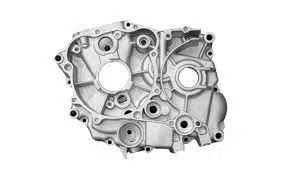
Iron is an indispensable metal in the industrial sector. Iron is alloyed with a small amount of carbon – steel, which is not easily demagnetized after magnetization and is an excellent hard magnetic material, as well as an important industrial material, and is also used as the main raw material for artificial magnetism.
Price
$ $ $ $ $
Lead Time
< 10 days
Tolerances
Down to ±0.005 mm
Max part size
3000*2200*1100 mm
Min part size
2*2*2 mm
Magnesium Image

Due to the low mechanical strength of pure magnesium, magnesium alloys are mainly used. Magnesium alloy has low density but high strength and good rigidity. Good toughness and strong shock absorption. Low heat capacity, fast solidification speed, and good die-casting performance.
Price
$ $ $ $
Lead Time
< 7 days
Tolerances
Down to ±0.005 mm
Max part size
3000*2200*1100 mm
Min part size
2*2*2 mm
Let’s Build Something Great, Together

FAQs: Valve Components for Automation Applications

Valve components are parts responsible for the precise control of fluids by regulating the flow, pressure, and the direction of hydraulic and pneumatic systems. These components range from hydraulic valve bodies which control the flow of oil at pressures up to 350 bar, to valve spools which provide directional control with lap dimensions of 5 microns, precision pressure relief valves with seats and springs, and check valves, to solenoid valves and housings with coil mounting interfaces, proportional valve cartridges for variable flow control, ball valve seats and stems, poppet valve components for fast response, and specialty parts such as pilot-operated valve assemblies, servo valve components for precision motion control, and cartridge valve cavities as per ISO 7368 standards.

Brass C36000 and C46400 possess excellent machinability for intricate configurations of the internal passages, with sufficient strength for operating pressures of up to 40 bars, natural valve spool lubricity, and lowering the friction of the valve, augmented hydraulic fluid and compressed air corrosion, and reasonable costs for high-volume production runs. Stainless steel 303, 316, and 17-4 PH has the supreme strength needed for high-pressure hydraulic valves up to 420 bars, the unrivaled corrosion resistance of hydraulic fluids in chemical processing and marine applications, the hardening mechanism to withstand wear of the seating surfaces, and the compliance with food-grade standards for stainless steel and alloys in valves. alloy steel 4140 is the material of choice. It exhibits great strength and toughness, particularly in the construction of heavy-duty valves, while also being cost-effective. Furthermore, the 6061-T6 aluminum alloy is lightweight, has decent corrosion resistance, and has sufficient strength to manufacture construction pneumatic valves to 16 bar.

In a single operation of under 90 seconds, Swiss-type CNC turning completes entire valve bodies, spools, and seats of intricate designs. Multi-axis milling machines are used for the creation of internal flow passages, port connections, and features for valve mounting. Lapping produces exceptionally flat sealing surfaces to a flatness of 0.0001 inches and a surface finish below 0.05 Ra microns, achieving metal-to-metal sealing with absolute no leakage. Flat honing produces precise valve spool bores with controlled clearances of 3–8 microns for smooth operation. Cross-drilling and thread cutting produces intersecting fluid passages and port threads respectively to meet both ISO 228 and NPT standards. The internal passages of valves are electropolished to reduce internal surface corrosion and to smoothen the surfaces to reduce pressure drop.

We achieve sealing surface flatness within 0.0001 inches for leak-free performance below detectable limits, valve bore tolerances within ±0.0005 inches controlling spool clearance and leakage, orifice diameter accuracy within ±0.0003 inches for precise flow control within 2 percent, surface finish below 0.05 Ra microns on lapped seating surfaces, concentricity within 0.0005 inches for proper valve alignment, and thread dimensions within ±0.0003 inches ensuring leak-free port connections meeting ISO 228 standards.

Yes, we provide rapid prototyping to verify fit and test assembly, with same-day CAD-to-part capability available for critical projects. For custom automation cells and research platforms, we perform low-volume production of 20 to 500 brackets. For standardized robot models, we perform high-volume production of thousands to tens of thousands of brackets annually, incorporating complete dimensional inspection, flatness verification, and material certifications.

Yes, and all components are manufactured under ISO 9001 with complete material traceability, examination of dimensions by design, pressure-tested hydraulic and pneumatic components up to 300 bar, and documented motion components in industrial robotics for intricate requirements. Documentation includes positioning accuracy within 0.05 mm, controlled motion within 2% of a load, durability through millions of cycles, and within motion for programmable sequencing.

Options include anodizing on aluminum for the protection against corrosion, powder coating for environmental protection in custom colors where corrosion resistance exceeds 1000 hours in salt spray tests, zinc plating on steel for rust resistance, black oxide coating on steel for non-reflective surfaces in vision applications, bead blasting for uniform matte texture, and chromate conversion coating for electrical conductivity, while for precision grinding ultra-flat mounting surfaces are made with flatness made 0.003 inches.
Got any more questions?