We have moved to a new Website Check Now

Spindles CNC Machining for Automation Industry

Spindles are high-precision rotating components in automated manufacturing systems that provide control and transmission of power for motion. Zintilon specializes in CNC machining for spindle shafts, housings, and mounting assemblies, achieving outstanding concentric and surface finishes to ensure reliable performance and dynamic balancing for industrial automation in machine systems.
  • Machining for complex spindle geometries and bearing interfaces
  • Tight tolerances up to ±0.0005 in for rotational accuracy
  • Precision turning, grinding & dynamic balancing
  • Support for rapid prototyping and full-scale production
  • ISO 9001-certified manufacturing with automation industry expertise


Trusted by 15,000+ businesses

Automation Springs Machining Capabilities

Increased Productivity

Fast Delivery

A professional engineering team that can respond quickly to customer needs and provide one-stop services from design to production in a short period of time to ensure fast delivery.

10x Tighter Tolerances

High Precision

We are equipped with automated equipment and sophisticated measuring tools to achieve high accuracy and consistency, ensuring that every part meets the most stringent quality standards.

AS9100D Quality Certification

ITAF16949 Certified

As a IATF16949 certified precision manufacturer, our products and services have met the most stringent quality standards in the automotive industry.

From Prototyping to Mass Production

For machine builders, automation system integrators, and industrial equipment builders globally, Zintilon offers CNC machining for spindles and other automation components.

Prototype Spindles

Consistently and rapidly manufacture high-quality spindle automation. Ensure optimum performance and timely delivery for automation system integrators and machine builders..
Key Points:
Consistent, high-volume production
Precision machining for automation-grade quality
Fast turnaround with strict quality control
3 Axis CNC Machined Stainless Steel Passivation

EVT – Engineering Validation Test

Verify the production of spindles and identify manufacturing challenges to be addressed for mass production to maintain balance and efficiency.
Key Points:
Test large-scale production capability
Detect and fix process issues early
Ensure consistent part quality
Anodized Aluminum 1024x536

DVT – Design Validation Test

Validate spindle design by heat treating materials and assessing structural integrity and operational balance to ensure design correctness and optimal performance prior to mass production.
Key Points:
Confirm design integrity and balance quality
Test multiple materials and treatments
Ensure production-ready performance
design aluminium

PVT – Production Validation Test

Rapidly test and iterate spindle designs to assess functionality and performance for early identification of possible problems to enable seamless automation component manufacturing.
Key Points:
Validate prototype functionality
Rapid design iterations
Ensure readiness for production
Anodized Titanium Fastener

Mass Production

Receive high-precision spindle assemblies designed to replicate your final design as closely as possible to serve as prototypes. They allow you to validate dynamic performance, bearing fits, balance conditions, and machine system interfaces before commencing full automation production.
Key Points:
Rapid prototyping with high precision
Tight tolerances (±0.0005 in)
Test design, balance, and bearing interfaces early
production

Simplified Sourcing for
the Aerospace Industry

Our aviation industry parts manufacturing capabilities have been verified by many listed companies. We provide a variety of manufacturing processes and surface treatments for aerospace parts including titanium alloys and aluminum alloys.

Explore Other Automation Components

Browse our complete selection of CNC machined automation components, engineered for accuracy and long-lasting operation. From precision shafts and brackets to robotic frames, housings, and end effectors, we deliver tailored solutions to support automation, robotics, and smart manufacturing technologies.

Automation Spindles Machining Capabilities

With our highly skilled automation component machinists, automation industry Spindle CNC machining encompasses all automation components from insulated motor spindles, tool holder spindles, and high-speed machining spindles with precision bearing seats. Each component is designed to ensure optimal concentricity, minimal runout, and high durability in severe automated manufacturing environments for proven spindle longevity. Polished spindle performance is achieved and guaranteed with precision CNC turning, cylindrical grinding, thread grinding, dynamic balancing, runout, and bearing fit verification. Each spindle is constructed from a selected alloy (4140, 4340), stainless (17-4 PH, 416), aluminum (7075-T6), or tool (D2, M2) steel. This careful selection ensures spindle machining retains required strength, abrasion resistance, and dimensional stability for high-speed rotation and prolonged use.
milling

CNC Machining

sheet metal

Sheet Metal Fabrication

edm

Wire EDM

Aerospace
Materials & Finishes

Materials
We provide a wide range of materials, including metals, plastics, and composites.
Finishes
We offer superior surface finishes that enhance part durability and aesthetics for applications requiring smooth or textured surfaces.

Specialist Industries

you are welcome to emphasize it in the drawings or communicate with the sales.

Materials for Spindles Components

Our CNC machine shop is equipped with a large selection of spindle components machining materials for the automation industry. The ability to switch between 20 metals and custom heat-treated alloys allows us to provide materials for rapid prototyping and precision automation component manufacturing while maintaining excellent machining quality.
Aluminum Image

High machinability and ductility. Aluminum alloys have good strength-to-weight ratio, high thermal and electrical conductivity, low density and natural corrosion resistance.

Price
$ $ $
Lead Time
< 7 days
Tolerances
Down to ±0.003 mm
Max part size
3000*2200*1100 mm
Min part size
2*2*2 mm
Zinc Image

Zinc is a slightly brittle metal at room temperature and has a shiny-greyish appearance when oxidation is removed.

Price
$ $ $ $ $
Lead Time
< 10 days
Tolerances
Down to ±0.005 mm
Max part size
3000*2200*1100 mm
Min part size
2*2*2 mm
Titanium Image

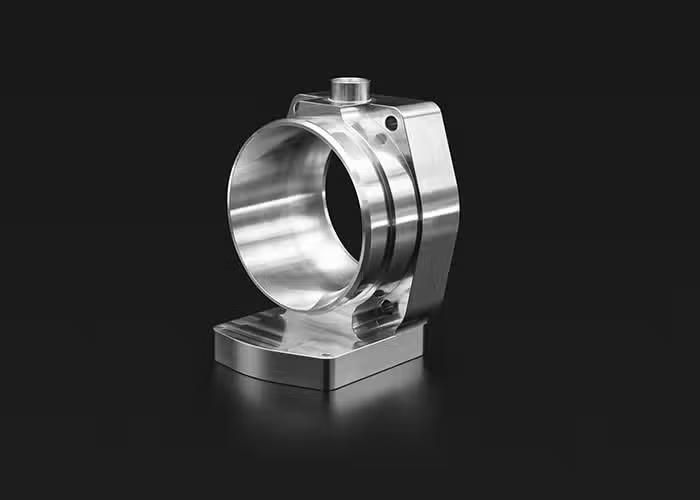
Titanium is an advanced material with excellent corrosion resistance, biocompatibility, and strength-to-weight characteristics. This unique range of properties makes it an ideal choice for many of the engineering challenges faced by the medical, energy, chemical processing, and aerospace industries.
Price
$$$
Lead Time
< 10 days
Tolerances
Down to ±0.005 mm
Max part size
3000*2200*1100 mm
Min part size
2*2*2 mm
Stainless steel Image

Stainless steel alloys have high strength, ductility, wear and corrosion resistance. They can be easily welded, machined and polished. The hardness and the cost of stainless steel is higher than that of aluminum alloy.

Price
$ $ $
Lead Time
< 7 days
Tolerances
Down to ±0.005 mm
Max part size
3000*2200*1100 mm
Min part size
2*2*2 mm
Steel Image

Steel is a strong, versatile, and durable alloy of iron and carbon. Steel is strong and durable. High tensile strength, corrosion resistance heat and fire resistance, easily molded and formed. Its applications range from construction materials and structural components to automotive and aerospace components.

Price
$ $ $ $ $
Lead Time
< 10 days
Tolerances
Down to ±0.001 mm (routing)
Max part size
3000*2200*1100 mm
Min part size
2*2*2 mm
Bronze Image

Highly resistant to seawater corrosion. The material’s mechanical properties are inferior to many other machinable metals, making it best for low-stress components produced by CNC machining.

Price
$ $ $ $ $
Lead Time
< 10 days
Tolerances
Down to ±0.005 mm
Max part size
3000*2200*1100 mm
Min part size
2*2*2 mm
Brass Image

Brass is mechanically stronger and lower-friction metal properties make CNC machining brass ideal for mechanical applications that also require corrosion resistance such as those encountered in the marine industry.

Price
$$$
Lead Time
< 10 days
Tolerances
Down to ±0.005mm
Max part size
3000*2200*1100 mm
Min part size
2*2*2 mm
Copper Image

Few metals have the electric conductivity that copper has when it comes to CNC milling materials. The material’s high corrosion resistance aids in preventing rust, and its thermal conductivity features facilitate CNC machining shaping.
Price
$$$
Lead Time
< 10 days
Tolerances
Down to ±0.005 mm
Max part size
3000*2200*1100 mm
Min part size
2*2*2 mm
Magnesium Image

Due to the low mechanical strength of pure magnesium, magnesium alloys are mainly used. Magnesium alloy has low density but high strength and good rigidity. Good toughness and strong shock absorption. Low heat capacity, fast solidification speed, and good die-casting performance.

Price
$ $ $ $
Lead Time
< 7 days
Tolerances
Down to ±0.005 mm
Max part size
3000*2200*1100 mm
Min part size
2*2*2 mm
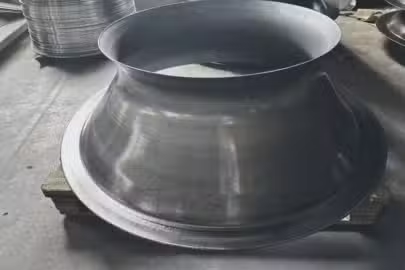
Iron Image

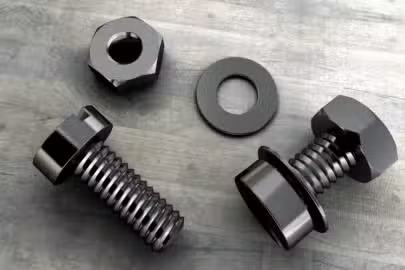
Iron is an indispensable metal in the industrial sector. Iron is alloyed with a small amount of carbon – steel, which is not easily demagnetized after magnetization and is an excellent hard magnetic material, as well as an important industrial material, and is also used as the main raw material for artificial magnetism.
Price
$ $ $ $ $
Lead Time
< 10 days
Tolerances
Down to ±0.005 mm
Max part size
3000*2200*1100 mm
Min part size
2*2*2 mm
Let’s Build Something Great, Together

FAQs: Spindles for Automation Applications

We provide comprehensive finishing solutions tailored to the needs of each precision bearing component. These include precision cylindrical grinding to attain surface finishes below 4 Ra microinches on raceways with stock removal for dimensional accuracy control, superfinishing with abrasive stones to below 2 Ra microinches to create ultra-smooth surfaces for lower friction and extended life, lapping for bearing faces to attain mirror finishes and flatness within 0.0001 inches, through-hardening heat treatment to attain 58 to 63 HRC hardness on 52100 steel with tempering for toughness, case hardening for selective hardening of raceway surfaces while leaving ductile cores, black oxide coating for light corrosion protection and break-in lubrication retention, phosphate coating for temporary corrosion protection during storage and shipping, passivation on stainless steel to remove free iron and to enhance corrosion resistance, and specialized coatings like titanium nitride (TiN) and diamond-like carbon (DLC) for extreme wear applications or dry running conditions where conventional lubrication is used.

Yes, Zintilon spindles and every other component they sell are certified to the relevant industry standards. All of them are produced under an ISO 9001 certified quality management system. Zintilon then certifies compliance with the relevant ANSI and DIN standards and additional certifications as required for all interfaces, tapers and other spindle components. Zintilon provides AGMA standard compliance for gear driven spindles and complete material traceability along with mill certs and heat treat reports. Zintilon certifies compliance with automation industry standards as well.

Yes, Zintilon provides versatile manufacturing options, which includes rapid prototyping for bearing designs and custom application testing with CNC turning and grinding, as well as low-volume production for specialized robotics where size and geometry are non-standard and custom, medium-volume production for research and limited production robots, high-volume production for standardized bearing components which are for robots equipped with sophisticated automation where thousands of races or housings are produced annually to precise tolerances, complete dimensional inspection and external and internal geometric consistency was ensured using bearing measuring machines, CNC measuring machines, and complete process documentation assessed and verified critical components for motion control bearings including dimensional and surface roughness, contours with profilometers, hardness for thermal treatment assessed and verified against control steps, ABEC or ISO tolerance classes were documented for critical motion control applications, and tolerances defined by the customer were verified for motion control application to bearing and housings.

For spindles, we are capable of attaining tolerances of bearing seat diameters of ±0.0003 inches. This is for optimum bearing seat fit and bearing preload. Concentricity of the journal surfaces of 0.0002 inches is achieved, which effectively minimizes runout. Surface finish on bearing contact areas is below 0.1 Ra microns, ensuring smooth rotation of the spindle. Thread tolerances of 6H/6g are achieved for the spindle, securing the tool on the spindle. Straightness of the spindle is controlled within 0.0005 inches per foot of length. Dynamic balance is accomplished to G2.5 grade which reduce vibration, and enhance the life of the bearing in high-speed automation applications.

Certain CNC processes are used for the manufacture for spindles. Computer numerically controlled precision turning performs the first stage of spindle processing, dimensioning the cylindrical spindle bodies, turning, and creating bearing seats. Tolerances of 0.0003 inches are controlled. Subsequent processing of spindles is performed in the cylindrical grinding with tolerances of 0.0002 inches in concentric grinding. Finish surface of the spindle is less than 0.1 Ra microns. Thread grinding is used for the precision grinding of threads for tool holding assembly and connection. Hard turning performs the machine spindle surface turning after heat treatment for hardening. Dynamic balancing is used for the spindle, for reducing the vibration, with balance grade of G2.5 or better. This is the optimum spindle balance. Honing is performed for the precision bearing bore and surface finish. This is needed for longer bearing life.

Spindles are shafts of automation machinery that are precision-engineered to rotate, transmit power, and facilitate controlled rotation in machinery. Spindle types include motor spindles, which are drive motors integrated for direct drive systems. Tool holder spindles accept end effectors and cutting tools. High-speed machining spindles operate within 10,000-60,000 RPM and belt-driven spindles transmit power. Electrospindles have built-in motors for compact designs, while grinding spindles are crafted for precision surface finishing. Modular spindle cartridges are designed for quick tooling changes in flexible automation systems.
Got any more questions?