We have moved to a new Website Check Now

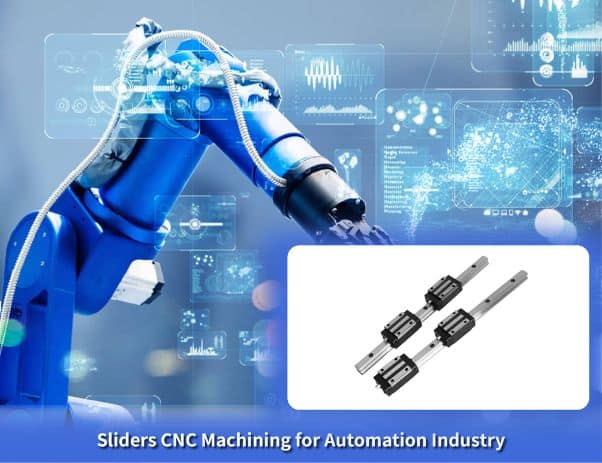
Sliders CNC Machining for Automation Industry

Automation sliders are precision-machined linear motion components that enable smooth, accurate positioning and travel in robotic systems and automated equipment. At Zintilon, we specialize in CNC machining of sliders using advanced multi-axis machining to achieve exceptional straightness, surface finish, and dimensional consistency for reliable linear motion and extended service life in industrial automation applications.
  • Machining for complex slider geometries and bearing surfaces
  • Tight tolerances up to ±0.001 in
  • Precision milling, grinding & surface hardening
  • Support for rapid prototyping and full-scale production
  • ISO 9001-certified automation manufacturing

Trusted by 15,000+ businesses

Automation Springs Machining Capabilities

Increased Productivity

Fast Delivery

A professional engineering team that can respond quickly to customer needs and provide one-stop services from design to production in a short period of time to ensure fast delivery.

10x Tighter Tolerances

High Precision

We are equipped with automated equipment and sophisticated measuring tools to achieve high accuracy and consistency, ensuring that every part meets the most stringent quality standards.

AS9100D Quality Certification

ITAF16949 Certified

As a IATF16949 certified precision manufacturer, our products and services have met the most stringent quality standards in the automotive industry.

From Prototyping to Mass Production

Zintilon provides CNC machining for sliders and related linear motion components for industrial automation, assembly systems, and material handling equipment worldwide.

Prototype Sliders

Obtain high-precision prototypes of sliders that accurately replicate your final design. Test motion smoothness, verify load capacity, and ensure proper alignment before full-scale production.
Key Points:
Demonstrate precision in rapid prototyping
Maintain tight tolerances (±0.001 in)
Early stage design testing for motion quality/load capacity
3 Axis CNC Machined Stainless Steel Passivation

EVT – Engineering Validation Test

Rapid slider prototype iterations focus on confirming compliance with all motion automation and durability expectations. Engineering validation tests' focus on potential issue identification enables more seamless transitions to more extensive automated manufacturing.
Key Points:
Validation of prototype functionality
Rapid design iterations allow for sequential design testing
Finalize products for manufacturing
Anodized Aluminum 1024x536

DVT – Design Validation Test

In various materials and coatings, confirm the motion slider performance for design validation in precision mass manufacturing. With the intent of final mass manufacturing precision placement of the motion slider in the assembly.
Key Points:
Design and straightness confirmation
Multivariate material and batt surface treatments
Production performance confirmation
design aluminium

PVT – Production Validation Test

Verification of slider mass production feasibility for design and assembly received, focusing on design automation of the preceding steps to ensure efficient and uninterrupted workflow overall.
Key Points:
Test the large-scale production capability
Detect and fix process issues early
Ensure consistent part quality
Anodized Titanium Fastener

Mass Production

Produce high-quality, precision-grade sliders at scale with precision and speed, ensuring reliable linear motion and on-time delivery for automation equipment manufacturers and system integrators.
Key Points:
Ongoing Production of Large Consistent Volumes
Scale Production with Industrial-quality Precision Machine
Rapid Turnaround with Complete Quality Assurance
production

Simplified Sourcing for
the Aerospace Industry

Our aviation industry parts manufacturing capabilities have been verified by many listed companies. We provide a variety of manufacturing processes and surface treatments for aerospace parts including titanium alloys and aluminum alloys.

Explore Other Automation Components

Browse our complete selection of CNC machined automation components, engineered for accuracy and long-lasting operation. From precision shafts and brackets to robotic frames, housings, and end effectors, we deliver tailored solutions to support automation, robotics, and smart manufacturing technologies.

Automation Sliders Machining Capabilities

The integration of advanced CNC machining and surface grinding systems with expert precision machinists ensures exceptional slider CNC machining for the Automation industry. Every component, whether dovetail sliders, T-slot carriages, or tailored linear bearing block slider assemblies, is designed for optimal straightness and aligned axes. Friction is minimized and engineered for abrasion resistance for exceptional wear, and is of industrial grade. Each slider is machined and designed with the appropriate cold or hot worked or cast tool steel, D2 or S7, alloy steels 4140, aluminum alloys 7075-T6 or 6061-T6, or cast iron. Designed and engineered with appropriate surface grinding, induction hardening, and lapping, the machining provides excellent surface for sliding, dimensional stability, straightness, and load testing of industrial reciprocating machines and assemblies.
milling

CNC Machining

sheet metal

Sheet Metal Fabrication

edm

Wire EDM

Aerospace
Materials & Finishes

Materials
We provide a wide range of materials, including metals, plastics, and composites.
Finishes
We offer superior surface finishes that enhance part durability and aesthetics for applications requiring smooth or textured surfaces.

Specialist Industries

you are welcome to emphasize it in the drawings or communicate with the sales.

Materials for Sliders Components

Using advanced CNC machines provides a wider variety of materials for slider precision machining in the Automation industry. More than 25 industrial-grade and metal construction alloy supplies interconnect precision machining for the construction and polymer machining.
Aluminum Image

High machinability and ductility. Aluminum alloys have good strength-to-weight ratio, high thermal and electrical conductivity, low density and natural corrosion resistance.

Price
$ $ $
Lead Time
< 7 days
Tolerances
Down to ±0.003 mm
Max part size
3000*2200*1100 mm
Min part size
2*2*2 mm
Zinc Image

Zinc is a slightly brittle metal at room temperature and has a shiny-greyish appearance when oxidation is removed.

Price
$ $ $ $ $
Lead Time
< 10 days
Tolerances
Down to ±0.005 mm
Max part size
3000*2200*1100 mm
Min part size
2*2*2 mm
Titanium Image

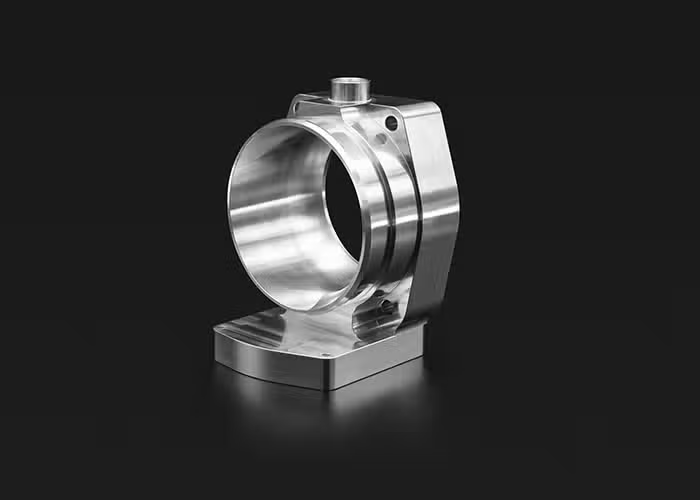
Titanium is an advanced material with excellent corrosion resistance, biocompatibility, and strength-to-weight characteristics. This unique range of properties makes it an ideal choice for many of the engineering challenges faced by the medical, energy, chemical processing, and aerospace industries.
Price
$$$
Lead Time
< 10 days
Tolerances
Down to ±0.005 mm
Max part size
3000*2200*1100 mm
Min part size
2*2*2 mm
Stainless steel Image

Stainless steel alloys have high strength, ductility, wear and corrosion resistance. They can be easily welded, machined and polished. The hardness and the cost of stainless steel is higher than that of aluminum alloy.

Price
$ $ $
Lead Time
< 7 days
Tolerances
Down to ±0.005 mm
Max part size
3000*2200*1100 mm
Min part size
2*2*2 mm
Steel Image

Steel is a strong, versatile, and durable alloy of iron and carbon. Steel is strong and durable. High tensile strength, corrosion resistance heat and fire resistance, easily molded and formed. Its applications range from construction materials and structural components to automotive and aerospace components.

Price
$ $ $ $ $
Lead Time
< 10 days
Tolerances
Down to ±0.001 mm (routing)
Max part size
3000*2200*1100 mm
Min part size
2*2*2 mm
Bronze Image

Highly resistant to seawater corrosion. The material’s mechanical properties are inferior to many other machinable metals, making it best for low-stress components produced by CNC machining.

Price
$ $ $ $ $
Lead Time
< 10 days
Tolerances
Down to ±0.005 mm
Max part size
3000*2200*1100 mm
Min part size
2*2*2 mm
Brass Image

Brass is mechanically stronger and lower-friction metal properties make CNC machining brass ideal for mechanical applications that also require corrosion resistance such as those encountered in the marine industry.

Price
$$$
Lead Time
< 10 days
Tolerances
Down to ±0.005mm
Max part size
3000*2200*1100 mm
Min part size
2*2*2 mm
Copper Image

Few metals have the electric conductivity that copper has when it comes to CNC milling materials. The material’s high corrosion resistance aids in preventing rust, and its thermal conductivity features facilitate CNC machining shaping.
Price
$$$
Lead Time
< 10 days
Tolerances
Down to ±0.005 mm
Max part size
3000*2200*1100 mm
Min part size
2*2*2 mm
Magnesium Image

Due to the low mechanical strength of pure magnesium, magnesium alloys are mainly used. Magnesium alloy has low density but high strength and good rigidity. Good toughness and strong shock absorption. Low heat capacity, fast solidification speed, and good die-casting performance.

Price
$ $ $ $
Lead Time
< 7 days
Tolerances
Down to ±0.005 mm
Max part size
3000*2200*1100 mm
Min part size
2*2*2 mm
Iron Image

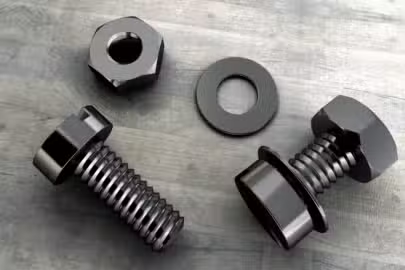
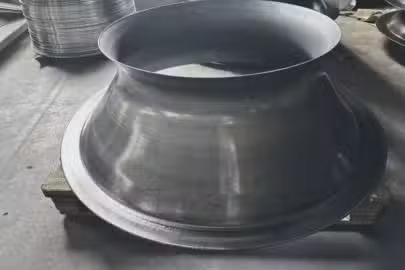
Iron is an indispensable metal in the industrial sector. Iron is alloyed with a small amount of carbon – steel, which is not easily demagnetized after magnetization and is an excellent hard magnetic material, as well as an important industrial material, and is also used as the main raw material for artificial magnetism.
Price
$ $ $ $ $
Lead Time
< 10 days
Tolerances
Down to ±0.005 mm
Max part size
3000*2200*1100 mm
Min part size
2*2*2 mm
Let’s Build Something Great, Together

FAQs: Sliders for Automation Applications

All components are manufactured under ISO 9001 quality management systems with complete material traceability including heat treatment certifications, dimensional verification against design specifications, straightness and flatness measurement reports, hardness testing documentation validating 58-62 HRC on bearing surfaces, and adherence to manufacturing standards for linear motion components requiring reliable positioning accuracy within 0.05 millimeters, smooth motion with friction coefficients below 0.1, and durability through millions of travel cycles.

Yes, we provide rapid prototyping to verify fit and test assembly, with same-day CAD-to-part capability available for critical projects. For custom automation cells and research platforms, we perform low-volume production of 20 to 500 brackets. For standardized robot models, we perform high-volume production of thousands to tens of thousands of brackets annually, incorporating complete dimensional inspection, flatness verification, and material certifications.

Flattening and smoothing of bearing surfaces for motion within a range of 0.001 inches, 0.002 inches between opposing surfaces for seamless binding, 0.001 inches per foot straightness for travel paths, less than 0.2 Ra microns for sliding surfaces, ± 0.001 inches for critical features, and 0.003 inches perpendicularity between mounting and bearing surfaces for proper alignment were all achieved.

Precision CNC milling creates slider profiles including dovetails, T-slots, and mounting surfaces. Surface grinding achieves flat bearing surfaces with flatness within 0.001 inches and parallelism within 0.002 inches. Coordinate drilling produces mounting holes and lubrication passages with position accuracy within ±0.003 inches. Induction hardening provides selective surface hardening to 58-62 HRC on bearing surfaces while maintaining core toughness. Lapping achieves ultra-smooth surfaces with Ra below 0.2 microns for minimal friction. Straightness grinding ensures travel paths within 0.001 inches per foot.

Automation sliders allow assembly systems, pick-and-place robots, and material handling systems to achieve controlled linear motion automation. These linear motion components come in various designs, including: dovetail sliders for precision machine tools, T-slot carriages for extruded aluminum profiles, linear bearing blocks, cross-roller slides for multi-axis positioning, cam followers and track rollers, as well as plain bearing sliders which use low-friction materials. Other designs include custom assemblies with telescoping slides, indexing mechanisms, adjustable gibs for backlash elimination, and backlash slip gibs.
Got any more questions?